
Russia holds scaled-down Victory Day parade as temporary ceasefire in Ukraine war takes effect
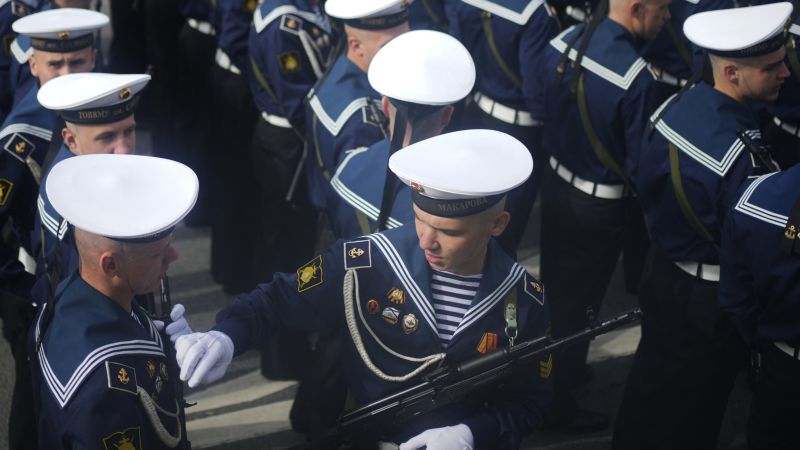
Russia holds scaled down Victory Day parade – On May 9, Russian President Vladimir Putin oversaw a diminished Victory Day parade on Moscow’s Red Square, marking a notable departure from the grand displays of military might typically associated with the annual event. This year’s procession, which celebrated the Soviet Union’s triumph over Nazi Germany in World War II, featured fewer participants and no heavy artillery or tanks, the first time in nearly two decades such omissions had occurred. The decision to scale back the ceremony coincided with the implementation of a three-day ceasefire agreement between Russia and Ukraine, announced by U.S. President Donald Trump and endorsed by both the Kremlin and Ukrainian President Volodymyr Zelensky.
The traditional Victory Day parade, held every year on May 9, has long served as a symbolic showcase of Russia’s military prowess. Under Putin’s leadership, it has become a recurring stage for emphasizing the nation’s strength in the face of global challenges. However, this year’s event took on a different tone, reflecting the evolving dynamics of the Ukraine war. Instead of showcasing the full arsenal of Russia’s armed forces, the parade highlighted strategic assets such as drones, air defense systems, and nuclear-capable submarines, as reported by state media. This shift underscored the Kremlin’s focus on security measures amid ongoing hostilities.
“The great feat of the victorious generation inspires the soldiers carrying out tasks of the special military operation today. They are standing up to an aggressive force armed and supported by the entire NATO bloc,” Putin stated Saturday. “And yet, our heroes march forward.”
Russian authorities had previously disclosed the absence of live military hardware, opting instead for pre-recorded videos that depicted frontline activities. These clips, broadcast across state media and displayed on screens in Red Square, aimed to project a sense of resilience and progress. The footage featured drone strikes, air defense maneuvers, and scenes of long-range bombers and submarines, offering a glimpse into Russia’s modernized military capabilities. This approach, while less ostentatious than past parades, still conveyed a message of national determination.
The scaled-down parade occurred against the backdrop of intensified Ukrainian strikes targeting Russian infrastructure, particularly oil refineries. The Ukrainian government accused the Kremlin of continuing attacks on Kyiv and other cities, even as the temporary ceasefire was in effect. This context added a layer of complexity to the event, as the display of military might was juxtaposed with the ongoing conflict. For Putin, the connection between the Soviet Union’s wartime sacrifices and the current “special military operation” remained central, framing the present struggle as a continuation of the Great Patriotic War.
Notably, the event featured a smaller contingent of participants, with only four military units, including one from North Korea, taking part. Over 1,000 soldiers from the “special military operation” marched through the Red Square, accompanied by a flyover of fighter planes above the Kremlin. The parade’s reduced scale was also evident in the attendance of international leaders, who were fewer in number compared to previous years. Belarusian President Alexander Lukashenko and his son Nikolai Lukashenko, along with Malaysia’s King Sultan Ibrahim Iskandar and the presidents of Kazakhstan and Uzbekistan, were among the guests.
Inside the parade, a symbolic pairing highlighted the historical and contemporary narrative. To Putin’s left sat Leonid Ryzhov, a soldier recognized for his role in the “special military operation” and awarded the “Hero of Russia” title in 2022. To his right was Svet Turunov, a WWII veteran, creating a deliberate contrast between past and present. This arrangement reinforced the Kremlin’s messaging that the current conflict is a natural extension of the Soviet Union’s historical sacrifices, despite the differing realities of modern warfare.
Amid the ceremony, Russian authorities emphasized the economic challenges and heightened domestic control measures. The government has faced growing concerns over a slowing economy and increased internet restrictions, which have disrupted daily life. These measures, according to Putin, are essential for maintaining public safety and stability. On Friday, a major telecom operator in Russia warned Muscovites of potential mobile internet and text messaging restrictions around the capital, citing security needs during the festivities.
Historically, Victory Day has been a moment for national pride, with the Soviet Union’s 27 million wartime deaths serving as a reminder of the immense sacrifices made. Today, the event took on new significance as Russia sought to balance commemoration with the realities of its current military campaign. While the parade lacked the spectacle of previous years, its message of perseverance and unity remained intact. For many, the contrast between the past and present was stark, yet the Kremlin’s narrative of continuity sought to bridge the gap.
The ceasefire, which lasted from May 9 to 11, included a halt to fighting and a large-scale prisoner exchange, with Zelensky describing the agreement as “in the format of 1,000 for 1,000.” This arrangement provided a brief respite for both sides, though the effectiveness of the pause remained a subject of debate. The international press, unable to attend the event in person, relied heavily on state media footage to cover the proceedings. CNN and other outlets were informed by the Kremlin that only “host broadcasters” would be present, signaling a tightening of control over the narrative.
As the parade unfolded, the symbolism of its reduced scale was unmistakable. The absence of traditional military displays, such as tanks and artillery, mirrored the strategic withdrawals and repositioning of forces on the battlefield. Yet, the inclusion of drone footage and air defense systems emphasized Russia’s technological advancements and its focus on air superiority. The event also served as a platform to highlight the role of soldiers in the “special military operation,” portraying them as the inheritors of a legacy of sacrifice.
While the ceasefire offered a temporary pause in hostilities, the underlying tensions persisted. The Ukrainian government’s accusations of continued attacks, coupled with Russia’s emphasis on security, painted a picture of a war that remains far from resolution. For Putin, the parade was as much about reinforcing domestic morale as it was about projecting strength abroad. The ceremony’s message was clear: despite the challenges, Russia would continue its mission, guided by the sacrifices of the past.
Victory Day remains a powerful tool for shaping national identity, even as the Ukraine war reshapes its meaning. This year’s parade, with its focus on security and strategic assets, reflected the changing priorities of a nation at war. The reduced format, while less grandiose, still served as a reminder of the sacrifices made in World War II and the ongoing struggle in Ukraine. As the sun set over Moscow, the event concluded with a sense of resolve, underscoring the Kremlin’s commitment to its vision of the conflict as a continuation of the Great Patriotic War.





