White House as Arena: Trump’s UFC Celebration and the Michelle Obama Smear
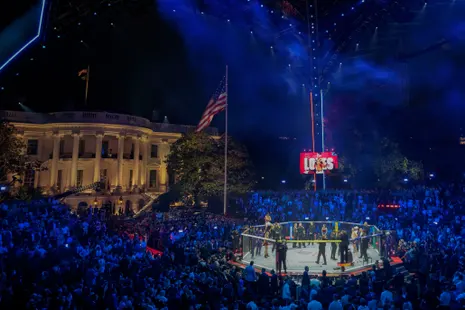
Wanderstayfinder.com – For the first time in its 250-year history, the White House South Lawn transformed from a ceremonial stage into a battleground of combat sports. On Sunday night, the iconic space hosted a professional UFC event, a bold departure from its usual role as a venue for state dinners, diplomatic rituals, and patriotic displays like the annual turkey pardon. The occasion marked a dual celebration: Donald Trump’s 80th birthday and the 250th anniversary of American independence. Amid the backdrop of military flyovers and a crowd of thousands, the event blurred the lines between politics, entertainment, and national pride, culminating in a historic upset that captured the nation’s attention.
A Stormy Beginning, Sunny Resolution
The night began with a forecast of thunderstorms, raising concerns about the weather’s impact on the outdoor spectacle. Organizers, however, anticipated the disruption and delayed the start by an hour, ensuring the festivities would proceed unimpeded. The skies cooperated, casting no shadow over the carefully arranged setup. A massive steel canopy, dubbed the Claw, loomed over the arena, while the Ellipse and South Lawn hosted a sea of spectators. The air buzzed with excitement, not just for the fights but for the political theater unfolding in real time.
Unlikely Champion and a Defiant Statement
At the heart of the evening’s drama was the lightweight championship bout between Justin Gaethje and Ilia Topuria. Gaethje, a 37-year-old American fighter, entered as a significant underdog against Topuria, the undefeated Georgian-Spanish phenom hailed as one of the sport’s elite pound-for-pound contenders. The fight, spanning four grueling rounds, became a testament to resilience. Gaethje, battered and bruised, rallied from perilous moments to deliver a decisive finish, securing the undisputed title. “I’m from America,” he declared afterward, his words resonating beyond the octagon. “Two hundred and fifty years ago, we were way bigger than six-to-one underdogs, and look at this country now.” His statement underscored the event’s broader theme: a celebration of American grit and triumph.
The Fusion of Power and Combat
The White House’s transformation into a sporting arena was emblematic of its role as a symbol of national power. As the sun set, Trump and UFC CEO Dana White emerged from the presidential residence, flanked by a military color guard and a rare synchronized flyover by the Blue Angels and Thunderbirds. The display was both ceremonial and militaristic, reinforcing the sense that this was more than a fight night—it was a demonstration of strength. A recruitment ad from the newly renamed Department of War played during the broadcast, subtly aligning the event with broader geopolitical narratives. The crowd, echoing with “U-S-A! U-S-A!” chants, seemed to absorb the message, their energy fueling the spectacle.
Political Undercurrents in the Octagon
While the fights promised athletic drama, they also served as a platform for political messaging. The evening’s tone shifted when Josh Hokit, a rising contender in the heavyweight division, delivered a post-fight interview that veered from praise to controversy. After defeating Derrick Lewis in the second round, Hokit approached Trump at ringside, presenting a necklace as part of the ceremony. His remarks, however, took an unexpected turn. “Michelle Obama is a man,” he claimed, invoking one of the most enduring and malicious slurs against the former First Lady. The crowd’s reaction was mixed—some erupted in applause, while others exchanged puzzled glances. The comment, though brief, highlighted how the event straddled the line between celebration and incitement.
The political fervor wasn’t limited to Hokit’s outburst. In the Sean O’Malley vs. Aiemann Zahabi matchup, the crowd’s nationalism reached a fever pitch. Trump, sporting a white “USA” hat, sat in the crowd as chants of “U-S-A!” filled the air. Supporters even shouted “Canada is the 51st state!”—a reference to Trump’s long-standing rhetoric about annexing the northern neighbor. The moment O’Malley secured a second-round TKO, the celebration was palpable. Fans on the Ellipse erupted, their cheers a collective affirmation of American superiority. O’Malley, before exiting the cage, thanked the crowd and paid tribute to White, calling him a “fucking gangster.” The exchange, laced with both praise and flair, encapsulated the night’s blend of sportsmanship and political bravado.
A Historic Card of Knockouts
Despite the political distractions, the fights themselves delivered on the promise of action. Every bout on the seven-fight card ended in a knockout or technical knockout, a first in the UFC’s 33-year history. Ciryl Gane’s victory over Alex Pereira for the interim heavyweight title, along with emphatic wins by Hokit, O’Malley, and Bo Nickal, showcased the fighters’ skill and tenacity. Yet the highlight remained Gaethje’s improbable triumph, which not only secured a title but also redefined the narrative of the night. His journey from being underestimated to claiming victory mirrored Trump’s own political persona, both of whom thrive on defying expectations.
The event’s guest list further emphasized its intersection with politics and technology. Meta’s Mark Zuckerberg, seated near the Winklevoss twins, observed the proceedings, his presence underscoring the influence of Silicon Valley on modern entertainment. Cabinet officials, foreign dignitaries, and Trump’s political allies mingled in the ringside area, their presence a reminder that the White House was not just a venue for sports but a stage for diplomacy and propaganda. The atmosphere was charged, with each fighter’s performance amplifying the nation’s self-image as a powerhouse.
Legacy and Ambiguity
As the night drew to a close, the White House’s role as a site of political and cultural significance became evident. The UFC event, while unprecedented, raised questions about its purpose. Was it a genuine celebration of American strength, or a calculated attempt to blend athletic achievement with political messaging? The answer, perhaps, lies in the ambivalent reactions of the audience. Some cheered Hokit’s claim about Michelle Obama, seeing it as a bold statement, while others viewed it as a cheap jab. The same can be said for the nationalistic chants, which, while energizing, risked reducing the event to a spectacle of pride rather than a showcase of skill.
Yet, the spectacle’s success was undeniable. Gaethje’s victory, the military presence, and the seamless integration of technology and tradition all contributed to a night that felt both historic and hyperbolic. The White House’s South Lawn, once reserved for the dignified, now bore the scars of combat—a reminder that American power, whether in politics or the ring, is often defined by its ability to command attention and assert dominance. The event’s legacy, like its fighters, will be a subject of debate, but its impact on the evening’s narrative is certain. In the end, the night belonged to Gaethje, but it was shaped by the politics of the White House, the weight of history, and the unyielding presence of a nation always eager to prove itself.
“I’m from America,” Gaethje said. “Two hundred and fifty years ago, we were way bigger than six-to-one underdogs, and look at this country now.”
The UFC’s decision to host a card at the White House was a statement in itself, merging the worlds of combat sports and presidential influence. As the first professional event of its kind, it set a precedent for future gatherings, where sport and politics might intertwine more closely than ever. Whether viewed as a triumph of American exceptionalism or a spectacle of over-the-top symbolism, the night’s events will linger in the memory of those who witnessed them—a blend of fighting, rhetoric, and the enduring fascination with the United States as a nation of champions.