
Roman shipwreck with 500 amphorae found off coast of Sicily

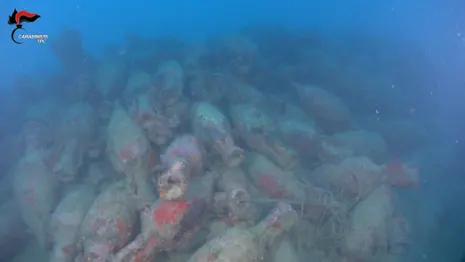
Table of Contents
Massive Roman Vessel Unearthed Near Sicily Carries Half a Thousand Ancient Wine Jars
Wanderstayfinder.com – Underwater archaeologists have uncovered one of the most remarkable maritime treasures in recent memory, a Roman vessel resting on the seabed near Sicily that contains approximately 500 ceramic amphorae. The shipwreck, estimated to be roughly 2,100 years old, was located three miles from the coastal town of Mazara del Vallo at a depth of 46 meters, or about 151 feet below the surface. Italian cultural heritage police, known as the Carabinieri, led the investigation following a tip from local fishermen who had noticed unusual formations on the ocean floor.
The vessel itself measures approximately 21 meters in length and six meters in width, making it a substantial find for maritime archaeologists. Most of the cargo consisted of Dressel 1A amphorae, ancient two-handled ceramic jars with narrow necks that were primarily used for transporting wine across the Mediterranean during the second and first centuries before Christ. These particular amphorae are especially valuable to researchers because they help reconstruct the commercial networks that connected Italy with other Mediterranean regions during antiquity.
Expert Reactions and Discovery Details
Italy’s culture minister, Alessandro Giuli, characterized the find as one of the most significant underwater archaeological discoveries of recent years. He emphasized that the wreck offers precious fragments of historical memory and provides additional evidence of the trade routes and cultural exchanges that transformed the Mediterranean into a crossroads of civilizations.
Visibility wasn’t the best … I got closer. And my heart stopped. Below me was a vast expanse of amphorae.
Divers Giacomo De Mola and Igor Bisulli were among the first to explore the site and documented their experience. De Mola shared his reaction on social media alongside video footage of the discovery, noting that it was without question the most incredible find of his career. He described the emotional weight of being among the first humans in nearly two millennia to witness the site once more.
Historical Context and Maritime Trade Networks
The discovery adds another layer to our understanding of Roman maritime commerce during the late Republic period. The Dressel 1A amphorae found aboard the vessel were produced primarily in central Italy, particularly in regions such as Campania and Latium, and were widely distributed throughout the Mediterranean basin. Their presence in such large quantities suggests that this ship was engaged in commercial wine trade rather than personal or diplomatic transport.
Sicily’s strategic position along ancient maritime routes connecting Greece, the Middle East, North Africa, and Europe has made its surrounding waters one of the Mediterranean’s richest areas for underwater archaeology. The island’s seabed is believed to contain some of the most significant surviving wrecks from the ancient world, with ongoing discoveries continuing to reshape our understanding of Mediterranean civilization.
Related Discoveries in Italian Waters
This finding is part of a broader series of important Roman shipwrecks uncovered in Italian waters over the past decade. In 2021, another Roman vessel dating from the second century BC was discovered off the coast of Palermo, lying 92 meters beneath the sea near Isola delle Femmine. Images captured by an underwater robot revealed that this earlier wreck also carried a substantial cargo of wine amphorae.
Before that discovery, an almost intact Roman vessel from the second century BC was found in 2013 off the coast of Liguria. That ship, carrying approximately 50 valuable amphorae, was located by police divers about a mile from Alassio at a depth of roughly 50 meters. In that instance, authorities had been alerted to the wreck during a year-long investigation into archaeological artifacts believed to have been looted and sold on the black market in northern Italy.
Future Research and Preservation Plans
Over the coming months, Sicily’s superintendency of the sea will conduct a new phase of scientific documentation and research at the site. Archaeologists aim to establish more precisely the date of the wreck, determine the origin and intended destination of its cargo, and assess the condition of the surviving material. Officials will also draw up measures to protect what they have described as a site of exceptional archaeological significance.
Italian police recover hundreds of illegally removed ancient Roman amphorae each year, many of them found in the homes or warehouses of collectors and art dealers. The ongoing work at the Mazara del Vallo site will help distinguish between legitimate archaeological recovery and illicit trade, contributing to broader efforts to preserve Italy’s maritime heritage for future generations.
Agence France-Presse contributed to this report.
Related Reading
Frequently Asked Questions
What is Roman shipwreck with 500 amphorae found?
Roman shipwreck with 500 amphorae found is the main topic of this guide. The article explains the context, practical details, and next steps readers should understand.
Why does Roman shipwreck with 500 amphorae found matter?
Roman shipwreck with 500 amphorae found matters because readers are looking for a useful answer, not just a short summary. Good content should match search intent and help them decide what to do next.


