I was struggling after eight rounds: When IVF Failed, Surrogacy Succeeded Wanderstayfinder.com – For Narzny McKinney, the journey toward motherhood
A New Path to Parenthood: When IVF Failed, Surrogacy Succeeded
Wanderstayfinder.com – For Narzny McKinney, the journey toward motherhood stretched across eight years and eight separate attempts at in vitro fertilization. Each cycle ended in disappointment, leaving her with only two precious embryos remaining—her final opportunity to welcome biological children into her life. Faced with this critical juncture, she and her husband Roy decided to explore surrogacy as an alternative route to parenthood.
“We were eight years down the line at this point and I just didn’t want to risk anything going wrong,” McKinney explained regarding her choice. “It was a tough decision but it was absolutely the right thing to do.”
The Search for a Surrogate
The couple registered with two British surrogacy organizations and began attending networking gatherings where prospective parents could meet potential surrogates. However, rising demand created unexpected hurdles. Increasing rates of infertility, combined with older couples and same-sex partners seeking to build families, meant that McKinney and Roy frequently encountered other parents rather than willing surrogates.
“It’s quite emotionally draining, because obviously you go with high hopes each time,” she noted. “You can probably go to a social most weekends; it takes up a big part of your life.”
While traveling overseas presented another possibility—something an increasing number of British families are pursuing—the logistical complications made this option less appealing. After two years of patient waiting, their persistence paid off when Nappy Endings, one of their chosen agencies, contacted them with news of a potential match.
Meeting Sarah Turner
Sarah Turner was a London-based midwife and mother of three who had long harbored dreams of becoming a surrogate. Her professional background and personal experience made her an ideal candidate.
“I’d always felt very lucky that I was able to have low-risk pregnancies and have babies without any issue,” Turner reflected. “So I thought I would always really like to help somebody that couldn’t do it as easily as I could. I was very up for it. I did a lot of research. I know myself and I was quite relaxed about it.”
The two families connected immediately. Shortly thereafter, Turner, then forty-one years old, became pregnant using one of McKinney’s remaining embryos.
A Pregnancy Built on Trust
From the outset, Turner prioritized keeping McKinney deeply involved throughout the pregnancy. She purchased a special bracelet designed to vibrate whenever the baby moved, allowing McKinney to feel the connection despite not carrying the child herself.
“Having had three of my own babies, I can’t even imagine how difficult it must have been for Narzny, trusting another woman to carry her baby for her and not being able to do it herself,” Turner shared. “That really got me in the guts, and I just used to sit and think, how must she feel? She has to trust me to do everything right for her.”
“So I thought it would be so nice if she could feel the baby move and have that reassurance.”
McKinney emphasized that the bond between mother and surrogate proved essential for a smooth experience. “We went to all the appointments together. I was really connected,” she stated.
The Unexpected Birth
Despite careful preparation for the delivery, circumstances took an unexpected turn. Sarah gave birth at home with such speed that McKinney and Roy, residing a forty-minute drive away, could not reach the hospital in time.
“People would say, ‘Oh my God, how do you feel about missing it?’ But I imagine we would have been so stressed and anxious, so it was nice turning up and being told, ‘it’s all done, he’s safe and he’s perfect’,” McKinney recalled.
For Turner, the immediate post-birth period presented its own challenges. “The hormones come into play and you can’t do anything about that. So it was challenging,” she admitted. “Your mind knows there shouldn’t be a baby but your body doesn’t.”
She credited McKinney and Roy for their sensitivity during this transition. “They didn’t just abandon me as soon as they had their baby. They checked in, they sent photos, we visited them. They were really mindful of how I was feeling.”
Navigating Legal Complexities
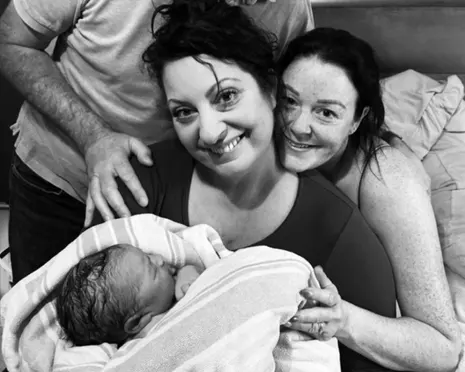
Today, McKinney cherishes motherhood with one-year-old Zak while maintaining regular contact with Turner and her family. Both women believe that legal reforms and greater public understanding of surrogacy would have eased their journey.
Under existing UK legislation, the surrogate and her partner remain the legal parents until a parental order transfers those rights following birth. McKinney’s experience required visits to three separate courts to complete this process—a situation that advocates argue should occur automatically from birth.
Additionally, obtaining Zak’s passport consumed several months. “It’s a shame because he’s obviously been ours since day one, but the legal documentation to show that is quite far behind,” McKinney observed.
Through patience, trust, and determination, what began as a desperate hope after eight failed IVF cycles blossomed into a beautiful new chapter for both families—a testament to the evolving landscape of modern parenthood and the generosity of strangers who become family.
Related SEO Topics
- Home
- Artikel terkait I was struggling after eight rounds
- Could the World Cup be back in the US as soon as 2038? Absolutely
- ‘The explosion is what I remember’: man nearly sucked out of Ryanair plane recounts ordeal
- Tropical Storm Bertha strengthens as Gulf coast braces for flooding and surge
- Trump to allow direct US flights to Lebanon after 41-year halt
Frequently Asked Questions
What is I was struggling after eight rounds?
I was struggling after eight rounds is the main topic covered in this article, with practical context to help readers understand the subject clearly.
Why does I was struggling after eight rounds matter?
I was struggling after eight rounds matters because it helps readers compare options, avoid common mistakes, and make a more informed decision.
How should readers use this I was struggling after eight rounds guide?
Use the key points, examples, and related links in this page as a starting point, then review the latest details before making a final decision.