The explosion is what I remember: eet Wanderstayfinder.com – Eleven days have passed since Ljubisa Karović was nearly pulled from his Ryanair seat, yet
A Near-Death Experience at 15,000 Feet
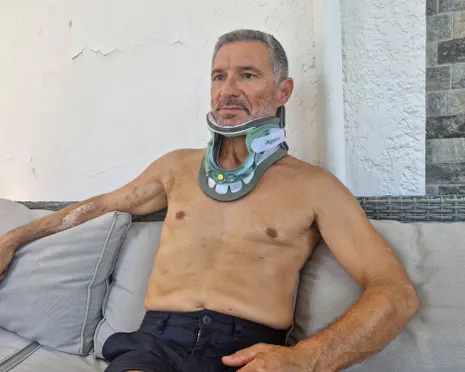
Wanderstayfinder.com – Eleven days have passed since Ljubisa Karović was nearly pulled from his Ryanair seat, yet the Serbian entrepreneur still wakes with the memory of that deafening blast. The 61-year-old sits on the porch of a modest villa in Katerini, a seaside town near Thessaloniki, where he has come to recover. His head rests against a supportive brace, and his gaze drifts toward something only he can see. “The explosion is what I remember,” he tells reporters, describing the moment that changed everything.
That thunderous crack of glass shattering woke him from sleep in seat 11F. What followed was a sequence of events that Karović describes as “the prelude to the chaos, the catastrophe.” Even now, when he closes his eyes to rest, that sound echoes in his mind. The Serbian businessman survived an ordeal that medical professionals call miraculous. He is believed to be the only person ever to be partially ejected from an aircraft window during flight and live to tell the story.
The Flight That Changed Everything
Karović had been traveling to Germany to celebrate his brother’s birthday. His son Danjell had booked the journey. At approximately 15,000 feet altitude, with the aircraft traveling faster than 600 kilometers per hour, something went wrong. The cabin lost pressure suddenly. Karović was hurled forward from his chest up, his head and right arm ending up outside the plane while his body remained partially inside.
“Ljubisa dipped in and out of death,” explained his Greek attorney, Vasilis Tsiaras. “When the cabin lost pressure he was hurled out of the window from his chest up and immediately lost consciousness.” The lawyer described the father of two as “being alive by mistake.” Karović fainted twice while partially outside the aircraft and twice more after being pulled back inside. His face became briefly swollen and deformed from the intense pressure and rushing air.
His wife Svetlana sat in seat 14C, three rows behind her husband. She recalls the chaos vividly. Oxygen masks descended, bottles and objects flew through the cabin, and passengers scrambled to help. “I rushed over too. None of the cabin crew helped. It was the passengers,” she said. An Albanian man, she believes, performed heroically. He attempted to block the opening first with a bag that was immediately sucked away, then successfully with a suitcase.
Recovery and Questions
The unbearable moments of watching her husband “half in and out of the plane” lasted between one and a half to two minutes. Barely 100 hours have elapsed since Karović was discharged from the hospital. “I am lucky,” he says with characteristic understatement. “I don’t remember much and my head and neck still hurt but I am still alive. It could have been the seatbelt, the fact that I was still strapped in. But maybe it is fate. I believe in God and I thank him every day.”
Ryanair has defended its crew’s performance, stating they did a “phenomenal job.” However, Tsiaras disagrees with this assessment. While Karović’s son has been contacted by the airline, neither Ljubisa nor Svetlana have received any assistance or support. “We have no complaint with the pilot, who followed the safety protocols and dealt with the situation very well,” Tsiaras noted regarding the rapid descent necessitated by cabin depressurization. “At no point did the cabin crew offer to help.”
The airline disputed this claim, explaining that during depressurization all passengers and crew must fasten seatbelts and don oxygen masks. Ryanair stated that once the aircraft reached a safe altitude, crew members attended to Karović, moved him to seats beside his wife, and arranged for an onboard doctor to remain with them until landing in Thessaloniki. Medical assistance was also arranged on the ground.
For Karović, the physical pain persists alongside the psychological scars. The burns and bruises on his right arm, extending to his armpit and chest, serve as permanent reminders of that extraordinary day. He looks at death, that “other world,” and feels grateful to have returned.
Related SEO Topics
- Home
- Artikel terkait The explosion is what I remember
- Tropical Storm Bertha strengthens as Gulf coast braces for flooding and surge
- Trump to allow direct US flights to Lebanon after 41-year halt
- Bill Gates foundation met with Jeffrey Epstein about 30 times, external review finds
- Fiscal hawk or big spender – what kind of chancellor will John Healey be?
Frequently Asked Questions
What is The explosion is what I remember?
The explosion is what I remember is the main topic covered in this article, with practical context to help readers understand the subject clearly.
Why does The explosion is what I remember matter?
The explosion is what I remember matters because it helps readers compare options, avoid common mistakes, and make a more informed decision.
How should readers use this The explosion is what I remember guide?
Use the key points, examples, and related links in this page as a starting point, then review the latest details before making a final decision.