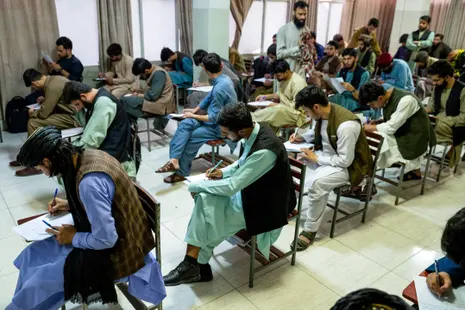
Boys’ Education Under Siege: The Silent Crisis in Afghan Universities
The Taliban s war on education – While international attention has largely focused on the exclusion of girls from Afghan higher education, a parallel transformation is reshaping the experience of male students. Five years following the Taliban’s return to power, young men enrolled in universities report an educational environment increasingly defined by religious conformity, diminished academic rigor, and strict behavioral codes.
Appearance as Discipline
Each morning before departing for Kabul University, Hashmat* examines his reflection to ensure his beard meets the required standards. Male students face mandatory grooming regulations alongside traditional dress codes, with violations met with disciplinary action. According to Hashmat, he witnessed a fellow student recently struck for wearing trousers instead of traditional attire.
“They look at you before they listen to you. If your appearance is wrong, you are already in trouble before the class begins,” he explains.
The emphasis on outward conformity extends beyond clothing. Students must attend daily religious lectures and participate in public prayers, sometimes lasting two hours. These sessions cover Islamic principles, proper conduct, and obedience—requirements that are not optional. In certain instances, these religious sessions displace regular academic coursework.
“I am missing my actual classes to sit in a lecture about obeying. That is what they [the Taliban] think education is for. Everyone talks about the girls who were banned, but nobody talks about what is happening to the boys who were allowed to stay.”
The Decline of Academic Rigor
Qader*, a student studying in central Afghanistan, identifies a fundamental shift in classroom dynamics. Beyond concerns about teaching quality, he notes that critical thinking has largely disappeared.
“We are expected to listen, not to question,” says Qader*. “Since the fall of Kabul, the university has lost its purpose. It feels more like a madrassa now — a place where curiosity is banned and remaining silent ordered.”
Hashmat’s field of study—journalism—provides a telling example of this decline. The discipline traditionally relies on digital tools, online verification methods, ethical frameworks, and technological innovation. Yet Hashmat questions whether his instructor truly comprehends the subject matter.
“He is teaching us about the modern world while struggling to use PowerPoint in the class. How can you teach journalism technology if you do not understand what technology is?”
A System in Transition
Hashmat’s observations align with testimonies from over twenty students across public and private institutions in seven provinces: Kabul, Kandahar, Helmand, Nangarhar, Bamiyan, Balkh, and Wardak. According to UNESCO data, Afghanistan’s higher education sector experienced significant contraction between 2019 and 2024. Female enrollment dropped to zero by 2024, while male enrollment declined from 310,369 to 188,957 during the same period.
Kabul University maintains its external appearance as a functioning institution. Buildings remain open, examinations continue, and degrees are awarded. However, students describe an institution whose core academic functions have been substantially eroded. Veteran professors have departed the country, ceased teaching, or been marginalized. They have been replaced by ideologically aligned instructors appointed by the Taliban administration.
In certain departments, recent graduates and even undergraduate students now serve as instructors. Hashmat highlights one lecturer who completed his own degree merely two years prior yet now stands before students as their teacher.
“Now he is standing in front of us. It is clear he does not know more than we do.”
Zalmay*, a Helmand province student, echoes similar concerns about instructional quality. He describes teachers who merely read from outdated notes and struggle to elaborate beyond prepared materials when questioned.
“Some teachers come to class and only read from old notes,” he says. “When we ask questions, they cannot explain beyond what is written in front of them. We are university students, but sometimes it feels like we are back in high school.”
Historical Significance and Uncertain Future
A former Kabul University professor, speaking anonymously due to concerns about potential retaliation, validates these student accounts. He emphasizes that the exodus of qualified educators has weakened institutions that continue to bear responsibility for producing graduates.
Nearly every student interviewed by the Guardian describes a comparable crisis: inadequate instruction, underqualified faculty, compulsory religious sessions, appearance-related pressures, and mounting skepticism that university education translates into employment opportunities.
Kabul University once held profound significance for Afghan society. For generations, it educated the nation’s physicians, engineers, journalists, civil servants, and political figures. Admission represented family pride and signaled the possibility of a brighter future. Following the Taliban’s takeover, Hashmat notes that two of his classmates left the country entirely, seeking educational opportunities abroad.
The transformation extends beyond statistics and institutional changes. It represents a fundamental redefinition of what university education means in Afghanistan—a shift from intellectual exploration to religious conformity, from critical inquiry to obedient acceptance, and from preparation for professional careers to preparation for a society governed by ultra-conservative Islamic principles.