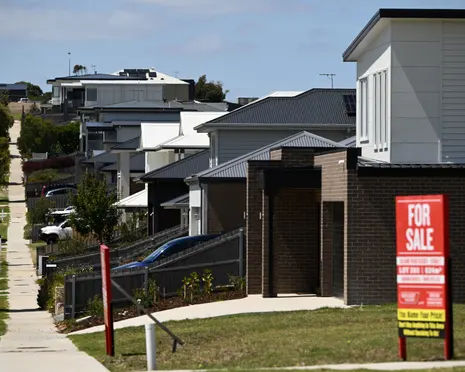
Liberals are scaring first-home buyers with warnings of negative equity – but experts believe there’s little to worry about
Wanderstayfinder.com – Recent data has eased anxieties among first-time home buyers about the prospect of negative equity, as falling property prices are largely confined to the high-end markets of Sydney and Melbourne. This shift in market dynamics has prompted some analysts to question whether the alarm raised by certain political figures is overblown. While concerns about economic instability, rising inflation, and increased interest rates have contributed to price declines, the broader picture suggests that many new entrants to the housing market remain in relatively safe territory.
Market Trends and Expert Reassurance
CBA economists sparked debate earlier this month by forecasting a potential 6% to 7% drop in property values for Sydney and Melbourne by the end of 2026. However, this projection has not dampened the confidence of some housing market experts. Gerard Burg, head of research at Cotality, has downplayed the risks of negative equity, emphasizing that first-home buyers typically purchase in the lower price brackets where affordability constraints are most pronounced.
“It’s always difficult to know where first home buyers are making a purchase, but we do know that it’s most likely to be in the bottom 25% of the market, just from an affordability perspective,” Burg said. “This is evident in both Sydney and Melbourne, where dwelling values in the three months to May were up 0.4% in Sydney and down 0.2% in Melbourne, considerably stronger than the trends for either the upper quartile or middle of the market.”
Burg acknowledged that while some recent buyers might face challenges, the risk of negative equity is not as widespread as feared. He pointed out that the majority of first-time purchasers are in the lower tiers of the market, where price movements are less volatile. “History suggests that downturns are relatively short-lived,” he added. “Homeowners with stable employment should be able to navigate a period of negative equity without significant distress.”
Angus Moore, a senior economist at REA Group, echoed Burg’s perspective, noting that the price declines have primarily affected upscale suburbs. “The current drop is concentrated in the more expensive areas, such as Sydney and Melbourne’s eastern suburbs, which are not typical hunting grounds for first-time buyers,” Moore explained. This focus on higher-end properties means that the average first-home buyer, often relying on smaller deposits, may not be as vulnerable to market fluctuations.
Financial Realities of First-Time Buyers
Amid the affordability crisis, many first-home buyers are forced to stretch their financial resources to the limit. In Sydney, saving a 20% deposit for a median-priced home requires over a decade of consistent saving, prompting many to use alternative funding sources, such as parental support or shared ownership arrangements. The government’s 5% deposit guarantee scheme has also enabled some buyers to enter the market with minimal upfront costs, but this has raised concerns about potential future liabilities.
Liberal MPs and senators have seized on these worries, warning that young Australians are “leveraged up to their eyeballs” and facing “a looming threat of negative equity.” Andrew Hastie, a prominent Liberal MP, has highlighted the risks of home ownership for those who purchase near the top of the market. However, experts argue that the situation is more nuanced. “The key factor is how much of a risk this really is,” said Burg. “A lot of people talk about it as a major crisis, but it’s only a problem if you’re forced to sell.”
The 5% guarantee scheme, while a lifeline for some, has also exposed buyers to a higher probability of being affected by price drops. Burg noted that individuals who purchased under this scheme may now owe more on their homes than their market value, particularly if prices decline sharply. Yet, he stressed that the impact of such a downturn would depend on broader economic conditions. “If we see a sharper correction similar to past cycles, there could be a higher risk for those who bought at the peak,” Burg warned. “But the question remains: how severe is this risk?”
Broader Implications and Market Resilience
Moore added that the current price declines are unlikely to have a major impact on the majority of first-time buyers. “The affordability crisis has already pushed many to the lower end of the market, where prices have been more stable,” he said. “Even if there is a downturn, the effect is likely to be more contained than the general public perceives.”
While negative equity can limit options for homeowners, experts highlight that the situation is not as dire as some politicians claim. Moore pointed out that challenges arise when homeowners are unable to refinance or sell their properties during a downturn. “The difficulty comes when you’re in negative equity and struggling to manage your mortgage,” he explained. “But with low unemployment and manageable arrears rates, the risk of widespread defaults remains low.”
Further analysis of the data reveals that price drops in Sydney and Melbourne are not uniform across all segments. In the three months leading up to May, the cheapest dwellings in Sydney saw a modest 0.4% increase, while Melbourne’s prices fell slightly by 0.2%. These trends underscore the divergence between the high-end and lower-end markets, suggesting that first-time buyers may benefit from the stability in the more affordable tiers. “It’s important to differentiate between the market segments,” Burg said. “Negative equity is a concern, but it’s not a universal threat.”
Despite the Liberal Party’s emphasis on the risks, some analysts believe the market’s resilience will help cushion the impact. “The broader economy is in good shape, with low unemployment and strong consumer confidence,” Moore noted. “These factors provide a safety net for homeowners, even in times of volatility.” He also mentioned that changes to capital gains tax and negative gearing in the recent budget could influence investor behavior, but the primary concern for first-time buyers lies in the affordability challenges they already face.
In conclusion, while the warnings of negative equity have generated significant public concern, the data and expert analysis suggest that the risk is manageable for most first-time homeowners. The focus on the top-end markets means that the majority of new buyers are not immediately affected, and historical patterns indicate that downturns are often short-lived. As the housing market continues to evolve, the challenge will be to balance the need for caution with the reality of sustained affordability and economic stability.