Mass Migration Crisis Sweeps Through Spanish Enclave of Ceuta
Unprecedented Border Crossing Claims Dozens of Lives
Wanderstayfinder.com – A dramatic surge of migrants has transformed the Spanish territory of Ceuta into the epicenter of a humanitarian and political emergency. According to official reports, at least 57 individuals lost their lives during the attempt to reach the enclave, while estimates suggest that as many as 50,000 people crossed from Morocco within a single day. Prime Minister Pedro Sánchez characterized the event as “a violation of Spain’s territorial integrity,” noting that the sudden influx overwhelmed the city’s capacity to handle such a massive arrival.
The tiny territory, home to approximately 85,000 residents, found itself struggling to cope with the overwhelming numbers. The situation quickly escalated into a political crisis for Madrid while simultaneously generating varied responses across European Union member states. Several nations have even proposed that Spain should face suspension from the Schengen free-movement zone due to the border situation.
Government Response and Legal Considerations
Sánchez traveled to Ceuta on Friday morning to personally oversee the response efforts. He pledged to mobilize every available resource necessary to protect the local population. The prime minister pointed to “human trafficking mafias” as the primary drivers behind the mass movement, explaining that these organizations exploited a recent judicial decision. Spain’s supreme court had determined that individuals intercepted at sea while attempting to enter Ceuta or Melilla could no longer be returned immediately under existing special regulations.
“That has spread like wildfire during these last few hours through the networks of mafias that traffic in human beings and has produced an avalanche of the characteristics and dimension that we experienced yesterday.”
To address the immediate needs, the government announced plans to create a temporary reception facility. This center would handle documentation, registration, medical triage, and the “expedited” removal of individuals without legal standing to remain in Spain. Additionally, officials committed to installing a visible line of buoys near the Tarajal beach breakwater. This physical marker would clarify the border location and ensure compliance with the court’s recent ruling.
Numbers and Historical Context
While the Spanish government estimated that 50,000 people crossed on Thursday and into early Friday, Ceuta’s president suggested the total might reach 60,000. By 6pm on Friday, the interior ministry reported that more than 48,300 individuals had voluntarily returned to Morocco. This current episode significantly exceeds the previous major crossing in May 2021, when Morocco relaxed border restrictions and permitted roughly 10,000 people to enter over two days.
That earlier movement occurred during heightened tensions between Madrid and Rabat. At the time, Spain had allowed the leader of the Polisario Front, the Western Sahara independence movement, to receive medical treatment for Covid-19. Both Morocco and the Polisario Front maintain claims over Western Sahara, a territory that remained under Spanish administration until 1975, when colonial powers transferred control to Morocco and Mauritania.
Diplomatic Repercussions and Humanitarian Concerns
The diplomatic landscape shifted again in 2022 when Madrid abandoned its traditional neutrality and endorsed Morocco’s proposal for Western Sahara. This decision created friction between Spain and Algeria, which had long supported the Polisario group. However, relations have shown signs of improvement, with Sánchez visiting Algiers on July 20—the first visit by a Spanish head of government in four years.
Moroccan officials attributed the current surge to “criminal organisations” while maintaining that Rabat’s cooperation with Spain remained “exemplary.” Meanwhile, Rachid Sbihi, who represents Spanish Guardia Civil officers through a local workers’ association, described the scene as a “serious humanitarian crisis.” Thousands of people, including unaccompanied minors, were forced to sleep in parks and on sidewalks without adequate shelter.
“It’s chaotic,” said Sbihi.
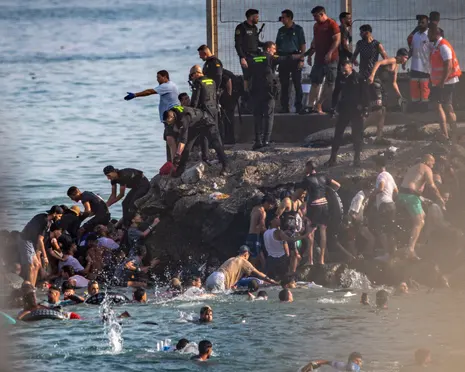
Among the fatalities, many victims drowned, while others perished in a crush while attempting to cross the breakwater fence at Tarajal beach. Video evidence captured large crowds navigating the breakwaters and moving onto local roads. Although the majority appeared to be young men, families with women and small children were also present in the crowds.
Ceuta and Melilla represent the European Union’s sole land borders with the African continent. Both cities regularly experience waves of attempted crossings by individuals seeking to reach Europe. The recent events in Ceuta prompted several EU nations to issue strong warnings or formal rebukes. Spain’s foreign minister, José Manuel Albares, summoned Italy’s ambassador to Madrid after Giorgia Meloni’s far-right government demanded that Spain be suspended from the Schengen zone.
Related Reading
Frequently Asked Questions
What is At least 57 people die as tens?
At least 57 people die as tens is the main topic of this guide. The article explains the context, practical details, and next steps readers should understand.
Why does At least 57 people die as tens matter?
At least 57 people die as tens matters because readers are looking for a useful answer, not just a short summary. Good content should match search intent and help them decide what to do next.