Trump Revives 1930 Trade Law to Target Canada with Sweeping Tariffs
Wanderstayfinder.com – Amidst global economic turbulence stemming from a conflict Trump initiated with Iran back in February, the American president escalated his commercial confrontation with Canada on Monday. Through three separate proclamations, Trump mandated 50 percent tariffs on the majority of Canadian merchandise entering the United States. He invoked an obscure clause within a 1930 trade statute to justify these measures. According to Trump, the levies against one of America’s most vital trading partners—which could potentially drive up inflation domestically—were warranted by what he characterized as Canada’s discriminatory treatment of American automobiles, alcoholic beverages, and dairy items.
A representative from the Trump administration informed the Associated Press that Canada stood among the handful of countries, alongside China, that had pushed back against Trump’s earlier tariff impositions. This retaliation, the official noted, necessitated a firm response. Several Democratic legislators had previously suggested eliminating the specific section of the 1930 Tariff Act that Trump now utilized. Their concern centered on the possibility that the president might employ this provision to create economic instability following numerous rulings by the US Supreme Court that invalidated many of his tariffs as unlawful.
What the New Tariffs Cover and Exclude
The freshly imposed 50 percent tariffs deliberately leave out energy commodities, fish products, and critical minerals. However, they do encompass merchandise that had previously enjoyed protection from import duties under the United States-Mexico-Canada Agreement, commonly known as USMCA. This 2020 trade agreement recently came to an end, setting off a fresh round of negotiations that may extend through 2036. Reports suggest additional tariffs could be on the horizon.
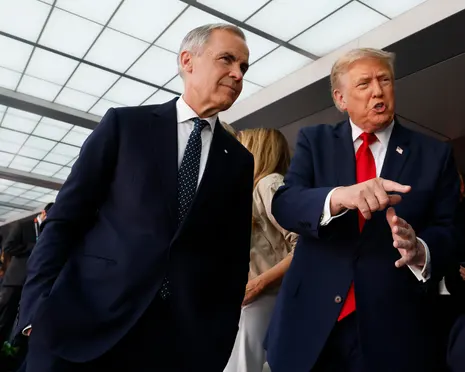
The official who provided a briefing to reporters regarding the proclamations revealed that Trump had also directed his staff to investigate further tariffs on Canada. This consideration stems from Canadian wildfires that have negatively impacted air quality across American borders. Meanwhile, at Sunday’s World Cup final, Trump took to the stage to congratulate competitors alongside Canada’s prime minister, Mark Carney. Carney, who co-hosted the tournament, has been vocal in his opposition to Trump’s tariff policies and threats regarding potential annexation of Canada.
Canadian Reactions and Historical Parallels
While Trump’s proclamations assert that Canada discriminates against American vehicles, alcohol, and cheese compared to other nations, his reasoning heavily relies on retaliatory measures Canada implemented after Trump levied tariffs on Canadian goods last year. The proclamation concerning alcoholic beverages specifically mentions that Canadian provinces and territories suspended the purchase and retail sale of American alcoholic products last year. Notably, it fails to acknowledge that this decision was a direct response to Trump’s tariffs and his public suggestions that Canada should become the 51st US state.
“If these tariffs proceed, Canada should respond tariff for tariff, dollar for dollar,” Ontario premier Doug Ford declared.
Canada’s prime minister, Mark Carney, characterized the tariffs as a “direct violation” of the US-Mexico-Canada free trade agreement that Trump himself had negotiated.
Canada’s Conservative Party described the tariffs as “another unacceptable and unjustified attack on Canadian workers and our businesses,” adding that “Canadians are not a punching bag.”
The leader of Canada’s New Democrats labeled them “the latest economic grenade thrown over the border by an out of control President who has lost touch with reality.”
Ilya Somin, a law professor at George Mason University who contributed to the successful legal challenge against Trump’s “liberation day” tariffs, highlighted that the president’s new 50 percent tariffs on Canadian imports “are based on Section 338 of the notorious 1930 Smoot-Hawley tariff legislation, which severely exacerbated the Great Depression.” This creative application of the infamous 1930 statute—which, as anyone who has watched Ferris Bueller’s Day Off can attest, proved ineffective—is, according to Somin, “just the latest” example of Trump’s trade policy approach.
Scott Lincicome, an international trade law expert, summarized the situation with a fitting observation: “Tariff Crazytown is officially BACK.” This marks the conclusion of our live coverage of the second Trump administration on a day when the president deployed new tariffs under an obscure provision of a 1930 law that had previously worsened the Great Depression.
In unrelated political developments, Nancy Mace, a Republican congresswoman representing South Carolina, announced on Monday that she would not enter the race to succeed the late senator Lindsey Graham in the upcoming snap Republican primary scheduled for next month.