The Rise of India’s Cockroach Janta Party: From Internet Meme to Political Force
A Satirical Movement Gains Real Momentum
Wanderstayfinder.com – What began as a humorous social media response has transformed into one of the most surprising political movements challenging Prime Minister Narendra Modi’s administration. The Cockroach Janta Party, or CJP, emerged from the frustration of millions of young Indians who feel marginalized by their country’s political and educational systems. Founded in May by Abhijeet Dipke, a thirty-year-old Indian who recently completed his university studies in the United States, the party represents a generational shift in how young Indians engage with politics.
The catalyst for the party’s creation came during a supreme court hearing when India’s chief justice made remarks comparing unemployed young people to “parasites” and “cockroaches.” Rather than accepting this characterization passively, Dipke took to social media with a simple question:
“What if all cockroaches came together?”
The response exceeded all expectations. Dipke quickly established a website and social media presence for what was initially meant as a satirical political party—a playful jab at the ruling Bharatiya Janata Party, commonly known as the BJP. The movement adopted a sharp manifesto criticizing government policies and embraced the tagline:
“A political party for the people the system forgot to count.”
Explosive Growth and Government Response
The CJP’s digital presence expanded at remarkable speed. Within just fourteen days, the party’s Instagram following surpassed twenty-two million users, effectively overtaking the BJP’s social media reach. This rapid growth demonstrated the depth of youth dissatisfaction with the current political establishment. The Modi administration, known for its low tolerance of public criticism, attempted to restrict the party’s social media accounts citing national security concerns, but these efforts ultimately failed to gain traction.
As the movement gained momentum, Dipke channeled energy toward a critical issue affecting millions of Indian students: the recurring scandal of medical entrance exam leaks. These examinations, known by the acronym NEET, have repeatedly been compromised, with test papers being sold to wealthy candidates willing to pay the highest prices.
The Education Crisis at the Heart of the Movement
The pressure facing Indian students is extraordinary. More than two million young people compete for only 130,000 available medical school positions. Families routinely deplete their life savings and accumulate substantial debt to fund expensive coaching programs designed to prepare students for these notoriously difficult examinations. In fact, Indian families now spend more on private tutoring than the government allocates for its entire higher education sector.
The consequences of exam corruption extend beyond financial hardship. A series of high-profile leaks has forced millions of students to retake examinations, and these incidents have been connected to dozens of student suicides over recent years. While the NEET exams have received particular attention, they are far from the only standardized tests to experience breaches.
The CJP has positioned itself as a voice for accountability, demanding that the government accept responsibility for these educational failures. The party has called specifically for the resignation of Education Minister Dharmendra Pradhan, arguing that his leadership has been inadequate in addressing systemic problems.
From Online Movement to Street Protests
For India’s Generation Z and millennial populations, the CJP has articulated broader concerns about an education system in crisis and an employment landscape that has consistently failed to deliver opportunities. Research indicates that nearly forty percent of Indian graduates under the age of twenty-five remain unemployed.
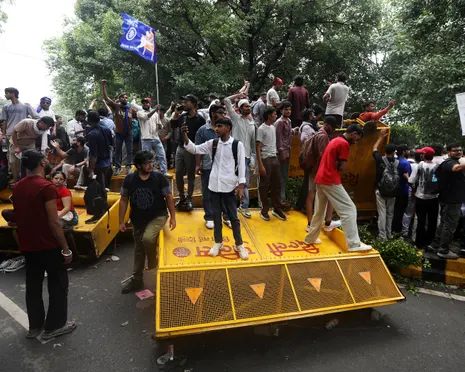
The movement transitioned from digital activism to physical demonstrations in early June when the CJP organized its first offline protest in Delhi. Dipke traveled back from the United States to lead the demonstration, which subsequently expanded to events throughout the country. By the end of the month, supporters returned to Delhi for a second major demonstration, this time vowing not to disperse until Minister Pradhan stepped down.
The protests gained additional prominence through the participation of Sonam Wangchuk, a respected engineer and education activist from the northern Indian state of Ladakh. Wangchuk, who had been arrested and detained under terrorism legislation the previous year for his activism, announced plans for a Gandhian-style hunger strike. He committed to fasting until the education minister resigned, demonstrating solidarity with student protesters.
Escalation and National Attention
As Wangchuk’s hunger strike continued into July, it attracted visits from numerous senior opposition politicians. However, the Modi government maintained its distance, refusing to engage directly with either the CJP or Wangchuk. Minister Pradhan dismissed the protesters, characterizing them as the “B-team of terrorists.”
Concerns mounted as Wangchuk’s health deteriorated after more than two weeks of fasting. Following eighteen days without food, a Delhi court mandated daily medical monitoring for the activist. On Sunday morning, as Wangchuk reached the twentieth day of his fast, Delhi police drew widespread criticism when they forcibly transported him to a government hospital against his wishes. While authorities claimed the action was necessary to protect his health, Wangchuk’s wife described the removal as illegal detention.
From his hospital bed, Wangchuk urged CJP supporters to march toward parliament on Monday, demanding Pradhan’s immediate resignation. The resulting demonstration became one of the largest anti-government protests witnessed in recent years. By early morning, thousands of demonstrators had gathered in central Delhi, joining hundreds who had maintained an overnight presence. The crowd consisted primarily of students and young people, though parents whose children had suffered through the examination system also joined the ranks of protesters.