Millions join funeral procession for Iran’s supreme leader Ali Khamenei
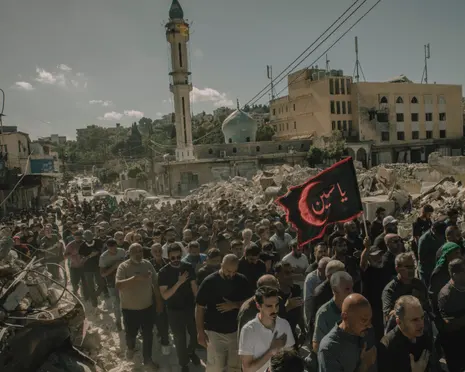
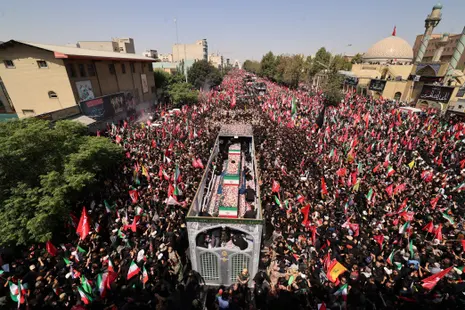
Millions join funeral procession for Iran – On Monday, millions of Iranians came together in a powerful display of solidarity to honor the late supreme leader, Ali Khamenei, who was assassinated in February by Israeli bombs. The event, marking the culmination of a two-day mourning period, contrasted sharply with the chaos of the previous seven months, during which widespread street protests erupted and security forces killed thousands. This collective outpouring of grief, however, was not merely a moment of sorrow—it symbolized a dramatic reversal in the nation’s political landscape.
A Nation in Mourning
The funeral procession traversed the heart of Tehran, moving from the city’s eastern districts to its western outskirts, passing through Revolution Square and Azadi Square. Mourners, draped in black, carried flags emblazoned with the slogan “We will rise” and the national emblem of Iran, their chants echoing through the streets. The atmosphere was electric, with participants expressing both personal grief and a unified sense of purpose against external adversaries.
“Mourning is the order of the day, as the day itself is dedicated to remembrance.”
The route was not just a physical journey but a symbolic act of defiance and resilience. Despite its carefully orchestrated nature, the scale of the procession underscores a remarkable shift in the nation’s trajectory. The Tehran metro, overwhelmed by the volume of attendees, became a secondary hub of movement as people converged on the capital to join the ceremony.
The Path of the Procession
The funeral ceremony began at the Grand Mosalla mosque, where the remains of Khamenei and members of his family were laid to rest. The two-day event allowed for a prolonged expression of grief, with the procession itself projected to span a minimum of ten to twelve hours. The timing was strategic, as the mosque could only accommodate a limited number of mourners at any given moment, ensuring that the gathering remained orderly and inclusive.
During the event, the slogan “Kill Trump” appeared prominently on the stage, reflecting the deep-seated resentment toward the former U.S. president, whose policies were perceived as a catalyst for the conflict that led to Khamenei’s death. The mourners’ chants and displays were a blend of national pride and anger, with images of the late leader juxtaposed against the flags of Iran and the widespread use of black garments. This visual unity, however, was not without controversy, as some questioned the authenticity of the emotional display.
“This greatness, these tears that flow from the eyes of girls, men, and children, is not something that can be created by order.”
The absence of Mojtaba Khamenei, the new supreme leader and son of the late leader, added a layer of complexity to the proceedings. While Iranian officials claimed his absence was due to safety concerns rather than injuries sustained in the Israeli attack on the presidential building, his three brothers attended the ceremony, highlighting the familial ties that bound the leadership to the people.
State-Organized Solidarity
Unlike past state-linked funerals that had devolved into chaos, this event was meticulously organized. State authorities, in collaboration with a volunteer civic army, ensured that the procession remained peaceful, with no reports of violence or disorder. The seamless coordination allowed for the seamless flow of millions, a testament to the government’s ability to mobilize support in times of crisis.
Iranian President Masoud Pezeshkian, a reformist elected two years ago, praised the crowds’ behavior during the ceremony. He emphasized that the public’s presence and actions spoke louder than words, capturing the attention of global audiences. Pezeshkian’s remarks underscored the event’s broader significance, framing it as a demonstration of Iranian unity in the face of external pressures.
“If I want to say something, only a few Persian speakers will understand it, but the behaviour and presence of the people are understood by the whole world.”
The president also addressed the Western perception of the mourning, dismissing Donald Trump’s assertion that the emotional outpouring was “fake tears.” Pezeshkian argued that the collective grief was genuine, rooted in the pain of loss and the shared sense of injustice. “Tears arise from the pain and sorrow that surges within a person,” he stated, “and the world sees this truth.”
Geopolitical Echoes
The funeral was not just a domestic affair but a global spectacle. Over 300 foreign journalists, including those stationed in Iran, were granted rare access to document the event. Their presence highlighted the international interest in the ceremony, which was seen as a pivotal moment in the country’s political narrative.
Pezeshkian further framed the event as a turning point in the region’s dynamics, stating that the “enemy’s” incursion into Iranian territory had disrupted regional geography but ultimately strengthened the bonds among Muslims. “By entering this war, the enemy disrupted the geography of the region, but in fact it strengthened the unity and cohesion among Muslims,” he explained, adding that the mourning had even made the global community aware of Iran’s human rights claims.
The president’s speech also targeted Israel, accusing it of perpetrating “all the crimes that are taking place in the region” with the backing of the United States and European allies. This critique aligned with the broader narrative of the funeral, which served as both a commemoration and a rallying cry for national strength. The event’s success in maintaining order and fostering unity was hailed as a victory over the chaos that had previously plagued Iranian state functions.
As the funeral procession concluded, it left an indelible mark on the nation’s psyche. The images of millions in mourning, juxtaposed against the backdrop of a country that had recently faced upheaval, painted a picture of resilience. For many, the procession was a reminder that despite the challenges, the spirit of the people remained unbroken, ready to continue the path Khamenei had set. The event thus became a powerful symbol of both loss and hope, a testament to the enduring influence of the late leader in shaping Iran’s future.