‘Vanishingly rare’ copy of US Declaration of Independence discovered in UK archives
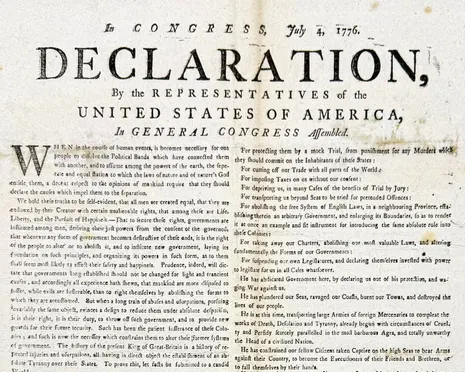
Vanishingly rare copy of US Declaration – On a seemingly unremarkable Thursday in late May, Michael Scurr, a volunteer at the National Archives in Kew, West London, found himself on the cusp of an extraordinary historical revelation. While cataloging a batch of documents from the British national collection—papers that had never before been meticulously documented—he encountered something unexpected. As he opened a volume of 18th-century Royal Navy correspondence, the opening words of a familiar document caught his eye: “In Congress, July 4, 1776. A declaration by the representatives of the United States of America…”
What Scurr had stumbled upon was a “vanishingly rare” copy of an early printing of the US Declaration of Independence, just weeks before the 250th anniversary of its signing. The moment was so striking that he immediately shared his find with his supervisor, who was seated nearby. “I think you should come and have a look at this,” he said, his tone betraying a mix of excitement and disbelief. The discovery, he added, was “a really thrilling moment.”
“In Congress, July 4, 1776. A declaration by the representatives of the United States of America…”
The document in question was a copy of the so-called Exeter printing, one of just 11 surviving versions of the original declaration. What sets this particular copy apart is its presence outside the United States, making it a unique artifact in the UK archives. Graham Moore, a records specialist at the National Archives, highlighted the significance of the document’s journey. “What makes it particularly remarkable is the ‘amazingly complete story’ of how it ended up in the Royal Navy’s possession,” Moore explained. “This tells us about the spread of news as the new nation sought to establish its independence.”
The Dalton’s Capture and the Forgotten Document
The Exeter printing was discovered among a collection of papers seized from the Dalton, an American privateer vessel, during its capture by a British warship off the coast of Spain in December 1776. While other crucial documents—including the ship’s commission, signed by John Hancock, president of the Continental Congress—were forwarded to the Admiralty Court, the declaration was overlooked. It was cataloged as “another document” and subsequently buried in the naval archives for over two centuries.
Moore noted that the declaration’s journey to the UK was likely facilitated by the Dalton’s captain, Eleazer Johnson. After the ship was captured, Johnson, who had declared himself a citizen of the United States of America, would have had the opportunity to share the document with the crew. “The spread of the declaration was deliberate,” Moore said. “These ‘broadsides’ were meant to be printed quickly, distributed widely, and consumed by as many people as possible in the shortest time possible.”
“This is about news in 1776.”
The Path of the Declaration and Its Impact
Though the Dalton didn’t dock in Exeter, the timing of the printing suggests it was likely acquired in nearby Portsmouth, New Hampshire, where the ship briefly stopped to replenish its crew. Moore speculated that Johnson, a steadfast American patriot, might have purchased a copy in the port, ensuring the document’s survival as it made its way to British hands. The discovery underscores how the revolutionary fervor of 1776 transcended borders, even reaching the shores of the UK.
The Exeter printing was created between 16 and 19 July 1776, just days after the original declaration was signed in Philadelphia. This timeframe highlights the speed at which news of the American Revolution spread across the Atlantic. “The document was printed and distributed with the intent of amplifying the message of independence,” Moore said. “It’s a testament to how the revolution was not just a battle for freedom but a movement that inspired others.”
“I have this nice image of Eleazar Johnson on the ship … potentially reading out the declaration of independence to his 120-man crew of diverse nations to say: ‘This is why we’re doing it, this is why we’re putting our lives at risk, this is why we’re heading out into the ocean to take our chances again.’”
A Crew of Diverse Origins
The Dalton’s crew was a mosaic of nationalities, reflecting the transatlantic nature of the revolution. Among the 120 sailors were English, Irish, Scottish, French, and Danish men, alongside those who had already embraced American citizenship. The presence of diverse individuals on the ship is not surprising, given the era’s interconnectedness. One crew member, Daniel Cottle, was listed in the muster book as a black man, a detail that Moore emphasized as significant. “This is not uncommon in North America,” he said. “It is likely by his role on this privateering ship that he is a free black man in 1776. We do see free black people fighting on both sides of the revolution.”
Cottle’s story, though incomplete, offers a glimpse into the broader context of the revolution’s impact. After the Dalton was captured, he and the rest of the crew were transferred to a guard ship and eventually brought to England. “That is really where we lose his story,” Moore admitted. “It’s possible that with more research, we’ll be able to follow him a bit further. It’s likely that he came from Newburyport, Massachusetts, where the majority of the Dalton’s crew originated.”
The Legacy of a Forgotten Artifact
The rediscovery of the Exeter printing has reignited interest in the movement that shaped the United States. Moore’s analysis of the document’s journey from the hands of American revolutionaries to the Royal Navy’s archives reveals a story of resilience and unintended preservation. The fact that it survived as a single copy outside the US underscores its rarity and the importance of its presence in the UK’s collection.
Moreover, the document’s discovery has prompted a deeper exploration of the Dalton’s role in the revolution. As the first American privateer captured in European waters, the Dalton’s fate was a pivotal moment in the conflict. The collection of papers from the vessel provides a rich tapestry of the revolution’s influence, including the published diary of sailor Charles Herbert, which is accessible online. These records offer a personal perspective on the events that unfolded during the Dalton’s brief but impactful history.
While the Exeter printing’s significance lies in its historical context, it also serves as a reminder of the broader narratives of the American Revolution. The document’s journey from the decks of a privateer to the archives of a British institution exemplifies how history is often shaped by chance and the persistence of those who seek it out. For Scurr, the find was more than just a cataloging task—it was a chance to uncover a piece of the past that had been hidden for generations.
The National Archives is now working to fully document the Exeter printing’s story, ensuring that its role in the history of the United States and its reach across the Atlantic is recognized. As Moore noted, the document’s existence outside the US “adds a layer of complexity to our understanding of how the declaration of independence was shared and preserved.” Its rediscovery not only highlights the courage of those who fought for freedom but also the enduring legacy of a nation’s birth in the hearts and minds of its allies and adversaries alike.