EU to Release €16bn to Hungary Previously Frozen Under Orbán
EU to release 16bn to Hungary – The European Union has announced the unfreezing of over €16 billion in funds for Hungary, marking a significant shift in the country’s political landscape following the recent election of Péter Magyar. Ursula von der Leyen, the president of the European Commission, has praised the “winds of change” emerging in Hungary, citing the new government’s commitment to reforms. This decision, hailed as a “historic breakthrough” by Magyar, aligns with the approval of the Budapest Pride parade for June 27, 2026, by Hungarian police. The previous ban on the event, imposed under the leadership of Viktor Orbán, had sparked international criticism and drawn attention to the government’s stance on LGBTQ rights.
Turning Point for Hungary
The move to restore EU funding comes as a response to Hungary’s evolving political direction since Magyar’s landslide victory in the March 2026 elections. The new prime minister, who has long championed equality, has positioned himself as a symbol of progress following Orbán’s 16-year tenure. His administration has pledged to address concerns over the erosion of democratic norms and civil liberties, including the controversial 2021 legislation that allowed for the prohibition of Pride events. While Magyar has not explicitly mentioned the event in his public statements, his alignment with the European Commission suggests a willingness to ease restrictions.
The EU’s decision is tied to Hungary’s compliance with specific conditions. Approximately €2.2 billion of the released funds depend on the restoration of academic freedom, a key demand from the European Parliament. An additional €500 million remains withheld until the government adheres to a recent European Court of Justice ruling that declared its anti-LGBTQ+ laws discriminatory. These measures reflect the EU’s cautious approach, balancing its support for Hungary’s transition with demands for accountability. “We can already feel a strong wind of change across Hungary,” von der Leyen stated during a press conference, emphasizing the country’s progress in recent weeks.
Historic Pride Approval
Hungarian police have confirmed their support for the 31st edition of the Budapest Pride parade, which will take place on June 27. This follows the EU’s landmark ruling earlier this year, which found Orbán’s 2021 law—amended to justify Pride bans—violated the bloc’s principles of non-discrimination. The approval of the event, after last year’s attempt to block it, signals a potential thaw in the relationship between the government and LGBTQ advocates. “After the extraordinary year of 2025, we trust in the cooperation of the authorities and their acceptance of the gathering,” said organizers in a statement, welcoming both previous participants and new supporters.
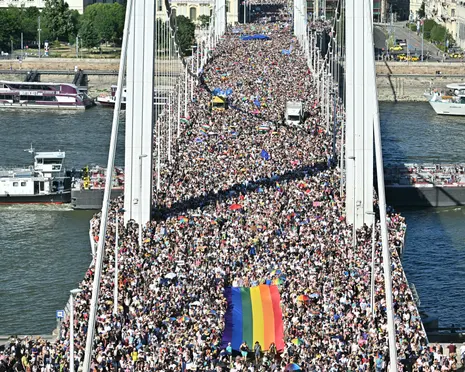
Despite the ban, last year’s Pride march attracted a record 200,000 attendees, turning it into a powerful act of defiance against Orbán’s policies. The event’s resilience highlighted the determination of LGBTQ communities to assert their rights, even as the government sought to suppress it. Magyar’s government, however, has not yet taken steps to repeal the legislation, leaving uncertainties about the future of Pride events. The organizers remain hopeful, citing the EU’s support as a catalyst for change. “We warmly welcome everyone in June who took part in last year’s demonstration, as well as those who continue to believe in equal rights and a democratic Hungary,” they added, emphasizing unity and hope.
Legal and Political Implications
The Budapest Pride organizers are not the only figures facing legal challenges. Géza Buzás-Hábel, a Roma rights activist in Pécs, has also been targeted for organizing the fifth edition of the Pride march outside Budapest. His case underscores the ongoing tension between the government and LGBTQ advocates, as well as the broader implications of Orbán’s policies on minority groups. Similarly, Gergely Karácsony, the progressive mayor of Budapest, played a pivotal role in last year’s event by rebranding it as a municipal cultural celebration. This strategy allowed the parade to bypass national restrictions, though Karácsony was later charged with organizing the banned demonstration, facing potential fines.
The EU’s decision to release funds is not without conditions. It requires Hungary to address issues such as academic freedom and legal compliance with the bloc’s standards. This aligns with the Commission’s broader strategy to incentivize democratic reforms while maintaining pressure on the government to uphold its commitments. Von der Leyen acknowledged Magyar’s efforts, stating that the country had “turned the page” on its previous trajectory. However, the success of these reforms will depend on the new administration’s ability to implement changes quickly and transparently.
Rebuilding Trust
Magyar’s government has emphasized its readiness to meet EU requirements, asserting that Hungary can pass all necessary laws to restore funding. “We have already convinced the European Commission that the country is moving forward with long-overdue reforms,” he told reporters in Brussels, underscoring the potential for improved relations. This statement suggests a strategic shift, positioning the new leadership as open to dialogue and compromise. However, the absence of direct references to Pride events in his speeches raises questions about the extent of his support for LGBTQ rights.
While the EU’s financial support is a significant step, it does not guarantee immediate resolution of all issues. The release of funds is contingent on Hungary’s ability to comply with specific rulings, including those from the European Court of Justice. This legal framework ensures that the government remains accountable, even as it negotiates with the bloc. The Pride parade’s approval, meanwhile, serves as a symbolic victory, though its success will hinge on the government’s willingness to allow public expression of diversity.
As the June 27 event approaches, organizers remain optimistic about its impact. The previous year’s march, despite the ban, became a global symbol of resistance, showcasing the resilience of the LGBTQ community. With the EU’s backing, this year’s parade is expected to draw similar crowds, reinforcing the movement’s momentum. Meanwhile, the government’s use of facial recognition technology to monitor participants has been tempered by police assurances that no immediate action will be taken. This development may ease fears of repression, though challenges persist.
A New Era for Hungary?
The EU’s decision to unfreeze funds represents both a reward and a test for Hungary’s new leadership. While it acknowledges the political shift under Magyar, it also sets clear expectations for continued progress. The success of the Pride parade could further bolster public confidence in the government’s commitment to democratic values. Yet, the broader implications of the legislation and its impact on rights remain under scrutiny. As Hungary moves forward, the balance between reform and resistance will be key to its future trajectory. The upcoming events will serve as a barometer for the nation’s evolving relationship with the EU and its own citizens’ rights.
With the EU’s financial support and the approval of the Pride parade, Hungary appears to be at a crossroads. The new administration has the opportunity to redefine its policies, embracing inclusivity and democratic principles. However, the persistence of Orbán-era laws and the legal challenges faced by activists like Karácsony and Buzás-Hábel highlight the need for sustained efforts. The release of the €16bn marks a turning point, but the true measure of change will depend on how Hungary navigates its next steps in the months to come.