Ukraine and Moldova Begin EU Membership Talks Amid Strategic Shifts
Wanderstayfinder.com – On Monday, Ukraine and Moldova marked a pivotal moment in their journey toward EU integration by initiating the first phase of formal membership negotiations. The event, held in Luxembourg, saw EU officials and ministers from both nations gather to launch discussions that symbolize a major step forward for countries once bound by Soviet influence. This development comes as Russia continues to escalate its military operations in Ukraine, with relentless attacks on cities and towns, while facing mounting challenges in capturing significant territory.
The process began with a landmark agreement, achieved after months of political maneuvering. Hungary, which had previously stalled progress under its pro-Russian president Viktor Orbán, now supports the move following a government change in April. This consensus allowed EU leaders to unanimously approve the opening of the first cluster of negotiations, focusing on foundational principles like democracy and the rule of law. The decision signals a renewed commitment to expanding the bloc, despite lingering concerns about the pace of reforms in candidate nations.
A Symbol of Resilience and Reform
For Ukraine and Moldova, the start of these talks represents more than just a procedural step—it is a testament to their resilience against external pressures. Ukraine, in particular, has faced immense challenges since Russia’s full-scale invasion in 2022. Yet, the nation’s persistence in implementing structural changes has earned it recognition as a serious candidate for EU membership. Moldova, meanwhile, has also demonstrated commitment to aligning with European standards, despite its smaller size and economic vulnerabilities.
The EU’s enlargement agenda has long been a tool for geopolitical influence, and the inclusion of these two countries underscores its strategic priorities. As
“Enlargement is a strategic choice,”
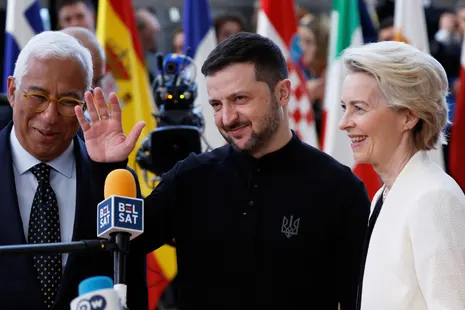
emphasized Ursula von der Leyen and António Costa in their joint statement last Friday. The leaders highlighted the importance of Ukraine and Moldova’s reforms, which include measures to strengthen judicial independence and combat corruption. However, they also noted that the process remains challenging, with both nations needing to meet stringent criteria before progressing further.
Progress and Setbacks in Reform
Ukraine’s reform efforts have been a central focus of EU negotiations. Recent high-profile actions, such as the arrest of Andriy Yermak—the chief of staff to President Volodymyr Zelenskyy—have been viewed as positive indicators. Yermak was implicated in a major corruption investigation, and his detention has been cited as evidence of the government’s willingness to address graft. However, EU officials remain critical of the pace of reforms, pointing out that Kyiv has only completed 15% of the 10-point plan agreed upon with EU enlargement commissioner Marta Kos in December 2022.
The plan outlines key areas for improvement, including the modernization of anti-corruption agencies like Nabu and Sapo, the adoption of a comprehensive anti-corruption strategy, and overhauls in judicial appointment processes. While these initiatives are commendable, their implementation has been slow, prompting questions about Ukraine’s readiness to fully embrace EU governance. President Zelenskyy acknowledged this, stating that the EU’s support is crucial for maintaining momentum.
“Ukraine is doing what is necessary, and it is important that the EU is also keeping its word,”
he said, emphasizing the mutual accountability required for the partnership to succeed.
Strategic Implications and Future Prospects
The opening of the first cluster of negotiations sets the stage for broader discussions on economic, social, and environmental policies. This phase is seen as a critical test for both countries, as it requires them to demonstrate their capacity to absorb and enforce EU laws. Heather Grabbe, a former EU enlargement adviser and Bruegel thinktank fellow, described the move as a “reality check” for Ukraine. “You can’t bypass the adoption and enforcement of EU regulations on Ukrainian soil,” she noted, stressing that the process will demand administrative and institutional adjustments over time.
Grabbe also argued that the EU should prioritize security and defense integration with Ukraine. She highlighted the country’s role as a key player in European security, with battle-hardened forces and a modern arsenal capable of countering threats.
“The worst thing for European security would be a future Ukrainian government turning against the EU and adopting Eurosceptic views,”
Grabbe warned. This perspective reflects broader debates about how to balance reform with political stability, particularly as Ukraine’s path to membership hinges on its ability to maintain alignment with EU values.
The negotiations also reflect a shift in EU strategy toward accommodating candidate nations more swiftly. While Germany’s proposal for “associate membership”—granting Ukraine representation in EU institutions without voting rights—was met with resistance, the recent progress suggests that the bloc is open to phased integration. Ukraine, like other candidates, is already participating in EU policies such as the energy union and the digital single market, indicating that the concept of “staged membership” is gaining traction.
Despite these advancements, the road to EU accession remains complex. Members must agree unanimously on all aspects, and the process could take up to four years to finalize technical talks. However, the political dimension of membership cannot be overlooked. As Grabbe pointed out, the final decision will depend on the EU’s ability to secure broad support while ensuring Ukraine’s continued commitment to European ideals. The next phase of negotiations will likely focus on testing the countries’ readiness to implement the rulebook, a task that will require sustained effort and institutional transformation.
With the first cluster officially launched, the EU and its candidates have entered a new chapter of collaboration. The symbolic and practical significance of this step cannot be overstated, as it represents a turning point for both Ukraine and Moldova. As the discussions unfold, the international community will be watching closely to see how these nations navigate the challenges of integration and whether their progress will translate into a lasting partnership with Europe’s largest political union.