Russia withdraws ambassador to UK as Kremlin raises pressure over Ukraine support

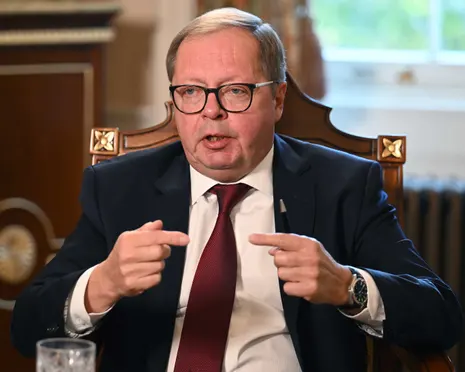
Table of Contents
Diplomatic Vacuum Opens in London as Russia Recalls Ambassador Amid Escalating Tensions
Wanderstayfinder.com – The seat of the Russian ambassador to Britain has stood empty since late July, marking the latest rupture in an already severely damaged bilateral relationship. Andrey Kelin, who had occupied the post for seven years, departed London last month, leaving only the chargé d’affaires, Vasily A Tsyganov, to head the embassy’s day-to-day operations. The Russian mission confirmed the departure, stating that the Kremlin formally concluded Kelin’s diplomatic assignment on 21 July and had not yet nominated a successor.
The timing of the withdrawal coincides with a sharp escalation in rhetoric from Moscow. Last week, after British Ministry of Defence sources confirmed that two drones manufactured by UK companies had been employed by Ukrainian forces to strike targets inside Russian territory, the embassy issued a pointed warning on its Telegram channel:
“London’s actions will inevitably carry consequences for which it will have to answer.”
That statement, widely circulated across Russian-language media, represented one of the most forceful public threats the mission has directed at Westminster in recent memory. It followed a broader pattern of increasingly strident messaging from the embassy as Britain deepened its military assistance to Kyiv, including the supply of attack drones.
A Gap in Leadership, or a Permanent Downgrade?
John Foreman, a former British defence attache who served in both Moscow and Kyiv, noted that periods without an ambassador are not without precedent in diplomatic history. Yet he raised the question of whether this particular vacancy signals something more structural. Writing on X, he observed:
“The embassy’s strident ‘consequences’ statement this week and the huge deterioration of bilateral relations since 2018 and especially since the start of the war make me wonder if Moscow will permanently downgrade the relationship this time, by default by not replacing him.”
The embassy, however, moved quickly to distance itself from that interpretation. In a follow-up statement, officials insisted that nothing in their recent comments was intended to suggest Russia planned to reduce the level of its diplomatic representation in Britain. The mission maintained that the vacancy was simply a matter of personnel transition, not a deliberate de-escalation of ties.
Moscow’s Account: London Chose Confrontation
In remarks relayed to the Sunday Times, an embassy spokesperson framed the departure in terms that placed responsibility squarely on the British government. The spokesperson said Kelin had worked to keep channels of communication open and accused Westminster of selecting a “path of confrontation” with Russia.
“He left Britain in the hope that a more constructive and respectful dialogue could eventually be restored, should the UK reconsider its policies towards our country.”
The same spokesperson added a broader assessment of bilateral relations, declaring that ties across all areas had fallen to “an unprecedentedly low level entirely on London’s initiative.” The phrasing echoed language frequently deployed by Russian officials since the full-scale invasion of Ukraine began in February 2022, a period during which formal diplomatic exchanges between the two capitals have grown increasingly sparse.
London’s Response: Business as Usual
The British Foreign Office responded with characteristic brevity. A spokesperson stated that the question of ambassadorial staffing was a matter for the Russian foreign ministry and that Britain retained its own ambassador and embassy in Moscow through which it could engage and raise concerns directly with the Russian government.
“We continue to stand shoulder to shoulder with Ukraine, which has the right to defend itself against Russia’s illegal and unprovoked invasion.”
The reply underscored Westminster’s position that the absence of a Russian ambassador does not alter Britain’s commitment to Kyiv or its willingness to press its grievances through whatever diplomatic channels remain open.
A Veteran’s Perspective on What the Empty Seat Means
Shaun Pinner, a former British soldier who later fought alongside Ukrainian marines and was captured and held by Russian forces for a period, offered a more sceptical reading of the situation. He acknowledged that some observers would describe Kelin’s departure as a “dangerous erosion” of the communication pipeline between London and Moscow. Yet he argued that, in practice, that pipeline had been largely non-functional for some time.
“If Moscow refuses to meaningfully engage, rebuffs attempts at communication and uses its diplomatic presence primarily to repeat Kremlin narratives, then we shouldn’t pretend we’re witnessing some functioning diplomatic relationship.”
Pinner’s comments reflect a growing sense among veterans and defence analysts that the formal architecture of diplomacy between the two countries has become, in many respects, a hollow shell. The ambassador’s office, in this view, has served less as a conduit for negotiation and more as a platform for broadcasting Moscow’s talking points to British audiences.
Kelin’s Tenure and the Rhetoric of War
Andrey Kelin entered the Soviet diplomatic service in 1979, giving him more than four decades of experience in foreign affairs before assuming the London post. During his seven years as ambassador, he gave numerous interviews to British broadcasters, consistently articulating Kremlin positions on the war in Ukraine. In one widely noted appearance on Sky News in June, he asserted that Russia “cannot lose” the conflict — a formulation that mirrored language used by senior Russian officials at home.
His departure thus closes a chapter in which the ambassador’s public role was defined less by quiet back-channel diplomacy and more by the amplification of state narratives. Whether Moscow will fill the vacancy in the near future, or allow the post to remain unfilled indefinitely, will be watched closely as an indicator of how far the Kremlin intends to let bilateral relations drift.
Broader Implications
The withdrawal arrives at a moment when Britain’s military support for Ukraine has expanded to include precision strike systems, a development Moscow has repeatedly characterised as a step toward direct involvement in the war. The embassy’s “consequences” language, combined with the decision to leave the ambassadorial post vacant, suggests that the Kremlin is recalibrating its diplomatic posture toward London — not necessarily toward formal severance, but toward a sustained period of minimal engagement. For British policymakers, the practical effect is a further narrowing of the already limited avenues through which misunderstandings might be corrected before they escalate.
Related Reading
Frequently Asked Questions
What is Russia withdraws ambassador to UK as Kremlin?
Russia withdraws ambassador to UK as Kremlin is the main topic of this guide. The article explains the context, practical details, and next steps readers should understand.
Why does Russia withdraws ambassador to UK as Kremlin matter?
Russia withdraws ambassador to UK as Kremlin matters because readers are looking for a useful answer, not just a short summary. Good content should match search intent and help them decide what to do next.