Wafa Mustafa’s Pursuit of Truth: A Journey for Syria’s Missing
Wanderstayfinder.com – Wafa Mustafa’s childhood was shaped by the soft, soulful melodies of Umm Kulthum, the iconic Egyptian singer whose music once filled her family home in Syria. Her father, Ali, often played the songs in a loop, his voice harmonizing with the artist’s timeless tones. As a child, Mustafa would listen intently, captivated by the emotional depth of the lyrics. One day, he posed a challenge: to write down the words of a favorite song. Wanting to please him, she selected “Aghadan Alqak,” a piece that translates to “Will I meet you tomorrow?” The song’s themes of longing, absence, and hope resonated deeply with her, as if the melodies had already foretold the fate that would one day befall her father.
A Father’s Disappearance and the Weight of Waiting
In 2013, as protests against the Assad regime erupted across Syria, Ali Mustafa was taken from his Damascus apartment by armed men. The event marked the beginning of his enforced disappearance, leaving his family in a state of perpetual uncertainty. At the time, Wafa was 23, her world upended by the abrupt loss of her father. Since then, she has carried the burden of waiting—each day a potential tomorrow, each moment a fragile hope that he might return or that the truth would finally emerge.
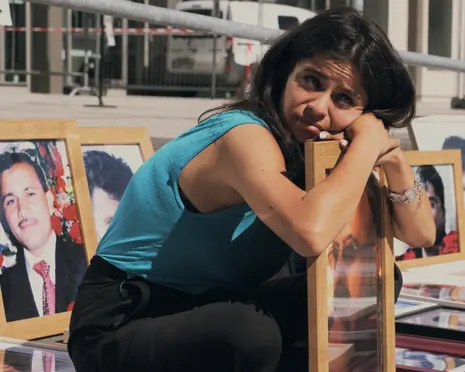
Mustafa’s story is emblematic of countless others in Syria. According to the Syrian Network for Human Rights, over 177,000 individuals were forcibly disappeared between 2011 and 2025, many subjected to arbitrary detention in notorious prisons. These facilities, controlled by Bashar al-Assad’s forces or affiliated armed groups, became sites of torture and execution. For millions of Syrians, the fate of their loved ones remains unknown, their lives suspended in the shadow of absence.
The Documentary: A Personal Chronicle of Loss
One year and six months after the fall of Assad, Wafa Mustafa has taken her search for truth to a new level. Collaborating with her childhood friend and acclaimed filmmaker Waad Al-Kateab, who co-directed the Bafta-winning documentary For Sama, she has created a new short film titled *Maybe Tomorrow*. The title, a nod to the Umm Kulthum song, encapsulates both the emotional core of the project and the collective yearning of Syrians for closure.
Al-Kateab explains that the film reflects the “experience of Wafa and others,” capturing the anguish of waiting for answers. It premiered at the Sheffield DocFest, offering a raw, intimate portrayal of the violence of uncertainty. The documentary follows Mustafa’s life in Berlin, where she now resides, and her return to Syria to trace her father’s fate. Through this journey, she documents the personal and emotional toll of forced disappearances, particularly on families scattered across the globe.
Mustafa, a social media enthusiast since her youth, describes the film as a condensed “memoir” of her six years of advocacy. It highlights the struggle of families to hold onto memories of those lost, especially in the absence of official records or justice. “Millions of people are disappeared,” she says, “but I only had this father, and he’s gone. And I cannot let him go.” The film’s emotional resonance lies in its ability to humanize the statistics, turning them into a story of resilience and sorrow.
The Legacy of a Father’s Words
Mustafa’s mother appears in the film, offering a poignant perspective on the enduring impact of Ali’s disappearance. “Sometimes we forget things, or our memory blocks them out,” the mother remarks, echoing a sentiment shared by many who have lost loved ones to the conflict. Yet, Ali’s advice to his daughters—“you must write things down, document things”—has become a guiding principle for Wafa. This directive, repeated through the years, has shaped her approach to activism, blending personal narrative with historical record.
Al-Kateab, who previously co-directed *For Sama* with Edward Watts, emphasizes the collaborative nature of *Maybe Tomorrow*. Unlike her earlier work, this project places Wafa at the helm, allowing her to shape the story according to her own vision. “I saw the power of what we can do when we own our stories,” Al-Kateab reflects. “For me, that moment was so big, and I realized Wafa has to do her own film.” This shift in creative control underscores the film’s dual purpose: to preserve Wafa’s personal grief and to amplify the voices of Syria’s missing.
A Glimpse into the Heart of Absence
Through *Maybe Tomorrow*, audiences are invited to step into Wafa’s shoes, experiencing the relentless search for answers. The film captures the dissonance of being told a loved one is dead without the certainty of their fate. “It’s not just about the disappearance,” Mustafa explains. “It’s about the inability to accept it, the void left by the absence of proof.” This emotional struggle is compounded by the distance of exile, where memories of Syria are both cherished and strained by the weight of loss.
Al-Kateab adds that the film’s narrative is intentionally layered, blending moments of hope with the harsh realities of the conflict. “Hope is a very dangerous thing,” she notes, “but it’s also what keeps people going.” Despite the uncertainty of the outcome, Mustafa and the film’s creators remain committed to the mission of uncovering the truth, ensuring that the stories of the disappeared are not lost to time. Their work is a testament to the enduring power of memory and the refusal to let grief go unchallenged.
The documentary also explores how individual tragedies shape collective memory. For Wafa, her father’s disappearance is a personal wound, but it resonates with the broader suffering of Syrians. In a world where mass disappearances have become a grim norm, her story serves as a reminder of the human cost behind the headlines. Through her lens, the audience witnesses the intersection of personal loss and national history, a narrative that bridges the past and present.
As the film unfolds, it becomes clear that Wafa Mustafa’s journey is not just about finding her father. It is about reclaiming agency, preserving the voices of the disappeared, and challenging the silence that surrounds their fates. With *Maybe Tomorrow*, she transforms her pain into a powerful call for justice, ensuring that the memory of those lost remains alive in the hearts of the Syrian people and the world beyond.