US kindergarten vaccination rates dip as exemptions hit record high

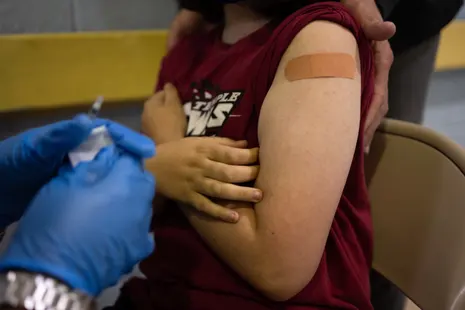
Table of Contents
Kindergarten MMR Coverage Slides as Non-Medical Exemptions Hit a Record
Wanderstayfinder.com – The Centers for Disease Control and Prevention published its most recent national kindergarten immunization figures just days after President Donald Trump repeated a string of inaccurate claims about childhood vaccines, including the assertion that certain injections are “like the size of a soda bottle.” The agency’s own press release was brief and reassuring — three sentences declaring that “overall vaccination rates among kindergarteners remained high” — yet infectious-disease specialists reading the underlying numbers saw a different story emerging across the country.
A Broad-Based Dip Across States and Vaccine Types
Dr Paul Offit, who directs the Vaccine Education Center and serves as an attending physician in the division of infectious diseases at Children’s Hospital of Philadelphia (CHOP), pointed to a pattern that extends well beyond any single shot. Immunization rates fell for every vaccine tracked in the dataset, and more than half of all states recorded a year-over-year decline. In absolute terms, at least 280,000 kindergarteners entered the school year without having received the measles, mumps, and rubella (MMR) combination vaccine.
“There’s been a decrease in immunization rates in all vaccines. There’s a decrease in immunizations in more than half the states, as opposed to the year before. There are at least 280,000 kindergarteners who did not get the [measles, mumps and rubella vaccine],” said Dr Paul Offit.
The most striking single metric, however, is the surge in non-medical exemptions. Over the past school year, the share of kindergarteners entering class with a personal-belief or philosophical exemption jumped 17 percent — the largest one-year increase on record — pushing the national figure from 3.6 percent to 4.2 percent. Pediatricians, municipal health directors, and vaccine researchers described the trend as a downstream effect of sustained public messaging that casts doubt on vaccine safety, whether through executive action, social-media commentary, or the visible presence of anti-vaccine figures in government.
The White House Executive Order and Its Aftermath
The confusion Offit and others describe did not arise in a vacuum. On 10 August, the president signed an executive order calling for a reduction in the number of vaccines children routinely receive — from 17 targeted diseases down to 11 — and directing that the MMR combination be broken into three separate administrations given at different visits. He was flanked at the signing by Robert F. Kennedy Jr. and Dr Heidi Overton, the administration’s nominee for the Food and Drug Administration. In remarks accompanying the order, the president linked vaccines to autism without citing supporting evidence, repeated the soda-bottle-size claim, and described both assertions as backed by “gold standard” science.
“We have the MMR, which hopefully will be split up. We have the MMR, we want it in three separate vaccinations given at separate times,” said Trump. “Together, there could be a possibility they’re quite lethal, and separately it looks like they are not at all lethal.”
No peer-reviewed evidence supports the premise that combining measles, mumps, and rubella antigens in a single dose makes the product more dangerous than administering each component separately. The MMR formulation has been used safely in the United States since 1978 and in dozens of other countries for decades.
Measles Returns to States That Had Largely Eradicated It
The practical consequence of even modest coverage gaps is already visible. The United States is experiencing its worst measles year since 1991, with hundreds of confirmed cases reported in Utah and South Carolina. Because measles is extraordinarily contagious — a single infected person can transmit the virus to up to twelve unvaccinated contacts in a closed space — pockets of low coverage can seed outbreaks that spread well beyond the initial community.
Those gaps are geographically uneven. While the national MMR figure still sits at 92.4 percent (a mere 0.1-percentage-point drop from the prior school year), local rates can fall far below that average. Idaho and Ohio have repeatedly appeared in the lower tiers of state-level coverage data, and individual metropolitan areas tell their own stories.
“In Cleveland, for example, a couple years ago, our percentage of kindergartners being up-to-date on vaccines was 68%,” said Dr David Margolius, director of the Cleveland Department of Public Health. “This past school year, we’re up to 76%. We are doing the work.”
Margolius acknowledged, however, that federal messaging is working against local efforts. “The federal government is causing more and more confusion, and that’s washing out the effects and the work that all of us are trying to do,” he added.
What the Data Still Shows — and What It Does Not
The overwhelming majority of American parents continue to vaccinate their children. A 92.4 percent national MMR rate, while below the 95 percent threshold generally considered necessary for herd immunity, means roughly nine out of ten kindergarteners enter school protected against measles, mumps, and rubella. The dip is real but narrow in magnitude; the exemption surge, though record-setting, still leaves fewer than five percent of children unvaccinated for non-medical reasons.
Historical context underscores why even small coverage losses matter. Before widespread US vaccination programs took hold in the mid-twentieth century, measles killed roughly 500 Americans annually. The World Health Organization credits widespread measles vaccination alone with saving an estimated 59 million lives globally between 2000 and 2024. Those gains were built over decades of consistent public-health policy and community trust — trust that, experts warn, can erode faster than it rebuilds.
Separately from the vaccine question, autism spectrum disorder has been associated with certain infections, advanced parental age, and genetic factors. Because autism is a complex, heterogeneous condition, specialists at CHOP and elsewhere maintain that no single cause explains every case. The decades-old claim linking childhood vaccines to rising autism prevalence has not been substantiated by the large epidemiologic studies conducted since the early 2000s, yet it continues to circulate in public discourse and, increasingly, in official government communications.
“If we had a secretary of Health and Human Services (HHS) who was an actual secretary of HHS instead of an anti-vaccine activist and science denialist, he would stand up in front of the American public and say, ‘Vaccinate your children’ – please, vaccinate your children,” said Offit.
Whether the next school-year dataset shows stabilization, continued decline, or a partial recovery will depend on how quickly local health departments can counteract the confusion now embedded in federal messaging — and on whether parents who hesitated this year return to routine immunization schedules before the next measles season arrives.
Related Reading
Frequently Asked Questions
What is US kindergarten vaccination rates dip as exemptions?
US kindergarten vaccination rates dip as exemptions is the main topic of this guide. The article explains the context, practical details, and next steps readers should understand.
Why does US kindergarten vaccination rates dip as exemptions matter?
US kindergarten vaccination rates dip as exemptions matters because readers are looking for a useful answer, not just a short summary. Good content should match search intent and help them decide what to do next.