Ukrainian publishers call for support after Russian attacks destroy 10m books

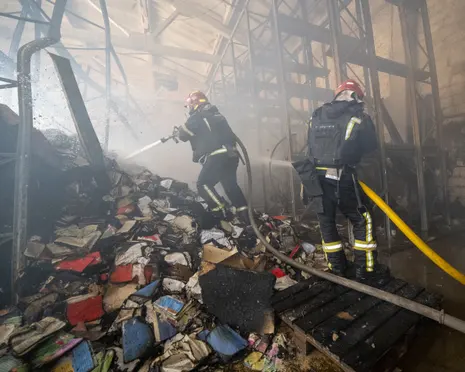
Table of Contents
Ten Million Books Gone: Ukraine’s Publishing Sector Faces Existential Threat After Sustained Russian Strikes
Wanderstayfinder.com – Roughly thirty percent of the books Ukraine produces in a single year vanished in a matter of weeks. That staggering figure, confirmed by the Ukrainian Book Institute, reflects the cumulative damage inflicted by Russian military strikes on publishing warehouses, printing facilities, and distribution hubs across the country during July and the first days of August 2026. The destruction totals approximately ten million volumes — a loss that has pushed several publishers to the brink of financial ruin and raised alarms about the survival of the nation’s entire literary infrastructure.
The Kharkiv and Kyiv Strikes
The single most devastating blow landed on 1 August, when Russian forces struck warehouses operated by the RNK-Ranok publishing group in Kharkiv. Around eight million books were destroyed in that one event. Earlier in July, separate strikes on facilities in Kyiv eliminated more than 1.5 million additional volumes. Together, these attacks wiped out the equivalent of nearly a third of Ukraine’s annual book output in a span of less than six weeks.
The Kharkiv logistics centre was far more than a storage facility. It held inventory for dozens of imprints under the RNK-Ranok umbrella and simultaneously served as the national distribution hub for KnyhoLand, the country’s largest bookselling chain, which operates fifty-one physical shops and multiple online storefronts. Alongside the estimated eight million general titles lost, some six hundred thousand school textbooks were also destroyed — a blow that will ripple through classrooms already strained by years of wartime disruption.
The Ukrainian Book Institute has placed the preliminary monetary value of the Kharkiv losses at close to one billion hryvnias, roughly £16.5 million at current exchange rates.
A Sector on the Verge of Collapse
Oleksandra Koval, director of the Ukrainian Book Institute, described the situation in blunt terms:
“At this stage, we face the risk of the collapse of the entire book ecosystem.”
Her warning underscores a reality that extends beyond any single company. When a distribution node of that scale is eliminated, the downstream effects cascade: smaller publishers lose their only viable logistics partner, regional bookstores face months-long supply gaps, and authors see their titles stranded in limbo. The institute has therefore issued a direct appeal to the international publishing community — requesting financial donations, urging foreign publishers to maintain or deepen partnerships with Ukrainian houses, and asking the global book trade to amplify awareness of what Russia is doing to Ukrainian cultural infrastructure.
Pochaina Market: A Second Front
The attacks did not end with the warehouse strikes. On 16 August, a Russian missile hit Kyiv and ignited a fire at the Pochaina book market, consuming several rows of stalls along with the books and personal property of vendors. Founded in 1997, Pochaina had grown into one of Ukraine’s largest open-air book markets, hosting hundreds of stalls and carrying titles from more than one hundred and twenty publishers. Its partial destruction removes another critical node from an already fractured supply chain.
State Response and Its Limits
The Ukrainian government is moving to develop targeted support programmes for affected publishers and printing companies. Measures under consideration include grants to replace destroyed equipment and compensation schemes for property damage. However, the Ukrainian Book Institute has cautioned that state assistance, even if fully implemented, will not cover the full scope of losses. The scale of the destruction — measured in billions of hryvnias and in years of accumulated inventory — exceeds what a national budget can absorb in the short term, particularly while the country remains at war.
Cultural War and the Question of Voice
Context matters. Russia launched its full-scale invasion of Ukraine in February 2022 and now occupies approximately one-fifth of Ukrainian territory. Throughout that period, strikes on cultural institutions — libraries, theatres, museums, and now publishing infrastructure — have followed a discernible pattern. The institute characterises the book industry as being of “strategic importance” to Ukraine: it preserves the language, promotes Ukrainian culture domestically and abroad, and gives the country a platform to articulate its own narrative.
Olena Odynoka, deputy director for international cooperation at the institute, framed the appeal in those terms:
“Against the backdrop of Russia’s ongoing attempts to destroy Ukrainian identity, culture and history, Ukrainian publishing has a special mission. Supporting Ukrainian publishers today is not simply about preserving an industry. It is about defending Ukraine’s right to speak in its own voice and shape its own narrative in the world.”
A Call to Sever Ties with Russian Publishers
Beyond financial aid, the institute has made a more pointed institutional demand: an end to active cooperation between foreign publishers, literary agencies, and their Russian counterparts. Solidarity with Ukrainian publishers, the institute argues, is inseparable from the broader effort to protect a cultural heritage that Russia is “deliberately trying to destroy.” In a sector where translation rights, co-publishing deals, and agency representation form the connective tissue of international trade, that call carries practical weight — and it positions the coming months of negotiations and catalogue planning as a moment where the global book industry’s choices will carry cultural as well as commercial consequences.
Related Reading
Frequently Asked Questions
What is Ukrainian publishers call for support after?
Ukrainian publishers call for support after is the main topic of this guide. The article explains the context, practical details, and next steps readers should understand.
Why does Ukrainian publishers call for support after matter?
Ukrainian publishers call for support after matters because readers are looking for a useful answer, not just a short summary. Good content should match search intent and help them decide what to do next.