Mark Zuckerberg buys 440-acre Strancally castle estate in Ireland

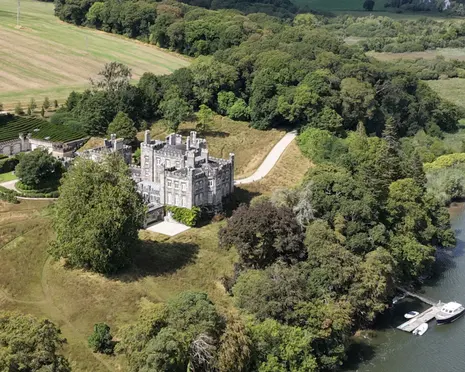
Table of Contents
Meta’s CEO Adds a Gothic Castle to His Irish Portfolio
Wanderstayfinder.com – The Blackwater Valley in County Waterford, a stretch of rolling farmland and ancient woodland in Ireland’s southeast, has long attracted buyers drawn to its quiet grandeur. Now its most storied address has changed hands once again. Mark Zuckerberg, chief executive of Meta Platforms, and his wife Priscilla Chan have completed the acquisition of Strancally Castle, a sprawling gothic-revival mansion set within a 178-hectare (440-acre) demesne. The couple intends to use the property as a residence during their periodic visits to Ireland, where Meta operates its European headquarters in Dublin.
The transaction was conducted privately, off-market, and no official figure has been released for the sum exchanged. Independent valuations circulating in Irish financial press placed the asking range between €20 million and €30 million (roughly £17 million to £25.5 million at prevailing rates). For perspective, that figure represents approximately one-tenth of what Zuckerberg reportedly paid for his 387-foot superyacht, a vessel that dwarfs most ocean liners in passenger capacity.
A Statement from the New Owners
“Mark and his family are excited to continue caring for this historic home and look forward to spending time in Ireland, where Meta maintains its international headquarters,” a spokesperson said on Thursday.
The framing of the purchase as a continuation of stewardship rather than a blank-slate renovation is notable. It signals an intention to preserve the building’s character while integrating it into the family’s existing pattern of travel between the United States and Europe.
Two Centuries of Strancally
The castle dates to 1830, when it was commissioned by John Keily, a former Conservative member of the British Parliament. The design was entrusted to James and George Richard Pain, a London architectural partnership known for lavish country houses. Their plan for Strancally was so expansive that, as recorded in the reference work The Houses of Ireland, a resident needed “a brisk walk of four and a half minutes” to travel from the dining room to the kitchen. The building’s exterior combines sandstone and limestone ashlar, materials that lend the composition a severity the National Built Heritage Service of Ireland has described with characteristic dryness:
“The construction in sandstone and limestone ashlar augments the dour tone of the composition while providing evidence of high quality stone masonry and craftsmanship.”
That heritage designation matters. Ireland’s state agency for built heritage oversees protections that constrain demolition, major alteration, and neglect of structures of architectural significance. Any future work by the new owners will operate within that regulatory framework, adding a layer of public accountability to what is, in essence, a private residence.
The Previous Keepers
Strancally passed into private hands in the early 2000s when Michael Alen-Buckley, co-founder of the London-based investment firm RAB Capital, and his wife Giancarla — a member of the family behind the Rocco Forte Hotels hospitality group — purchased the estate and undertook a substantial restoration. After roughly a quarter-century of ownership, the couple announced their departure with a statement that blended gratitude with a measured handover:
“We leave our home of 25 years fondly and are grateful for the opportunity we have been given to save and restore Strancally castle. We are delighted that Mark and his family intend to build on our stewardship by continuing to invest in maintaining and enhancing the property and grounds as their home in a sustainable manner. We wish them and their family much happiness in this unique and blessed place.”
The emphasis on “sustainable” maintenance and the explicit acknowledgment of prior restoration work suggest that the incoming owners are expected to fund ongoing conservation rather than undertake a wholesale redesign — a distinction that heritage bodies in Ireland watch closely.
A Pattern in the Irish Countryside
Zuckerberg’s purchase is the latest in a series of high-profile acquisitions of historic Irish estates by figures from technology and finance. In 2024, entrepreneur James Dyson acquired Ballynatray House, another grand property in the Blackwater Valley. Further north, in County Laois, John Collison — co-founder of the payments platform Stripe — bought Abbey Leix in 2021. Each transaction draws attention to a question that has followed Irish country houses for decades: who has the means to maintain structures of this scale, and what happens when that means is absent?
For estates of Strancally’s size, annual upkeep costs can run into the millions of euros, covering grounds management, structural monitoring, heating of vast interior volumes, and compliance with heritage guidelines. The arrival of owners with substantial independent wealth reduces the risk of neglect that has claimed lesser houses in the same valley. At the same time, it concentrates ownership of culturally significant architecture in the hands of a small number of very wealthy individuals, a dynamic that Irish heritage advocates have debated since the first tech-sector purchases appeared on the market in the late 2010s.
Why Ireland, Why Now
Meta’s European headquarters in Dublin employs thousands and anchors the company’s regulatory, legal, and public-policy operations for the EU. For executives who travel between Menlo Park and Dublin with regularity, a country residence in the southeast offers a quieter alternative to urban hotel stays while keeping them within a short drive of the capital. County Waterford sits roughly 130 kilometres south of Dublin, reachable by car in under two hours or by a short regional flight to Waterford Airport followed by a final leg on the road.
The estate’s 440 acres also provide a degree of privacy and self-containment that a townhouse or apartment cannot match — a consideration that has grown in weight among executives managing public scrutiny of their personal lives. In that sense, Strancally functions less as a holiday cottage and more as a working base: a place to stay, to host, and to step away from the constant visibility of Silicon Valley or the corporate campus in Dublin.
For the Blackwater Valley, the transaction adds another chapter to a landscape already shaped by centuries of aristocratic and industrial ownership. The castle’s sandstone walls will continue to weather over the coming decades, and the question of how they are maintained will remain, as it always has, a matter of both private choice and public interest.
Related Reading
Frequently Asked Questions
What is Mark Zuckerberg buys 440 acre Strancally?
Mark Zuckerberg buys 440 acre Strancally is the main topic of this guide. The article explains the context, practical details, and next steps readers should understand.
Why does Mark Zuckerberg buys 440 acre Strancally matter?
Mark Zuckerberg buys 440 acre Strancally matters because readers are looking for a useful answer, not just a short summary. Good content should match search intent and help them decide what to do next.