Palestinian and Israeli Civil Society Organizations Push G7 to Address Gaza Crisis
Paris Gathering Calls for Immediate Action to Preserve Two-State Solution
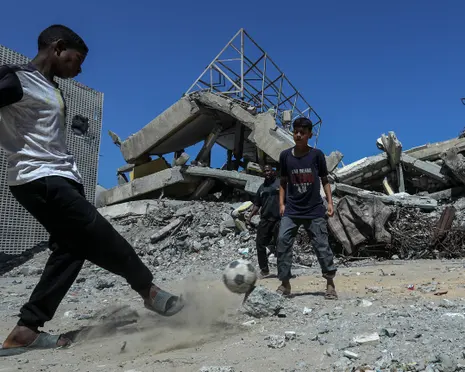
Wanderstayfinder.com – On Friday, a coalition of Palestinian and Israeli civil society groups convened in Paris to press G7 leaders for decisive measures at their upcoming summit in Évian-les-Bains. The event, which drew international attention, aimed to revive the prospects of a two-state solution before it becomes increasingly unattainable. The participants emphasized the urgent need for specific interventions, including enforcing a ceasefire, disarming Hamas, and initiating Gaza’s reconstruction efforts. They also called for a unified approach to peace processes, suggesting that initiatives like the Board of Peace should be consolidated into a single, cohesive program.
Over 150 activists from both Israeli and Palestinian communities attended the Paris meeting, representing diverse working groups. These groups had developed proposals targeting key challenges in the region, such as the ongoing conflict between Hamas and Israel. The collective statement issued by the groups highlighted the precarious situation in Gaza, where the population faces severe hardship, while Israel contends with persistent security threats. “The situation is deteriorating, and the risk of a failed peace agreement is growing,” the statement warned, underscoring the need for immediate diplomatic engagement.
“Gaza is devastated, Israel remains under threat. Settler violence, settlement expansion, and de facto annexation continue to erode the foundations of a future Palestinian state. Israelis and Palestinians alike are living in fear, insecurity, and trauma,” the groups declared.
The Paris meeting sought to bridge the gap between grassroots movements and high-level diplomacy. With Arab and European foreign ministers in attendance, including Kaja Kallas, the EU’s chief foreign policy representative, the focus was on aligning civil society efforts with governmental strategies. This integration, the groups argued, could provide a more sustainable path to peace. However, the G7 summit in Évian-les-Bains, scheduled for next week, faces skepticism about its ability to produce meaningful outcomes. Many believe the chances of a unified statement on Gaza are slim, given the political tensions between member states.
Stalled Progress and the Role of Civil Society
Progress on Palestinian self-rule and an Israeli withdrawal from Gaza has stagnated for six months, with each side blaming the other for failing to meet the demands of Donald Trump’s 20-point peace plan. This deadlock has raised concerns among civil society leaders, who see the need for alternative approaches. A recent meeting in Cairo brought together Palestinian organizations, but it yielded limited results in convincing Hamas to relinquish its heavy weaponry. Hamas insists on an Israeli withdrawal as a prerequisite, while Israel demands disarmament first.
John Lyndon, executive director of the Alliance for Middle East Peace—a coalition of over 200 NGOs—highlighted the importance of civil society in advancing peace. “Israeli society is open to the two-state solution, but this support isn’t reflected in political parties’ policies,” he noted. Lyndon criticized the top-down nature of current diplomacy, arguing that it has become disconnected from the realities faced by ordinary citizens. He described the collaboration in Paris as a rare opportunity for grassroots organizations to act as a unifying force, contrasting it with the challenges they encounter within Israel due to government-imposed restrictions.
“It’s ironic that under the French government’s umbrella, we can bring together groups from both sides more easily than within Israel itself,” Lyndon remarked. The Paris gathering, he said, represented a critical juncture where civil society could influence the political landscape. Without this, the peace process risks being overshadowed by the military and security concerns dominating headlines. The groups also stressed the need for long-term mechanisms to ensure transparency and accountability in Gaza’s reconstruction, which they describe as currently overlooked in favor of short-term political gains.
Funding and Governance as Key Priorities
As the Paris meeting unfolded, the UK, Canada, and Australia announced plans to establish a new funding initiative aimed at supporting peace organizations in the region. This move was seen as a positive step, though the groups remain cautious. They warned that without consistent financial backing, the Palestinian Authority could struggle to maintain stability, further entrenching Hamas’s control in Gaza. The funding stream, they argued, should not only sustain existing efforts but also empower civil society to lead future initiatives.
“The Palestinian Authority is facing a severe financial crisis, which weakens its ability to challenge Hamas’s dominance,” one activist noted. “If they aren’t given the resources to function effectively, the peace process will lose momentum.” The groups also called for Palestinian elections this year, viewing them as a necessary step to strengthen democratic institutions and create a more representative government. This, in turn, could bolster the Authority’s capacity to negotiate with Israel and secure international support.
Meanwhile, the Israeli government’s policies on the West Bank have intensified fears of settler violence. With upcoming elections looming, the groups warn that the expansion of settlements may accelerate, further complicating the path to a two-state solution. “Settler activity has become a daily occurrence, and the Palestinian Authority is not doing enough to counter it,” a participant from the Israeli side stated. “Without a clear stance, the occupation will continue to gain ground.”
Regional Integration and the Path Forward
The Paris meeting emphasized the potential of regional cooperation to drive lasting change. By uniting efforts across the Israeli-Palestinian divide, civil society groups hope to create a platform for dialogue that transcends political divides. They argue that such integration could serve as a catalyst for ending the occupation, provided it is not viewed as a replacement for a fully independent Palestinian state. “The goal is to complement statehood, not replace it,” Lyndon clarified.
One of the main proposals from the groups includes a permanent monitored ceasefire, which they see as essential for reducing hostilities and enabling humanitarian aid. They also called for measurable consequences for settler violence, ensuring that those responsible are held accountable. A guaranteed humanitarian access to Gaza was another key demand, with the groups highlighting the urgent need for aid to reach vulnerable populations. “The reconstruction of Gaza is not just a logistical challenge—it’s a symbol of hope for the people there,” a Palestinian activist said.
Finally, the groups urged G7 leaders to prioritize the inclusion of civil society in their decision-making processes. “The window for a solution is closing, and we need leaders to recognize the role of local voices in shaping the future,” they emphasized. With the summit approaching, the pressure on G7 members to act is mounting, as the groups believe the outcome could determine whether the two-state solution remains viable or is abandoned in favor of more militarized strategies.