Ukrainian cathedrals, Gaza’s archives, Iranian squares – modern war is systematically erasing human history

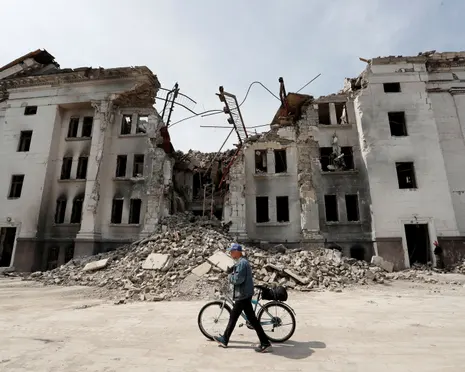
Table of Contents
The Systematic Unmaking of Human Heritage in Modern Conflict
Wanderstayfinder.com – While warfare rarely pauses for seasonal respite, a palpable weariness has settled over contemporary battlefields. Across the skies above Ukraine and the waters of the Strait of Hormuz, aerial campaigns have reached a grim equilibrium. These bombardments encounter minimal opposition yet yield little decisive triumph or defeat. Nations including Russia, Ukraine, Israel, Iran, and their respective partners appear capable of sustaining mutual destruction indefinitely, while international observers tally the accumulating toll.
Ukraine’s Cultural Erasure
Vladimir Putin’s documented ambition to strip Ukraine of its historical distinctiveness has manifested in widespread cultural devastation. According to UNESCO’s latest assessment, 545 historic structures have suffered destruction or abandonment, encompassing 156 religious buildings and 43 museums. This systematic removal of elements that Putin himself considers integral to Russian heritage represents something profoundly disturbing.
The Russian assault on Kyiv’s Pechersk Lavra complex and the Dormition cathedral, alongside the severe damage inflicted upon St Sophia cathedral, mirrors what would occur if Ukraine struck the Kremlin itself. Similar devastation has befallen a cathedral and museum in Odesa, while a theatre in Mariupol lies in ruins. These represent foundational monuments of Ukrainian civilization, yet their deterioration has attracted surprisingly limited attention from Western audiences.
Iran and the Middle East
Perhaps the Persian city of Isfahan might have escaped Donald Trump’s aggressive military posturing. Instead, a Reuters investigation conducted in June revealed that the historic Naqsh-e Jahan Square, the Jameh mosque, and the governor’s palace all sustained partial destruction. Within Tehran, the Golestan palace—a Persian royal residence—has suffered considerable harm. UNESCO has also documented an assault on a fortress dating back 1,800 years, which contains within it a prehistoric settlement estimated at 63,000 years old.
The most devastating outcome of Middle Eastern instability has been the reported destruction or severe damage to more than 80 percent of Gaza’s buildings. The ancient urban center now exists primarily as rubble. Israel’s bombardment has targeted the medieval Great Omari mosque and the church of St Porphyrius, a fifth-century structure among Christianity’s oldest sites. Gaza’s archival collections have been obliterated. The Omari mosque’s library and an adjacent cultural centre, which had preserved thousands of ancient documents through the Crusades, are now lost. The Al Qarara museum was struck from the air and subsequently bulldozed flat. An entire people’s historical memory has been deliberately eliminated.
Historical Precedents and Modern Failures
Israel’s conflict with Lebanon concluded in June with what seemed an unnecessary bombing of Tyre’s ancient port, including the Roman hippodrome site. The millennium-old Beaufort fortress also sustained damage. The past clearly enjoys no special protection in contemporary warfare.
Aerial campaigns differ fundamentally from ground operations. While soldiers with firearms possess clear targets, and modern missiles are similarly supposed to be precise, this logic fails to explain why the United States bombed an Iranian girls’ school in February. The underlying reality is that aerial bombers operate with near impunity while their targets appear diminutive and faceless. Unlike traditional warfare, these campaigns do not conquer territory or compel surrender; they represent expressions of political bravado.
During the Allied invasion of Italy between 1943 and 1945, individual British and American commanders actively protected monuments from destruction. Consequently, Italy’s ancient cities endured far better than Germany’s. Following that conflict, genuine efforts emerged to establish rules of war, including protections for cultural and historic monuments. Warfare was then viewed as a contest between professionals rather than between civilizations.
These efforts produced the Hague Convention of 1954 and the Convention for the Protection of Cultural Property in 1972. However, recent years marked by declining global governance have reduced the Hague Convention to little more than a paper tiger, much like the UN’s International Court of Justice.
“A whole civilisation will die tonight.”
Today’s victories increasingly depend on destroying an enemy’s identity and morale as much as eliminating its population. When the Islamic State devastated much of Mosul in 2014, it systematically erased all traces of the city’s past. Trump’s threat to Iran, captured in the statement above, demonstrated an equally primitive approach to conflict—one that offered little encouragement for bombers to spare Isfahan’s mosques.
UNESCO remains active in documenting the fate of cultural heritage worldwide, but documentation alone provides limited protection. Its cataloguing of Russia’s and Israel’s destruction of their adversaries resembles watching a historic tragedy unfold in real time. The question remains whether records will eventually translate into meaningful action, or whether human history will continue to be sacrificed to the machinery of modern warfare.
Related Reading
Frequently Asked Questions
What is Ukrainian cathedrals Gaza s archives Iranian?
Ukrainian cathedrals Gaza s archives Iranian is the main topic of this guide. The article explains the context, practical details, and next steps readers should understand.
Why does Ukrainian cathedrals Gaza s archives Iranian matter?
Ukrainian cathedrals Gaza s archives Iranian matters because readers are looking for a useful answer, not just a short summary. Good content should match search intent and help them decide what to do next.