
Venezuela Oil Pact Draws Sharp Scrutiny as US Energy Chief Defends Deal in Caracas
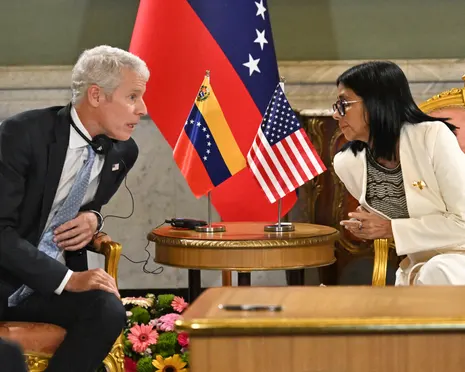
Wanderstayfinder.com – Chris Wright, the United States secretary of energy, arrived in Caracas on Tuesday evening to defend a sweeping petroleum arrangement that Washington struck with Venezuela’s interim leadership. His visit came four days after President Donald Trump unveiled what he branded “the biggest oil deal in world history,” a pact that, by Trump’s own accounting, hands American interests control over 65 billion barrels of Venezuelan crude. Wright was pressed by a CNBC reporter on whether the arrangement amounted to a “heavy-handed” seizure of oil in defiance of Venezuela’s constitution. The secretary’s answer was blunt: “Absolutely not.”
A Deal Framed as Commerce, Critiqued as Coercion
Wright framed the agreement in grand strategic terms, telling reporters that he was witnessing “an absolutely historic transformation of both Venezuela and the relations between Venezuela and the US.” He added that the pact embodied what he called “President Trump’s grand plan to replace conflict with commerce.” The White House has echoed that language, describing the deal as a mechanism for securing American “energy dominance for the next century” while simultaneously “purging foreign malign influence from our back yard” — a formulation that points directly to the exclusion of Chinese and Russian operators from oilfields in a country that holds the largest proven oil reserves on Earth.
Yet the characterization of the arrangement as straightforward commercial diplomacy has not gone unchallenged. Across the American political spectrum, commentators have questioned whether a deal negotiated under the shadow of military intervention can be separated from the circumstances of its creation. The Wall Street Journal’s editorial board drew an unflattering cinematic parallel, noting that the transaction “looks less like a normal commercial transaction than it does the famous scene of US businessmen meeting with the Cuban strongman in The Godfather Part II.” The newspaper went further, accusing Washington of essentially “getting in bed with a foreign dictator and her favored capitalist,” a pointed reference to Alejandro Betancourt, the Venezuelan industrialist positioned at the commercial centre of the arrangement.
The Gunpoint Question
The most pointed critique has come from within Venezuela’s own intellectual community. Economist Francisco Rodríguez, speaking to Democracy Now, argued that no Venezuelan government would have agreed to such terms absent external compulsion. He stated:
“It’s clear that this is not a deal that any Venezuelan government would have entered into unless this country had been subject to an invasion, and unless its authorities had been held at gunpoint. So I think we’ve replaced gunboat diplomacy now for gunpoint diplomacy.”
That observation lands with particular force given the sequence of events that produced the interim government now signing the pact. On 5 January, Delcy Rodríguez — formerly the vice-president of Nicolás Maduro — was installed as interim president just two days after Maduro was seized by US special forces in a predawn raid on Caracas. Trump reportedly warned Rodríguez that defying American directives would bring consequences worse than Maduro’s fate. Since that capture, Rodríguez has conceded a series of policy positions that her own nominally socialist movement, Chavismo, had spent years denouncing as the work of predatory imperialists bent on stripping Venezuela of its natural wealth.
Rodríguez’s Public Case
On Saturday, Rodríguez addressed the nation by televised broadcast, insisting the oil agreement carried “endless” benefits and would generate more than $209 billion in revenues earmarked for healthcare and education. She declared, “We are thinking of Venezuela’s future,” a line intended to position the deal as forward-looking rather than extractive. The following Wednesday, at a signing ceremony held in the Miraflores presidential palace, she thanked the Trump administration for its role in what she termed a “win-win deal” and offered:
“I have faith in the future of Venezuela. What we are doing today represents the future and the hope of the people of Venezuela.”
Opposition Alarm and Democratic Stakes
Venezuela’s political opposition has read the arrangement very differently. For parties that have long campaigned for a democratic transition and fresh presidential elections, the deal appears to remove the principal incentive for Washington to press those demands. A lucrative petroleum partnership with the interim government, they argue, gives Trump little reason to insist on electoral timelines or constitutional restoration. One opposition figure, speaking after the deal’s unveiling, summed up the concern tersely: “This is a game between the Trump administration and Delcy and her people.”
The stakes extend beyond Caracas. Venezuela’s oil sector, long constrained by underinvestment, sanctions, and state mismanagement, represents a potential reshaping of global energy flows. If American firms gain preferential access to fields previously shared with Chinese and Russian partners, the balance of influence in South American hydrocarbons could shift decisively. For neighbouring countries watching the precedent, the episode raises uncomfortable questions about how quickly a military intervention can be converted into a commercial framework, and how little democratic accountability survives the transition.
Wright’s Tuesday-night arrival in Caracas was thus not merely a diplomatic courtesy. It was a signal that Washington intends to operationalize the deal on the ground, with American energy officials embedded in a country whose interim leadership was installed under extraordinary circumstances. Whether the arrangement ultimately functions as the “commerce” Wright describes, or as the “gunpoint diplomacy” critics allege, will depend on how the next months unfold in Venezuelan oilfields, in congressional oversight hearings, and in the courts where constitutional challenges to the deal’s validity are already being contemplated.
Related Reading
Frequently Asked Questions
What is Trump ally defends Venezuela oil deal?
Trump ally defends Venezuela oil deal is the main topic of this guide. The article explains the context, practical details, and next steps readers should understand.
Why does Trump ally defends Venezuela oil deal matter?
Trump ally defends Venezuela oil deal matters because readers are looking for a useful answer, not just a short summary. Good content should match search intent and help them decide what to do next.