Russia Hits Kyiv with Hypersonic Ballistic Missile in ‘Deranged’ Attack
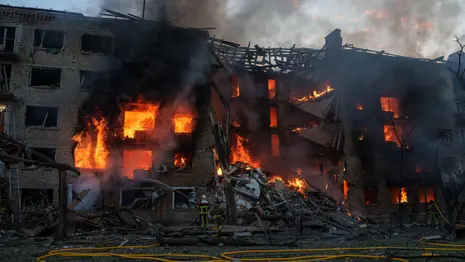
Russia hits Kyiv with hypersonic ballistic – In a dramatic escalation of the ongoing conflict, Russia launched its hypersonic Oreshnik ballistic missile for the third time in Ukraine, targeting Kyiv and its surrounding areas. The strike, which resulted in at least four fatalities and approximately 100 injuries, marked a significant moment in the war as the city faced a heavy bombardment. Ukrainian President Volodymyr Zelenskyy confirmed the attack, stating that the missile struck Bila Tserkva in the Kyiv region. He described the assault as a coordinated effort that also damaged critical infrastructure, including a water supply facility, a market, and numerous residential buildings and schools.
President Zelenskyy’s Condemnation of the Attack
Zelenskyy, speaking via Telegram, called the Russian assault “deranged,” emphasizing its unprecedented scale and intensity. On Sunday, he updated the public on X, detailing the toll of the attack: 100 individuals were injured nationwide, with four confirmed dead. He noted that Kyiv bore the brunt of the strikes, as 600 drones and 90 missiles, including 36 ballistic ones, were deployed. “Unfortunately, not all of the ballistic missiles were intercepted,” he wrote, highlighting that the city remained the primary target. “It is important that this does not pass without consequences for Russia,” he added, underscoring the strategic significance of the attack.
“They are genuinely deranged,” Zelenskyy said on Telegram. “It is important that this does not pass without consequences for Russia.”
The Russian defence ministry corroborated the use of the Oreshnik, a hypersonic weapon capable of carrying both nuclear and conventional warheads. This marks the third deployment of the missile in the conflict, according to official reports. The ministry claimed the strikes were a direct response to Ukrainian attacks on “civilian facilities on Russian territory,” citing successful operations against military command centers, airbases, and other strategic targets. Among the weapons used were Oreshnik, Iskander, Kinzhal, and Zircon, with the latter known for its speed and precision.
Local Impact and Casualty Reports
Damage assessments from Kyiv’s mayor, Vitali Klitschko, revealed casualties in every district of the capital. Two individuals were killed, and 56 were injured, while the head of the Kyiv region reported additional deaths and injuries in the surrounding area. Klitschko noted that the attack on a school triggered a fire, and another strike on a business center left people trapped in shelters. These incidents underscore the indiscriminate nature of the assault, which has left residents in shock and displacement.
Residents shared harrowing accounts of the night’s events. Svitlana Onofryichuk, a Kyiv market worker with 22 years of experience, told the Associated Press that the attack was unlike anything seen during the war. “It was a terrible night,” she said, adding, “I am very sorry that I have to say goodbye to Kyiv now. I am not staying there any more; there is no possibility.” Her comments reflect the deep emotional and practical toll on civilians, as the market—once a hub of activity—was reduced to rubble. “My job is gone, everything is gone, everything has burned down,” she lamented.
“It was a terrible night and there has never been anything like it in the entire war,” said Svitlana Onofryichuk. “I am very sorry that I have to say goodbye to Kyiv now, I am not staying there any more, there is no possibility.”
Yevhen Zosin, 74, who witnessed the attack in Kyiv, described the chaos firsthand. He recounted how the first explosion forced him to flee to save his dog. “Then there was another explosion, and she and I were thrown back like a pin by the shock wave,” he said. “We both survived, she and I. My apartment was blown to pieces.” His experience highlights the indiscriminate destruction, as the attack targeted not only military sites but also residential areas.
Cultural and Historical Damage
The National Art Museum of Ukraine, home to one of the country’s most significant cultural collections, suffered damage in the blast. The culture ministry shared images of shattered ceilings, broken windows, and debris scattered across floors and staircases, indicating the severity of the impact. However, the Kyiv Independent reported that the collection itself remained intact, though the building’s structural integrity was compromised. Tetyana Berezhna, the minister of culture, expressed outrage on Instagram, stating, “Russia is systematically attacking civilian infrastructure and cultural institutions. Each such strike is an attempt to intimidate and destroy our identity.”
“Russia is systematically attacking civilian infrastructure and cultural institutions. Each such strike is an attempt to intimidate and destroy our identity,” wrote Tetyana Berezhna, Ukraine’s minister of culture, on Instagram.
Additionally, the Ministry of Foreign Affairs, a historic building with “unique architectural heritage,” was damaged for the first time since World War II. Andrii Sybiha, the foreign minister, described the destruction as light but symbolic, noting that the attack targeted a historic area. “Yet another proof we are dealing with hordes of barbarians, not the heirs of civilisation,” he remarked, framing the strike as an intentional assault on Ukraine’s cultural and historical legacy.
Strategic Context and Retaliation
The barrage on Kyiv followed a series of events that intensified tensions between the two nations. Earlier this week, Russian forces accused Ukrainian troops of launching a deadly drone attack on a student dormitory in Luhansk, a region under Russian control. Ukraine denied the claims, asserting it had struck an elite drone command unit in the area. This disagreement over the incident prompted President Vladimir Putin to vow revenge, leading to the current assault. The Oreshnik missile’s use in Kyiv is part of a broader strategy to demonstrate Russia’s military superiority and inflict maximum pressure on Ukraine.
While the government headquarters in Kyiv were also damaged, with windows blown out, no casualties were reported. Yulia Svyrydenko, the prime minister, noted the strategic importance of the attack, stating that it was a calculated move to weaken Ukraine’s political and administrative capacity. The incident has raised concerns about the future of the conflict, with Zelenskyy warning of the broader implications. “This is not just an attack on a city,” he emphasized, “but a message to the entire country.”
As the situation in Kyiv continues to unfold, the dual impact on both military and civilian targets has drawn international attention. The use of hypersonic missiles, known for their speed and ability to evade traditional defenses, has escalated the war’s technological dimension. Analysts suggest that such strikes aim to destabilize Ukraine’s defenses and create a psychological toll on its population. For now, the focus remains on assessing the damage and providing aid to those affected, as the conflict enters a new phase of intensity.
The attack on Kyiv serves as a stark reminder of the evolving nature of warfare in modern times. With Russia deploying advanced weaponry to target both infrastructure and symbolic sites, the conflict is no longer confined to frontline battles. Instead, it is increasingly characterized by precision strikes and widespread destruction, aiming to erode Ukraine’s resilience and unity. As the city rebuilds from the aftermath, the human and cultural cost of the assault underscores the war’s deepening impact on everyday life.
In the days following the attack, officials and residents alike will continue to evaluate the full extent of the damage. The National Art Museum’s survival is a glimmer of hope, but the destruction of schools and business centers highlights the challenges faced by civilians. Zelenskyy’s repeated condemnation of the strike reflects the political and emotional stakes involved, as Ukraine strives to maintain its cultural identity amidst relentless aggression. The conflict, now in its third year, shows no signs of slowing, with Kyiv standing as a testament to both the destruction and the determination of its people.