Palestinians Brace as Israeli Settler Leaders Cement West Bank Gains
Palestinians brace as Israeli settler figures move to lock in territorial gains before the upcoming October election. With Benjamin Netanyahu’s far-right coalition facing potential defeat after more than three years in power, radical settler factions are accelerating efforts to establish permanent control over West Bank lands. The urgency is palpable as settlers race to create irreversible facts on the ground before voters head to the polls.
A Night of Destruction in Ein Arik
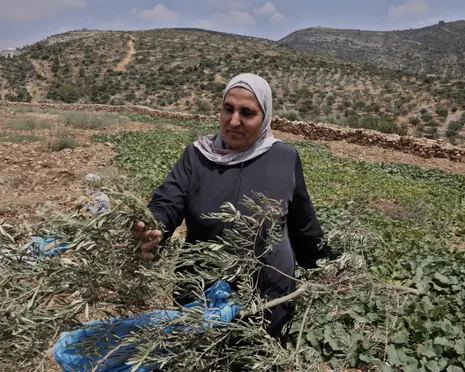
Ilham Karajeh discovered the extent of the damage when she woke on Friday morning. Her family’s carefully tended allotment had been thoroughly ravaged during the night. The assault targeted fundamental elements of agricultural life: irrigation pipes were severed, grape vines were torn from their supports, and seventy young olive trees—symbols of the family’s hopes for generations to come—had been pulled from the earth. By Sunday, Karajeh and her husband Mohammed were gathering the broken branches, noting with visible distress that they remained moist with fresh sap, evidence of the recent violence.
The village residents in Ein Arik have no uncertainty regarding who committed these acts. Since a settler outpost was established on an adjacent hill last year, aggression has cascaded downward into the valleys with increasing intensity. This settlement, now known as Maoz Tzur, started with only a small group of Israeli settlers but rapidly expanded its territorial claims. Their initial targets included a Bedouin shepherd community occupying the surrounding hills and valleys. Subsequently, pressure intensified against local Palestinian villagers.
Political Timing Drives Land Grab
For over twelve months, residents have been barred from accessing their olive and citrus groves, as well as water springs located on southern hillsides closest to the new outpost. Those courageous enough to attempt passage in that direction faced repeated assaults involving clubs and stones. The nighttime assault on the Karajeh family’s modest farm exemplifies an escalation in the intimidation campaign surrounding Ein Arik, spreading northward and climbing the slope toward the neighboring settlement of Deir Ibzi.
This surge in settler hostility across the West Bank connects directly to the volatile dynamics of Israeli domestic politics. Dror Etkes, who founded the advocacy organization Kerem Navot to track territorial expansion, explained the situation clearly: “These are going to be very tough months.” He noted that the current coalition appears vulnerable to defeat, potentially resulting in a new government. Additionally, he observed that electoral focus provides settlers with an opportunity to act with minimal oversight.
Unprecedented Pace of Annexation
Throughout 2025 and into the current year, the gradual de facto annexation of Palestinian territories has accelerated dramatically. Farm outposts like Maoz Tzur have been primary drivers of this expansion. Unlike established settlements requiring extensive planning and construction, these outposts need only a small, determined vanguard willing to employ violence to displace Palestinians across broad areas. A joint report released by Kerem Navot and Peace Now on Monday revealed that such outposts now control over one million dunams, equivalent to 100,000 hectares, representing eighteen percent of the entire West Bank. Remarkably, nearly one-third of this territorial seizure occurred within 2025 alone.
The report emphasizes that “the government has advanced de facto annexation at an unprecedented pace.” This acceleration has been achieved through multiple mechanisms: structural governance modifications, settlement expansion, retroactive authorization of previously unauthorized outposts, land confiscations, expulsion of Palestinian communities, and heightened Israeli control in regions formerly managed by the Palestinian Authority. At its core, the process depends on continuous violence.
“These amount to thousands of incidents, ranging from verbal abuse to murder. The vast majority of these incidents are neither documented nor counted by any authority, as they do not meet the threshold for news reporting,” the report states.
The document further explains that this violence operates within a funded and institutionalized framework designed specifically to remove Palestinians and appropriate their land. Standing at the apex of this system is Bezalel Smotrich, a hardline settler minister. Previously viewed as too extreme for mainstream political participation, Smotrich was brought into government by Netanyahu in 2019 when corruption scandals began weakening the prime minister’s hold on power. Now serving as finance minister, Smotrich’s influence has grown substantially as the coalition moves to secure its territorial ambitions before the election.