
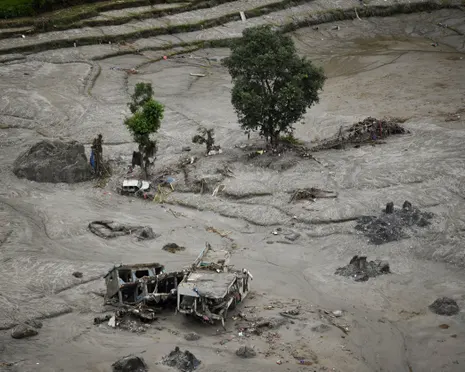
Over 1,000 Dead as Nepal and Tibet Grapple with Identification Crisis After Glacier-Triggered Floods
Wanderstayfinder.com – Nearly seven days after a catastrophic glacier collapse unleashed torrents of ice, boulders, and mud across the Himalayan border zone shared by Nepal and China, the confirmed death toll has climbed past the 1,000 mark. Yet behind that staggering figure lies a second, quieter crisis: thousands of families still do not know whether their loved ones are alive, and those who have lost someone face the agonizing task of proving who their dead relative was.
In Kathmandu, police have issued an urgent public appeal asking relatives of missing persons to submit fresh blood samples for DNA profiling, along with two passport-sized photographs, at the pathology laboratory attached to the Nepal police hospital or at the nearest district police station. For families living abroad, the instruction is to visit an authorised laboratory in their own country and transmit a soft copy of the resulting DNA profile to the Nepal police’s official email address.
The Scale of the Rescue Effort
Prime Minister Balendra Shah announced that more than 11,000 individuals had been pulled to safety across the devastated region, and that electricity and telecommunications networks had been partially restored in several districts. Temporary bridges have been erected to reach isolated valleys, and heavy earth-moving equipment operates around the clock beneath floodlights, carving through the rubble of collapsed hydropower installations.
Approximately 600 workers remain trapped inside multiple hydropower stations that have become the epicentre of ongoing rescue operations. Authorities estimate close to 1,000 people were caught inside those facilities when the deluge struck. So far, 279 workers have been extracted. Days after the disaster, however, optimism that anyone sealed inside a series of underground tunnels could still be breathing has faded sharply. Footage released by rescue crews shows soldiers guiding torches into a large excavation pit, searching for a viable entry point into one such tunnel.
4,400 Still Missing
Six days after the catastrophe, 4,400 people remained unaccounted for across both the Nepali and Tibetan sides of the border. Among them are 592 foreign nationals — mountain trekkers, Hindu pilgrims who had travelled to perform rituals at Mount Kailash in Tibet, and other visitors from India, the United States, the United Kingdom, Australia, and Canada.
The identification problem is compounded by time. In several flood-hit districts, hundreds of unclaimed bodies have already been interred because decomposition has advanced and hospital morgues have run out of space. At the police hospital in Kathmandu on Tuesday, a queue of more than 100 people waited to give blood samples, hoping a genetic match might bring closure or, in rare cases, confirmation of survival.
A Daughter’s Wait
Prakaiti Jurnj stood among those waiting. Her mother remains missing. Her father’s body, however, had been identified — not through DNA, but through a photograph pinned to the exterior wall of the teaching hospital, where images of the deceased are displayed in an attempt to jog family recognition.
“Both my father and mother, they were in the village in Nukawot. They were both swept away by the flood,” she said. “We haven’t heard from them since Wednesday. We found my father’s body; my brother saw the photo on the wall.”
Jurnj was waiting for two siblings based in the United Kingdom to arrive so the family could attempt a journey to the village. She hoped to reach her grandmother or sister-in-law, whom she believed might have survived because their home sits higher on the mountainside. The village remained in a total blackout, making any contact impossible.
“I can’t go there; the situation is very bad,” she said. “I can’t go up there alone. I am not sure if we’ll be able to get them.”
Glacier Collapse and a Warming Climate
The disaster was set in motion by a sudden glacier collapse that sent a wall of ice, rock, and saturated earth cascading through the border region. The area has long been prone to flooding and landslides, but scientists note that extreme weather events — ferocious monsoon bursts and accelerating glacial melt — have grown more frequent as human-driven climate change raises regional temperatures. The flood was attributed to glacier instability compounded by the long-term effects of global warming.
The event has landed squarely on a government barely six months old, forcing it to coordinate one of the largest disaster responses in the country’s modern history while managing a population still reeling from the loss.
Aid, Grief, and the Chinese Side
In a late-night social media post, Shah disclosed that aid worth more than $42 million had flowed into Nepal from foreign governments and international organisations.
“The government understands the immense pain they are enduring. The path ahead is to support them through this suffering and help them return to normal life through rehabilitation,” the prime minister said.
On the Chinese side of the border, state media coverage has centred largely on the official response — the deployment of firefighters, units of the People’s Liberation Army, and directives from top leaders. Detailed information about victims on the Tibetan plateau remains scarce, leaving thousands of families on both sides of the range in prolonged uncertainty.
For now, the work continues: shovels cutting through mud under night lights, blood vials filling at a hospital in Kathmandu, and families staring at photographs on a wall, searching for a face they may never see again.
Related Reading
Frequently Asked Questions
What is Nepal Tibet flood deaths pass 1 000?
Nepal Tibet flood deaths pass 1 000 is the main topic of this guide. The article explains the context, practical details, and next steps readers should understand.
Why does Nepal Tibet flood deaths pass 1 000 matter?
Nepal Tibet flood deaths pass 1 000 matters because readers are looking for a useful answer, not just a short summary. Good content should match search intent and help them decide what to do next.