Wall Street-Backed ‘Trump Accounts’ for Kids Go Live
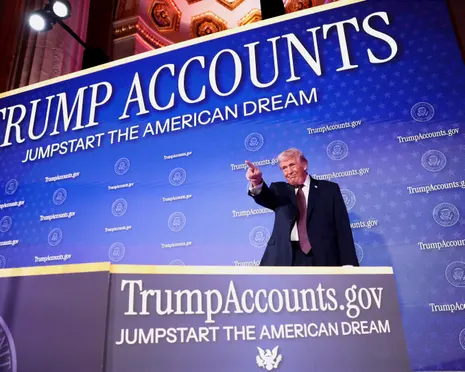
Trump accounts – On Saturday, a groundbreaking savings initiative called the ‘Trump accounts’ will officially launch, offering American families a new way to invest in their children’s future. This program, backed by prominent financial institutions, is designed to channel savings into diversified investment vehicles managed by major Wall Street firms. The initiative targets children born between January 2025 and December 2028, coinciding with the majority of the president’s second term. Federal authorities will deposit $1,000 into each child’s account at birth, creating an initial financial foundation to support long-term growth and stability.
Parents, friends, and employers can contribute up to $5,000 annually to these accounts, pooling resources for educational, housing, or entrepreneurial purposes. The program’s rollout aligns with the upcoming November midterm elections, where Republicans aim to solidify their congressional majority. This strategic timing positions the ‘Trump accounts’ as a platform to showcase economic progress and address concerns about the administration’s fiscal policies. The initiative also reflects a broader effort to engage families in intergenerational financial planning.
Symbolism and Institutional Foundations
The ‘Trump accounts’ serve as both a financial tool and a symbolic link to the 250th anniversary of American independence, celebrated on Saturday. This connection reinforces the president’s personal brand while embedding the program in a patriotic narrative. To formalize participation, the IRS requires parents to file form 4547, a reference to Trump’s political legacy as the 45th and 47th president. This step ensures the accounts are properly documented and aligned with the One Big Beautiful Bill Act, a cornerstone of Trump’s second-term domestic agenda.
Under the One Big Beautiful Bill Act, funds in these accounts will remain under parental control until the child turns 18. At that stage, the money will transition to the child, empowering them to use it for specific life goals such as higher education, homeownership, or business ventures. This structure emphasizes long-term planning and the role of guardians in managing financial resources for the next generation. The accounts are part of a larger push to modernize savings programs for American families.
Investment Vehicles and Accessibility
The program’s financial framework relies on Wall Street indices, with the U.S. Treasury specifying that initial deposits will be invested in a fund managed by State Street, a leading asset management company. This default option tracks the S&P 500 index, a standard benchmark for market performance. The Treasury has also partnered with BlackRock and Vanguard to introduce additional investment choices, expanding the range for families. These partnerships aim to balance growth potential with accessibility for individuals unfamiliar with complex financial markets.
A mobile application will further enhance the program’s usability, developed in collaboration with Bank of New York Mellon and Robinhood. The app allows users to monitor their accounts, make contributions, and track investment progress. This digital integration is intended to simplify the process for a broader audience, particularly families seeking to build long-term financial security. By leveraging technology, the ‘Trump accounts’ seek to make saving for children’s futures more intuitive and inclusive.
Support from Wealthy Donors
The initiative has received significant backing from high-profile billionaires. Michael Dell and Susan Dell, founders of Dell Technologies, pledged $6.25 billion to add $250 to 25 million accounts for children in underserved regions. Similarly, Ray Dalio and Barbara Dalio contributed funds to benefit over 300,000 children in Connecticut. These donations highlight a commitment to expanding the program’s reach and ensuring equitable access for all families. The financial support underscores the ‘Trump accounts’ as a collaborative effort between government and private sectors.
While the ‘Trump accounts’ are framed as a progressive savings tool, their political implications are evident. Republican lawmakers have rebranded the One Big Beautiful Bill Act as the ‘Working Families Tax Cuts Act,’ positioning it as a measure to reduce tax burdens. However, recent surveys indicate public skepticism about the president’s economic management, with two-thirds of respondents disapproving of his handling of the economy. The success of the ‘Trump accounts’ may depend on their ability to counter these perceptions and demonstrate tangible benefits for American families.