Air Quality Plummets in 20 US States as Canadian Smoke Spreads
Air quality plummets in 20 US states as a massive smoke cloud from Canadian wildfires drifts across the nation. Over 180 active fires in northern Ontario are generating hazardous conditions for millions of residents. Additional blazes in south-central Canada and Minnesota are intensifying the dense haze. This atmospheric disturbance has triggered warnings in more than twenty states, with experts predicting unhealthy conditions will persist through the week. According to IQAir global rankings, the smoke reached Chicago on Thursday evening, temporarily making it the city with the poorest air quality on the planet. Detroit and Minneapolis followed closely as the pollution plume moved eastward.
Urban Centers Under Siege
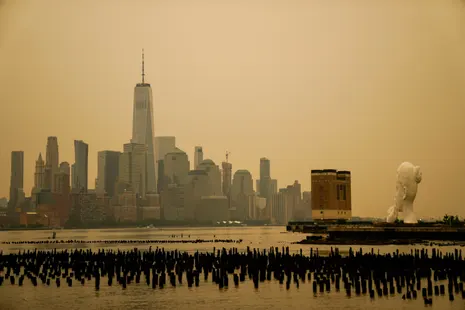
The smoke has blanketed skies from Minnesota to New York, significantly reducing visibility and worsening respiratory conditions. In New York City, the atmosphere took on a distinct orange hue, and the air carried an acrid scent that prompted local authorities to issue immediate advisories. Residents were encouraged to minimize time spent outdoors, particularly those belonging to vulnerable demographics such as the elderly, pregnant individuals, and people suffering from heart or lung diseases.
Zohran Mamdani, the mayor of New York City, addressed the public during a gathering on Thursday, emphasizing the severity of the situation. He stated,
Today is expected to be the worst day of this event.
Mamdani further clarified that at these elevated levels, health impacts are not limited to those with pre-existing conditions like asthma.
Everyone may feel health effects. So today, every New Yorker should take precautions.
Regional Air Quality Breakdown
The National Aeronautics and Space Administration (NASA) provided meteorological context, noting that winds transported the smoke primarily southeast across the southern portion of Ontario, as well as into parts of Quebec and the northeastern and midwestern United States. This movement resulted in skies tinted with shades of gray and yellow, while the sun appeared orange in many affected regions. As of Thursday, official alerts were active in North Carolina, Minnesota, Vermont, Connecticut, New York, Massachusetts, Rhode Island, New Jersey, New Hampshire, Pennsylvania, Illinois, Indiana, Ohio, Delaware, West Virginia, Colorado, Virginia, Maryland, Washington DC, Michigan, and Wisconsin.
Data from the US Environmental Protection Agency indicated that air quality reached “unhealthy” levels on Thursday in several key areas, including Pennsylvania, Delaware, New Jersey, New York, Ohio, and Michigan. Officials in these regions advised residents to reduce outdoor activities. By Thursday afternoon, conditions deteriorated further in certain zones. Parts of Pennsylvania, New York, Ohio, Michigan, Illinois, Wisconsin, Minnesota, and Indiana saw ratings of “very unhealthy.” In specific pockets of Pennsylvania and Michigan, particularly near Detroit, along with areas in Ohio, Illinois, Wisconsin, and Minnesota, the air quality was classified as “hazardous,” prompting strong recommendations for residents to remain indoors.
New York State Mobilizes Resources
In response to the compounding threats of heat and smoke, New York officials extended the city’s heat emergency plan operations. This included the activation of hundreds of cooling centers to protect citizens as high temperatures and heat indices continued alongside the incoming smoke from western Ontario. Kathy Hochul, the governor of New York, announced that more than 100,000 N95-style masks were being distributed to counties in need. Additional supplies were made available for commuters at major transit hubs, including Penn Station and Grand Central Terminal.
Local authorities warned that this occurrence could become New York City’s most significant smoke event since 2023. During that previous incident, Canadian wildfires pushed air quality to hazardous levels and covered the city in a thick orange haze. While current conditions do not yet signal a repeat of those peak levels, authorities remain vigilant and are closely monitoring for any potential deterioration. Weather officials in New York City confirmed on Thursday that wildfire smoke would continue to lower visibility and degrade air quality through the evening.
Weather Outlook and National Context
The air quality alert for New York remains valid until midnight on Thursday. Forecasters anticipate rain arriving on Saturday, which could help clear the skies ahead of Sunday’s highly anticipated World Cup final taking place in New Jersey. In Buffalo, New York, the air quality was projected to remain unhealthy through the weekend, with residents advised to keep windows closed and use air purifiers if available. The combination of heat and smoke creates a dual threat that public health officials are tracking closely across the affected regions.