
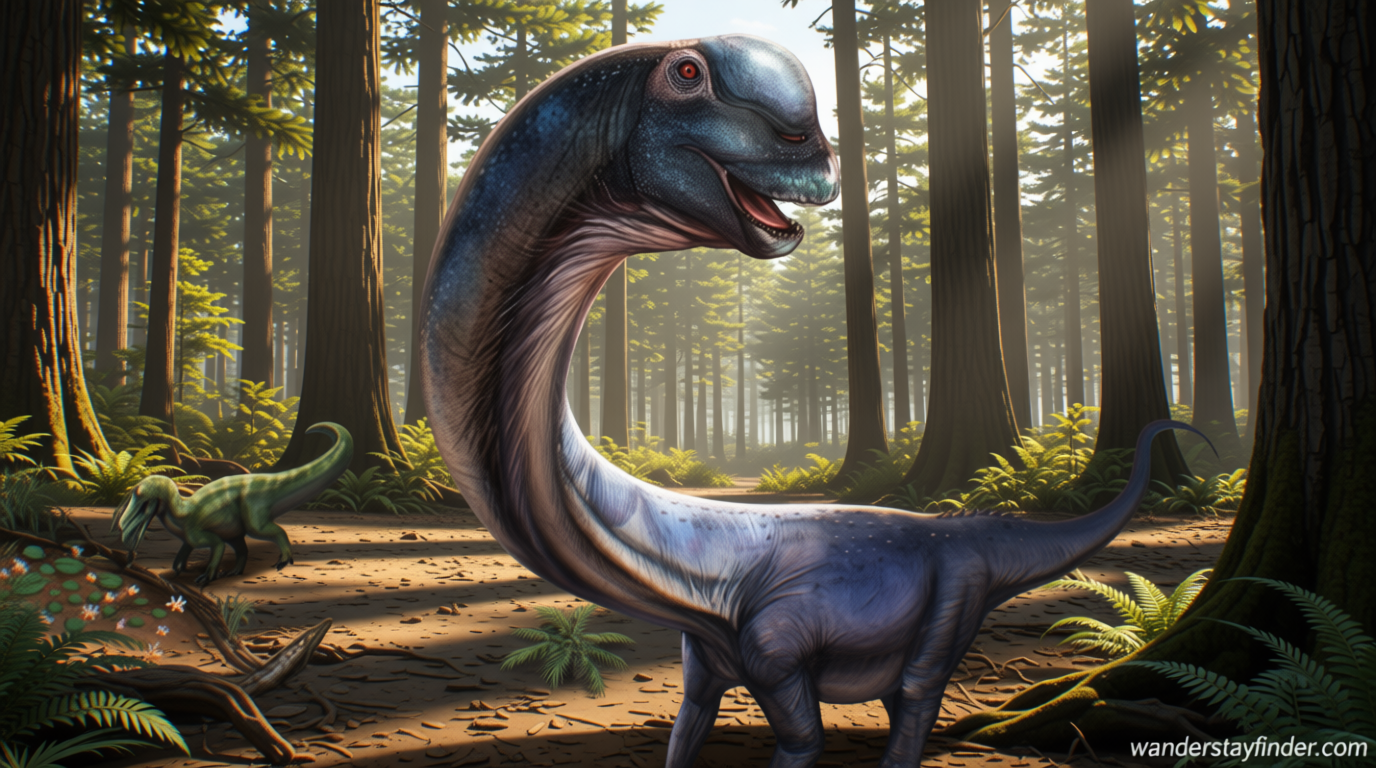
New Species of Giant Dinosaur Identified from Thailand Fossils
New species of giant dinosaur identified – In 2016, a local resident stumbled upon bones near a communal pond in northeastern Thailand, initiating a scientific journey that spanned nearly a decade. These fragments, unearthed during the dry season when water levels receded, eventually led to the classification of a previously unknown dinosaur species. Researchers from Thailand and London have named this colossal creature “Nagatitan chaiyaphumensis,” marking a significant milestone in paleontology. The discovery highlights a rare find in Southeast Asia, as this species is the largest dinosaur ever documented in the region.
Dimensions and Classification
The newly identified sauropod is estimated to have reached lengths of about 27 meters, or roughly 89 feet, and weighed approximately 27 metric tons—equivalent to nearly 60,000 pounds. This places it among the most massive terrestrial animals in history, rivaling the iconic Brontosaurus and Diplodocus. According to a study published in the journal Scientific Reports on Thursday, the dinosaur’s size surpasses that of many well-known species. For comparison, a large Tyrannosaurus rex typically measured over 12 meters in length and weighed between 9,000 and 15,000 pounds, making Nagatitan nearly double the length and weight of its carnivorous counterpart.
Belonging to the sauropod group, Nagatitan was a herbivore with a long neck and tail, supported by robust legs and a torso designed for holding a large gut. These features are characteristic of sauropods, which dominated prehistoric landscapes with their immense stature. The creature’s front leg bone, or humerus, measured 1.78 meters in length—almost six feet—revealing its extraordinary size. Lead researcher Thitiwoot Sethapanichsakul, a PhD student at University College London, described the humerus as “taller than me” when first examined, emphasizing its surprising scale.
Discovery Process and Team Efforts
The excavation process involved multiple stages, beginning with the initial discovery of the humerus in 2016. Over the next three years, additional skeletal remains were uncovered through fieldwork in the same area. The 2024 excavation phase provided critical insights, with 3D scans of the leg bones, spine, ribs, and pelvis enabling detailed analysis. These findings confirmed the existence of a unique species, underscoring the collaborative efforts of scientists from UCL, Thailand’s Department of Mineral Resources, Mahasarakham University, and Suranaree University of Technology.
Sethapanichsakul, whose home country is Thailand, expressed personal pride in the achievement. “It fulfills a kind of childhood promise,” he said, reflecting on his desire to name a dinosaur from his native land. The naming process itself is rich in cultural significance, blending mythological elements with scientific accuracy. The term “naga” references a traditional serpent from South and Southeast Asian folklore, a fitting choice given the dinosaur’s discovery near a pond. “The Nagas are often associated with water, and considering the dinosaur was found on the side of a communal pond, it just seemed very apt to have a serpent giant be the name,” he added.
Historical Context and Ecological Setting
The Nagatitan is believed to have thrived during the late Early Cretaceous period, around 120 to 100 million years ago. This era was marked by a warm, arid climate, which shaped the ecosystems the dinosaur inhabited. The site where the fossils were found is thought to have been part of a meandering river system teeming with freshwater fish, sharks, crocodiles, and turtles. Sethapanichsakul noted that this environment would have provided ample vegetation for the herbivorous sauropod, supporting its dietary needs.
Thailand’s fossil diversity is a key factor in this discovery. Sethapanichsakul highlighted the country’s rich geological history, pointing to sedimentary rocks from the Mesozoic Era—spanning 252 to 66 million years—as a critical resource. “These rocks are exposed to less rain and vegetation, which could end up eroding or destroying those bones,” he explained, suggesting that the preservation of such fossils is uncommon in the region. This makes each find invaluable for reconstructing prehistoric life.
Cultural and Scientific Impact
The name “Nagatitan chaiyaphumensis” not only honors the mythological roots of Southeast Asia but also ties to the specific location of its discovery. The “chaiyaphumensis” part of the name refers to the Thai province where the fossils were unearthed, adding a geographical layer to the species’ identity. Sethapanichsakul emphasized the importance of local contributions to global science, stating, “We don’t have a lot of specimens that are of that scale in Thailand.” His work continues to focus on sauropods in Southeast Asia, with a research center established at the discovery site to further study the region’s prehistoric heritage.
The unveiling of Nagatitan has sparked renewed interest in the biodiversity of the area. The creature’s existence challenges previous assumptions about the size and distribution of sauropods in Southeast Asia, offering new evidence for their ecological roles. Researchers speculate that Nagatitan coexisted with smaller, medium-sized plant-eating dinosaurs, such as Iguanodons, and early relatives of Ceratopsians—cousins of the famous Triceratops. This suggests a complex ecosystem with a variety of herbivorous species.
Further analysis of the fossils, including their anatomical structure and geological context, has provided insights into the creature’s habitat and behavior. The presence of a river system and aquatic life at the site implies that Nagatitan may have spent time near water sources, possibly foraging or drinking. The discovery also adds to the broader debate about the evolution and adaptation of sauropods in different environments, offering a unique case study for scientists.
Future Prospects
With the establishment of a dedicated research center, the study of Nagatitan and its relatives is expected to accelerate. Sethapanichsakul, who remains active in the field, aims to uncover more about the sauropod lineage in Southeast Asia. The findings may also influence future excavations, as the site’s potential for additional fossils grows. A life-sized reconstruction of Nagatitan is currently on display at the Thainosaur Museum in Bangkok, allowing the public to visualize the creature’s immense form and its place in ancient history.
This discovery underscores the importance of preserving and studying fossil sites, particularly in regions with unique geological conditions. The collaborative effort between Thai and international researchers highlights how global scientific partnerships can lead to groundbreaking revelations. As more data becomes available, the story of Nagatitan may reshape our understanding of dinosaur evolution in Asia and its connection to broader paleontological narratives.





