
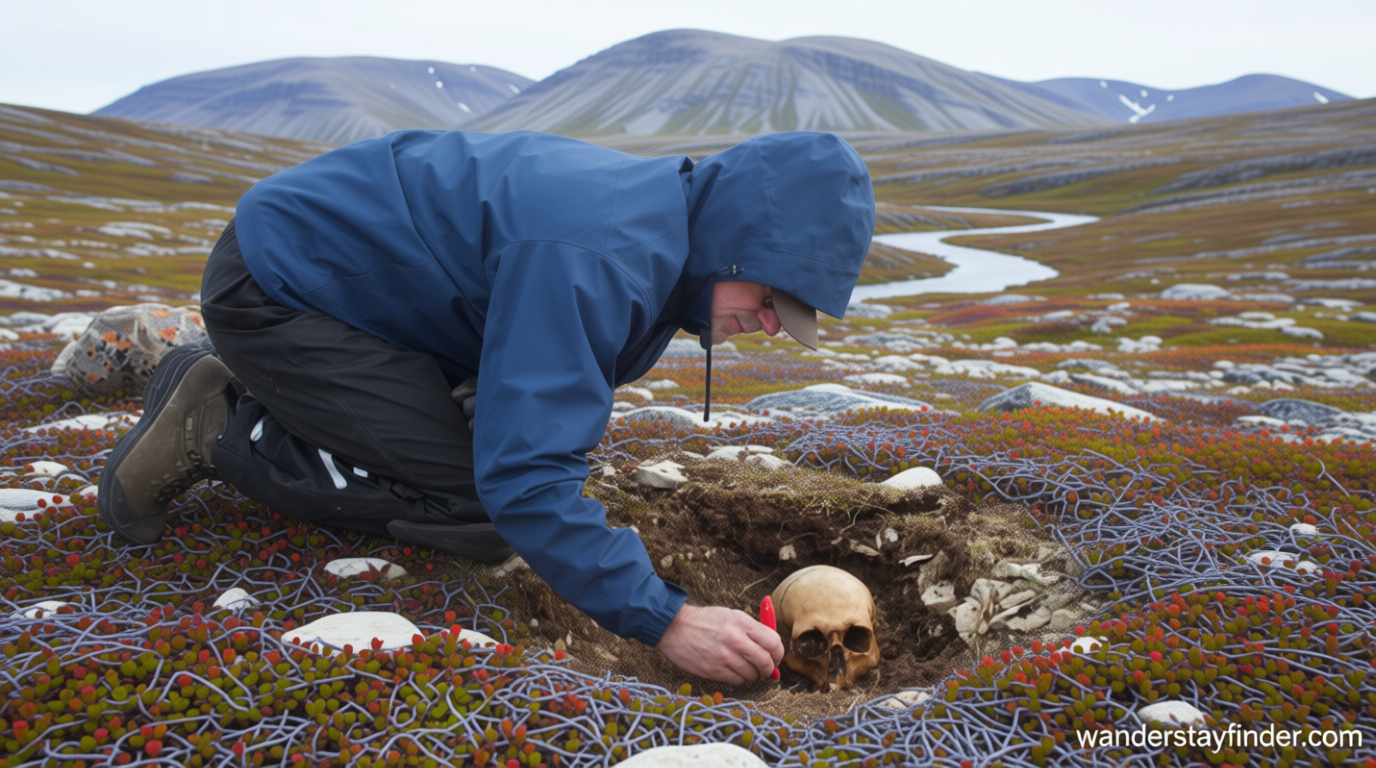
DN**A reveals identities of 4 sailors from doomed 1845 Franklin expedition
A Tragic Journey into the Arctic
DNA reveals identities of 4 sailors – The 1845 Franklin expedition, an ambitious British polar venture, aimed to chart the Northwest Passage—a hypothetical sea route through the Arctic Ocean that would link the Atlantic and Pacific via the northern reaches of Canada. Led by Sir John Franklin, the mission carried 129 men in two ships, the HMS Erebus and the HMS Terror, with hopes of revolutionizing trade by offering a shortcut between Europe and Asia. However, the expedition became a harrowing tale of survival and despair, as the crew faced extreme cold, dwindling supplies, and the ever-present threat of starvation. After becoming frozen in Arctic ice for nearly two years, the men were forced to abandon their vessels in April 1848, embarking on a perilous overland journey across King William Island. Despite their efforts, all 105 remaining sailors perished, leaving behind a legacy of mystery and unanswered questions.
Among the relics of this doomed voyage, researchers have recently uncovered the identities of four crew members through an innovative approach involving DNA analysis and living descendants. This breakthrough, achieved by a team based at the University of Waterloo and Lakehead University in Ontario, has not only identified specific individuals but also resolved a long-standing confusion about their roles. The findings, published in a recent study, mark a significant step forward in understanding the final days of the Franklin expedition.
The Genetic Breakthrough
For over a century and a half, the remains of the Franklin crew lay scattered across King William Island and the Adelaide Peninsula, their identities obscured by time and the harsh elements of the Arctic. While rescue teams and subsequent archaeologists had unearthed artifacts and bones, connecting fragments to specific individuals proved elusive. The breakthrough came when researchers began comparing DNA from the remains with genetic profiles of living descendants, a method that has now allowed them to pinpoint the identities of four sailors with remarkable accuracy.
Of the four confirmed, two were already known to history: John Gregory, the engineer aboard the Erebus, and James Fitzjames, the ship’s captain, whose bones showed signs of cannibalism. The remaining two—recently identified—were previously attributed to other crew members, creating a case of mistaken identity that has now been corrected. The team’s work, which combined traditional archaeological methods with cutting-edge genetics, has provided a clearer picture of who perished and how their stories were pieced together.
Dr. Douglas Stenton, the lead author of the study and an adjunct professor of anthropology at the University of Waterloo, emphasized the significance of this genetic approach. “We are trying to add more pieces to the puzzle, the genetic side of it, since it hadn’t been done before,” he explained. “It’s opening up a new chapter in the story of the Franklin expedition, and something that I like about this is that chapter is helping to be written by the families of the men who never made it home.” This collaboration between scientists and descendants has transformed the search for answers, turning the remains of the past into a tangible link to the present.
Connecting Past and Present
The process of identification began with the careful examination of the remains, focusing on age, sex, and health markers. Once these details were established, the team selected the most promising bones and teeth for DNA analysis at the Paleo-DNA Laboratory in Thunder Bay, Ontario. By comparing the genetic data to living relatives, they were able to match the remains to individuals with a direct lineage, ensuring that the identities of the sailors were confirmed with scientific rigor.
The identification of three additional Erebus crew members and one Terror sailor has deepened the understanding of the expedition’s composition. For example, the remains of the Terror sailor, found in 2016, were accompanied by documents that had puzzled researchers for decades. These records, which hinted at the man’s role in the mission, were finally deciphered through genetic analysis, linking him to his family tree. “We had to track down people who were directly related to a member of the Franklin expedition with an uninterrupted inheritance of DNA from one generation to the next,” Stenton noted. This meticulous effort has turned the scattered bones into stories of real individuals, their sacrifices now acknowledged with greater clarity.
Stenton’s journey into the Franklin expedition began in 2008 as the director of heritage for Nunavut’s government, where he played a key role in coordinating the search for the Erebus and Terror wreck sites. Using a blend of sonar technology and oral traditions from the Inuit community, the team located the Erebus in 2014 and the Terror in 2016. These discoveries were pivotal, as they provided not only the physical evidence of the crew’s fate but also the context needed to interpret the remains. Over the years, Stenton and his colleagues mapped the sites using photography and lidar, a method that allowed them to create detailed 3D models of the wreckages and surrounding areas.
“Once you get hooked by the Franklin expedition, you want to keep going back to try and find as many more pieces of the puzzle as possible that you can,” Stenton said. The team’s efforts extended beyond identification, as they collected artifacts for conservation and study. These items, often overlooked in their original state, were preserved to ensure they could be analyzed for further clues about the expedition’s final days. The researchers were granted permission in 2013 to examine the remains, which has allowed them to conduct a comprehensive study of the crew’s physical and genetic characteristics.
An Arctic Shipwreck ‘Frozen in Time’
The Erebus and Terror, now resting beneath the icy waters of the Arctic, were once symbols of human ambition and exploration. Their discovery in 2014 and 2016, respectively, has offered a rare glimpse into the past, as the ships were “frozen in time” by the relentless ice. The remains of the sailors, preserved in the permafrost, have provided critical evidence about the conditions they endured. The DNA analysis has not only identified individuals but also shed light on the genetic diversity of the crew, potentially offering insights into their health and resilience in the extreme environment.
Stenton’s work highlights the importance of integrating modern science with historical research. By leveraging genetic data, the team has bridged the gap between the fragmented remains and the living descendants, creating a narrative that spans generations. This approach has also allowed researchers to explore the broader implications of the expedition, such as the role of cannibalism and the challenges of survival in the Arctic. As more descendants share their DNA, the study continues to uncover new details, bringing the stories of the Franklin crew closer to the surface.
While the DNA breakthrough has resolved some of the mysteries, it has also raised new questions. Researchers are now focused on understanding what caused the crews to desert their ships and how they managed to survive for months before succumbing to the elements. The ongoing collaboration with families of the sailors has proven invaluable, as their knowledge of ancestral histories provides critical context for the genetic findings. “We wanted to think about how we might be able to contribute to work that others had done before us,” Stenton said. “Something that hadn’t been done was genetic analysis to see if we could identify who these men were. We know who was on the ships, but these are not complete skeletons. These are scattered bones.”
As the Franklin expedition’s story continues to unfold, the role of DNA analysis has become central to unlocking its secrets. The identification of four sailors, and the potential for more, offers a unique opportunity to connect the past with the present. The remains, once mere fragments, now represent individuals with distinct lives and legacies. Through this work, researchers not only honor the bravery of the Franklin crew but also contribute to a deeper understanding of polar exploration and its challenges. The Arctic, with its frozen relics, remains a testament to human perseverance and the enduring quest to uncover the truth behind one of history’s most enigmatic tragedies.





