
Saying ‘Screw You’ Through Architecture: America’s Spite Houses
A Bold Statement in Paint
Saying screw you through architecture – Aaron Jackson’s journey into the world of spite architecture began with a whim. While exploring Google Earth during a quiet moment in his Queens apartment, he stumbled upon the Westboro Baptist Church in Topeka, Kansas. Intrigued by the group’s reputation for extremist views, he noticed a “for sale” sign near their property. The idea struck him: what if he could turn that into a symbol of defiance? With a sense of humor and a touch of rebellion, Jackson decided to purchase the house, unaware it was no longer available. Undeterred, he found a replacement on the same street and moved in, setting up a direct confrontation with the church.
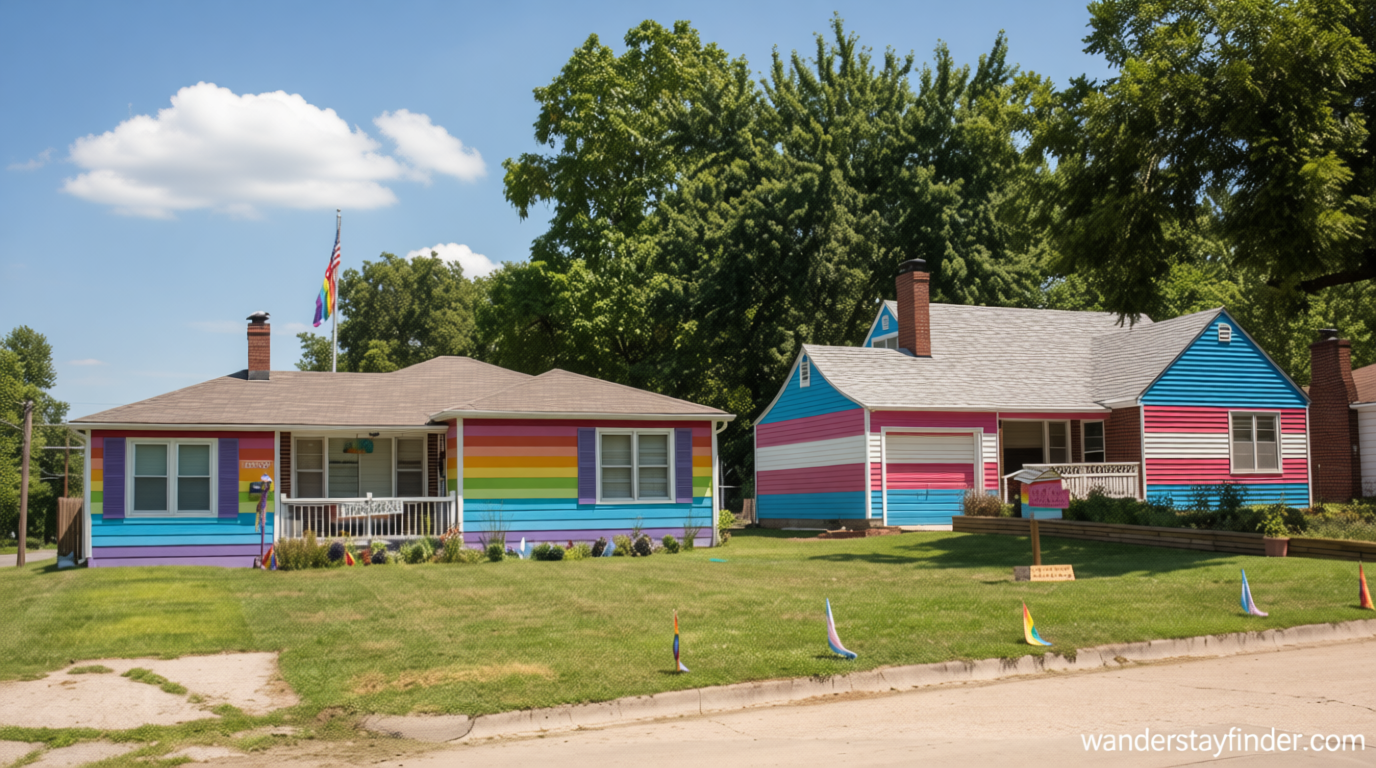
His new home, painted in vibrant rainbow stripes, stood as a visual rebellion against the Westboro Baptist Church’s anti-LGBTQ+ messages. The act wasn’t just about aesthetics—it was a calculated move to challenge the church’s influence. “I thought people would see a photo, laugh, and forget,” he recalls. Instead, the house became a focal point of public discourse. Its rainbow colors mirrored the Pride flag, a deliberate contrast to the anti-gay slogans the church displayed. Jackson’s home, dubbed the Equality House, became a living manifesto of resistance, drawing both admiration and ire.
“The Equality House is a symbol of compassion, peace, and positive change,” states the Planting Peace organization’s website. Yet its proximity to the Westboro Baptist Church has sparked debates about whether it qualifies as a “spite house.”
While Jackson himself avoids the term, the house’s location—directly facing the church’s windows—has made it a prime example of spite architecture. This form of design, often dismissed as a niche phenomenon, has roots in American history. It’s a unique blend of individualism, property rights, and a desire to assert dominance over neighbors. Unlike the more famous “nail” houses, which are held out by owners to resist development, spite houses are built to irritate or challenge someone specific. Their presence is both a statement and a statement of defiance.
From Pickets to Paint Stripes
The Westboro Baptist Church, known for its provocative pickets at military funerals and anti-LGBTQ+ rhetoric, has long been a lightning rod for controversy. Jackson’s decision to live next door was a way to inject a counter-narrative into the church’s aggressive presence. “I wanted to show that even in the face of hate, there’s space for hope,” he says. The house’s rainbow facade, which he painted without prior consultation, was meant to provoke thought and spark conversation. It became a backdrop for spontaneous protests, a reminder of the clash between tradition and modernity.
Topeka’s strategic location along Interstate 70—a major east-west artery—adds another layer to the story. The city, with its population of roughly 125,000, is a hub for travelers and a symbol of accessibility. Jackson’s Equality House, perched just off the highway, became a microcosm of this broader cultural tension. Its visibility ensured that anyone passing through the area would see it, making it a constant reminder of the church’s influence and the home’s purpose as a symbol of resistance.
History of Spite Architecture
Spite architecture is not a new concept, though its modern iterations often capture public attention. The term itself has roots in the 19th century, with early examples including homes built to block sunlight from neighboring properties. However, the most iconic example is Boston’s “Skinny House,” a narrow structure that rose from the city’s North End in the mid-1800s. The house, located on 44 Hull Street, was constructed by a brother who felt wronged after his sibling received a larger portion of a land plot during the Civil War. In retaliation, he built a 10-foot-wide, four-story building that overshadowed his brother’s grand mansion, effectively cutting off light and views.
Today, the Skinny House is labeled as a “spite house” on Google Maps, a designation that reflects its historical significance. Despite its diminutive size, it has become a tourist spot in a neighborhood dotted with landmarks like the Old North Church and Paul Revere’s statue. Visitors often pose in front of it, stretching their arms between the house and its neighbor, capturing the essence of its purpose. Yet, the house’s 2021 sale for $1.25 million reveals an unexpected twist: even in the face of defiance, the market often rewards spite.
Spite houses, like the Equality House, are more than just property disputes—they’re social experiments. While the Skinny House was a product of personal grievance, Jackson’s home was a proactive statement. The two are connected by a common thread: the use of architecture to challenge or provoke a specific entity. In Jackson’s case, the challenge was ideological, while in Boston’s example, it was personal. Both, however, highlight how architecture can be a tool for expression, sometimes with unintended consequences.
The Debate: Hostile Architecture and Its Impact
The concept of hostile architecture has gained traction in recent years, sparking debates about its role in shaping urban spaces. While some argue that it’s simply a way to assert property rights, others see it as a means of excluding or discomforting people. Jackson’s Equality House, though not explicitly hostile, sits at the intersection of this discussion. Its presence near the Westboro Baptist Church amplifies its symbolic value, turning a private residence into a public statement.
But is this the same as hostile architecture? The term usually refers to design choices that aim to deter people from using a space—think of benches with narrow seats to prevent sitting, or curbs that make wheelchairs difficult to navigate. Spite houses, on the other hand, are more about confrontation than exclusion. They’re built to irritate, to make a point, and to stand as a visible act of defiance. The Equality House, with its bold colors and strategic placement, does exactly that. It’s not just a house; it’s a statement, a monument to the power of design in shaping perceptions.
Despite the controversy, Jackson’s project has inspired others to use architecture as a tool for social change. His nonprofit, Planting Peace, has launched initiatives ranging from orphanages to elephant rescue efforts, but the Equality House remains its most recognizable symbol. The house’s impact extends beyond its immediate neighbors—it has become a rallying point for those who believe in the power of creative resistance. Yet, the debate continues: is it a form of activism, or does it simply highlight the tension between personal expression and communal space?
As cities evolve and spaces become more contested, the line between friendly design and hostile architecture grows thinner. Spite houses, like Jackson’s, are a reminder that architecture isn’t just about function—it’s about intention, symbolism, and the stories we choose to tell. Whether they’re seen as acts of defiance or simple acts of rebellion, these structures challenge the way we think about property, identity, and the spaces we inhabit. In the end, they are more than just buildings—they are living conversations, shaped by the people who live in them and the communities they affect.





