
The Middle of America: A Unique Place to Be
The middle is a unique place – Reaching the heart of the United States isn’t as simple as picking a random spot on a map. It requires a long, winding drive through landscapes that feel both expansive and intimate. This journey encapsulates the essence of the American road trip, where miles of unbroken asphalt and open skies create an atmosphere of discovery. Along the way, you’ll encounter towns that seem to hibernate under the weight of endless horizons, radio towers that hum with static, and a sense of solitude that stretches as far as the eye can see. But what lies at the end of this route is not just a destination—it’s a place that defies expectations and offers a unique perspective on the nation’s soul.
Debating the Geographic Center
For centuries, the notion of America’s geographic center has been a subject of debate. Some argue it lies in the cultural middle of the country, encompassing the everyday lives of those living between New York and Los Angeles. Others claim it’s a physical point, one that shifts depending on the boundaries of the nation. When Alaska and Hawaii were admitted into the Union in 1959, the calculation became even more complex. The US Department of the Interior once noted,
“There is no generally accepted definition of geographic center, and no completely satisfactory method for determining it.”
This lack of consensus has led to a patchwork of contenders, with the center often found in the Dakotas or northern Kansas. Yet, for a time, there was a clear answer—one that emerged from a surprisingly simple experiment.
Back in the early 1900s, before the nation expanded to its current size, experts devised a method that felt almost whimsical. By cutting out a cardboard map of the contiguous states and balancing it on the tip of a pin, they pinpointed a location that became symbolic of the country’s core. This point, just outside the small town of Lebanon, Kansas, sparked a quiet but persistent interest. For decades, the area surrounding it thrived on this singular designation, transforming a plain agricultural community into a destination that drew curiosity seekers and road trippers alike.
A Journey Through Time
The drive to this midpoint is as much about the experience as it is about the destination. Starting near Kansas City, the route westward takes you past Topeka, where a historical marker notes that the next eight miles mark the first section of US interstate highway. This stretch, opened in 1956, was a testament to President Eisenhower’s vision of connecting the nation through infrastructure. Yet, even as it symbolized progress, it also offered a glimpse into the quiet beauty of rural Kansas, where the land rolls and rises in a rhythm that feels untouched by time.
As the road veers deeper into the heart of the state, you’ll pass through the town of Manhattan—known as “the Little Apple”—and then Clay Center, which claims to be the halfway point between New York and Los Angeles. These stops are more than just milestones; they’re portals to a bygone era. Small communities with red-sided barns, grain elevators, and shuttered gas stations dot the landscape, each with its own story. The air is thick with the scent of wheat fields, and the silence between towns is broken only by the occasional hum of a truck or the rustle of wind through the tall grass.
The World’s Largest Ball of Twine
Just 25 minutes from the geographic center, the town of Cawker becomes a curious footnote in the story of Middle America. Its claim to fame rests on a seemingly odd attraction: a massive ball of twine that sits in a gazebo beside Route 24. According to the town’s signage, this colossal sphere is made from over 8,500,000 feet of sisal string, weighing more than 27,000 pounds. It was created in 1953 by local farmer Frank Stuber, who began the project as a hobby and eventually turned it into a national phenomenon. By 1961, the ball had been displayed publicly, and by 1982, it had secured its title as the world’s largest.
Today, the twine ball is more than just a quirky landmark—it’s a symbol of community and ingenuity. Even the town’s water tower, a prominent structure in Cawker, is adorned with twine, reflecting the local pride in this eccentric creation. Visitors to the town often describe the experience as both surreal and heartwarming. The air carries a faint aroma of string, and the act of adding one’s own length to the ball feels like a small but meaningful contribution to the town’s legacy. The visitor book, filled with names from all over the world, tells a story of connection and shared wonder.
A Sense of Place
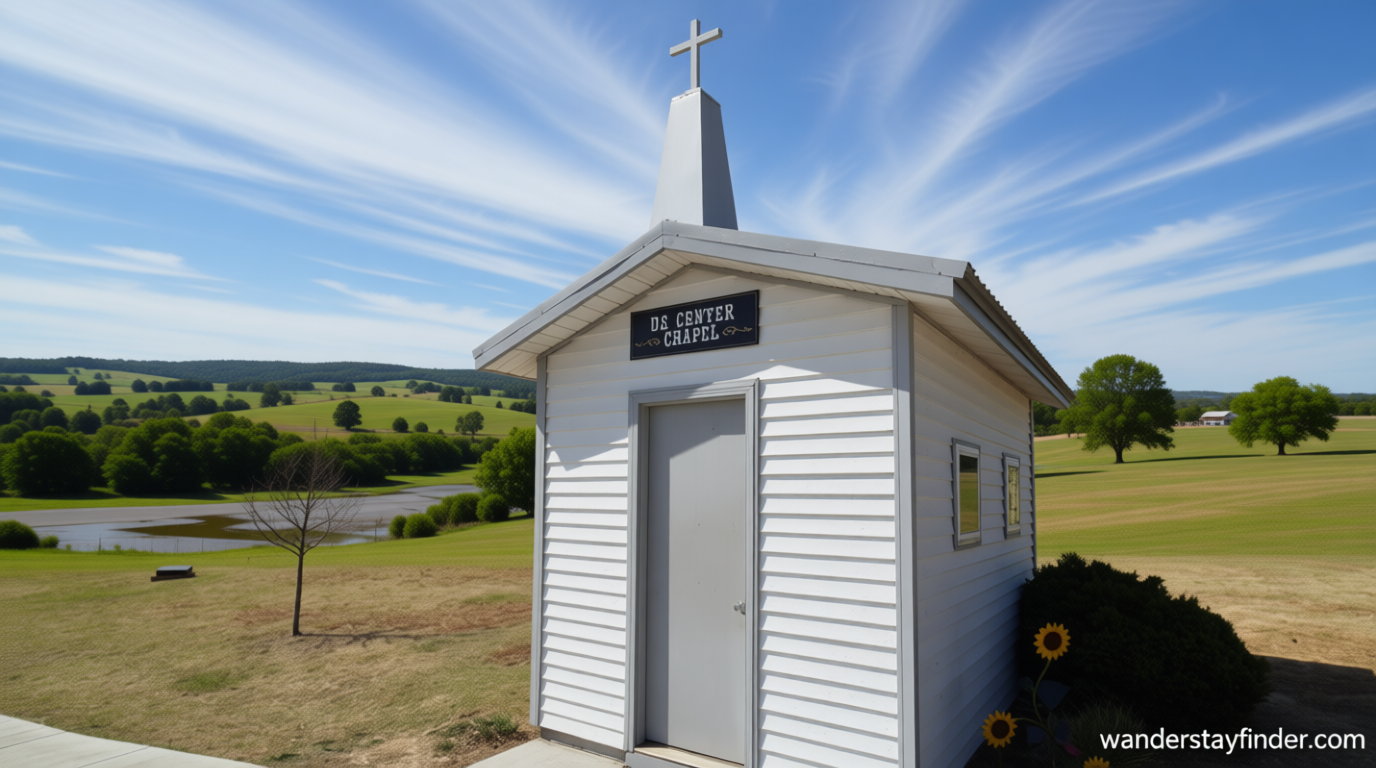
While the geographic center of the lower 48 states might seem arbitrary, the spot in northern Kansas evokes a profound sense of place. The location, once determined by a cardboard map and a pin, was later adjusted slightly to avoid being on private property. Yet, this change has done little to diminish its charm. A small, white one-room chapel sits nearby, surrounded by a stand of pine trees that offer a quiet contrast to the open plains. The town itself is modest, but its significance is undeniable. For those who have romanticized the American heartlands, this place feels like a homecoming.
Traveling to the middle of America is not just about reaching a physical point—it’s about embracing the spirit of the journey. The roads, the landscapes, and the communities along the way all contribute to a sense of discovery. Whether it’s the historical marker near Topeka, the quiet dignity of rural Kansas, or the whimsical charm of Cawker’s twine ball, the experience is one that lingers long after the trip ends. It’s a place where the nation’s vastness meets its intimacy, and where the American dream is not defined by skyscrapers or bustling cities, but by the simplicity of a town that chose to be at the center of it all.
As the sun sets over the horizon, casting long shadows across the fields, the atmosphere of the area feels both timeless and alive. The changing weather, the rhythmic sounds of nature, and the presence of the twine ball all add to the unique character of this spot. It’s a reminder that the heart of the United States is not just a location on a map, but a living testament to the country’s spirit. And for those who make the trip, it’s a journey that rewards with more than just a destination—it offers a deeper understanding of what it means to be in the middle of America.





