About 400,000 UK Children Supported by Baby Banks, Up 11% on Previous Year
About 400 000 UK children supported – According to recent data, nearly 400,000 children across the United Kingdom received assistance from baby banks in 2025, marking an 11% rise compared to the prior year. This increase has raised concerns among charitable organizations, which are now urging the government to provide critical support to sustain these efforts. The Baby Bank Alliance, a coalition established by Save the Children UK to represent over 400 such networks nationwide, reported that each of its members averages 1,096 children in need daily, with essential items seeing heightened demand.
The report highlights a 26% surge in the distribution of baby formula, alongside a notable uptick in requests for cots and beds. These findings come against the backdrop of a record 4.5 million children living in poverty across the UK, a figure that underscores the growing challenges faced by families. The government’s decision to eliminate the two-child benefit limit—formerly restricting universal credit to the first two children—has been seen as a modest step, yet charities argue it is only the starting point for a more comprehensive strategy.
Systemic Pressures Exposed by Baby Bank Data
Sophie Livingstone, the alliance’s chair, emphasized that the current situation reveals a deeper crisis. “The numbers are quite damning,” she remarked, noting that families require ongoing aid due to underlying systemic issues rather than one-time financial shocks. Over 75% of families using these services cite inadequate or unstable housing as a primary stressor, a point she expanded upon as the chief executive of Little Village, a London-based network of baby banks. “We frequently see families needing us to replace all their children’s clothing because the items have been damaged by mold,” she explained, illustrating the harsh realities of poverty in urban areas.
“Families are needing help for systemic reasons, not because there’s a one-off shock to their lives.”
Livingstone also highlighted the strain on nappy supplies, particularly larger sizes, which are often in short supply. “We never have enough large nappies,” she said, linking the demand to cramped living conditions, including temporary accommodations. “My assumption is that it takes children longer to potty train when they’re in such situations,” she added, pointing to the interconnectedness of housing and child welfare.
The alliance is now advocating for the government to take more decisive action. “Charities alone can’t keep absorbing this level of poverty’s effects,” Livingstone stressed. “It’s time for policy changes that address the root causes of hardship in early childhood.” She described the current system as a temporary fix, stressing the need for long-term solutions to ensure stability for vulnerable families.
A Community Hub in Manchester
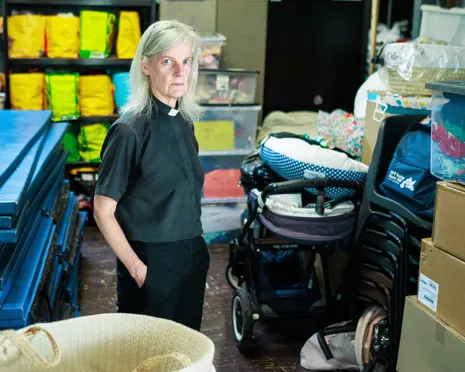
At the Little Lighthouse baby bank in Wythenshawe, Manchester, housed in a church hall, toddlers engage in playful activities while parents observe nearby. The space offers a range of goods—clothes, books, toys, and other necessities—many displayed on tables for easy access. Certain items, like nappies, toiletries, and baby formula for non-breastfeeding mothers, are distributed on a referral basis, reflecting the increased need for these essentials.
Laura, a 39-year-old mother, has relied on the baby bank for nearly three years. “I planned to breastfeed, but I struggled to produce enough milk,” she recalled. “The midwife told me, ‘You’re going to have to use formula.'” She and her partner, Daniel, 46, first visited the facility when they were preparing for their first child. “We wanted to meet other parents expecting babies around the same time,” Laura said, highlighting the social support aspect of the service. Now, both volunteers at the bank, they have become advocates for its role in community life.
“We used to get milk and baby wipes from here,” Laura said. “It’s a brilliant thing, but the fact that people have to come because they can’t afford to get things for their children is really sad.”
Laura described the financial burden as “skyrocketing,” citing the rising costs of everyday items. Despite their efforts, the couple has chosen not to have another child, fearing the strain on their resources. “We wouldn’t want to have another child knowing we’d struggle financially,” she admitted, underscoring the difficult choices families are forced to make.
Broader Implications for Child Poverty
Outside of London and the southeastern regions, the need for baby banks is particularly acute in areas like the northwest. These networks serve as lifelines for families grappling with fluctuating income, housing insecurity, and escalating energy and food bills. “Baby banks are doing everything they can to provide a crucial safety net,” Livingstone noted. “But without stronger government intervention, they’ll be stretched to their limits.”
The Baby Bank Alliance’s findings align with broader discussions on child poverty, emphasizing that the issue is not just about immediate financial aid but systemic support. “The government needs to pull on some big levers to make life livable for all families,” Livingstone urged. Her comments reflect a call to action for policies that address the multifaceted challenges of poverty, from housing to childcare affordability.
As the number of children relying on these services continues to grow, the pressure on charities intensifies. “We know families are struggling more than ever,” she said, highlighting the interplay between economic hardship and the early years of a child’s life. With no end in sight to the crisis, the role of baby banks remains vital—yet their capacity is increasingly tested.
Despite the challenges, the presence of these community-driven initiatives offers hope. For Laura and her partner, the baby bank has been more than a resource—it has become a cornerstone of their support network. “It’s not just about getting supplies; it’s about connecting with others who are facing similar struggles,” she said. As the demand for these services expands, the question remains: how long can charities continue to fill the gap without broader, sustainable government action?