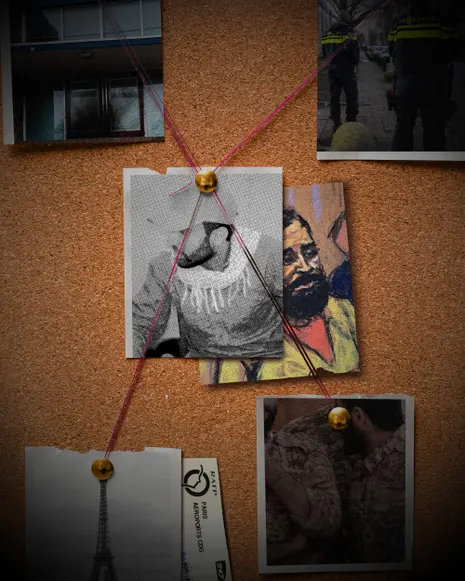
Could this one man have been behind terrorist attacks on Jewish communities across Europe?
Wanderstayfinder.com – In a dramatic courtroom scene in Manhattan, Mohammad Baqer Saad Dawood al-Saadi, a 32-year-old Iraqi national, stood before a judge and prosecutors, his disheveled appearance and beige prison overalls underscoring the gravity of his situation. He had just entered a plea of not guilty to a string of terrorism-related charges, a move that marked the beginning of a legal battle that could lead to life imprisonment. Yet, as he turned his gaze toward the court, al-Saadi’s voice carried a defiant edge. “I’m a prisoner of war,” he declared, “not a threat.” He added, “Children and women are being killed by your rockets.” His words, though brief, hinted at a broader narrative of conflict and retaliation that has gripped Europe in recent months.
The Shadow Campaign Begins
Al-Saadi’s alleged role in a series of coordinated attacks on Jewish communities has sparked intense scrutiny. According to legal documents and expert analyses, he orchestrated a “proxy campaign” that seemed to operate in the shadows, leveraging the chaos of geopolitical tensions. The campaign began with a series of clandestine messages posted on Telegram and Snapchat, which appeared to signal terrorist cells in Europe. These messages, cryptic yet precise, contained a code of three letters and nine numbers, possibly directing specific teams or individuals. Just 52 hours later, a makeshift bomb exploded outside a synagogue in Liège, Belgium, marking the first in a string of 18 attacks that would span several months and multiple countries.
The attacks targeted Jewish schools and places of worship, with the UK becoming a focal point. In Rotterdam, a synagogue was struck, while in Amsterdam, a Jewish school and a branch of the Bank of New York Mellon were both bombed. The violence eventually crossed the English Channel, with CCTV footage capturing three individuals setting ambulances ablaze in north London. Despite the lack of casualties, the attacks ignited widespread fear within a community already reeling from rising hostility and discrimination. Public and security officials expressed alarm, as the campaign’s rapid spread suggested a level of coordination previously unseen in Europe.
A Lone Figure Behind the Scenes
At the heart of this unfolding crisis was an organization that claimed responsibility for the attacks: Harakat Ashab al-Yamin al-Islamia (HAYI). Initially perceived as a new militant Islamist group, HAYI was later revealed to be a single individual—al-Saadi. Court records and investigative reports indicate that he directed the attacks from an office in Baghdad, effectively operating as a decentralized hub of operations. This revelation has raised questions about the evolving nature of terrorism, where a lone actor can wield the influence of a larger network without direct involvement from a formal group.
Al-Saadi’s background in Iraqi Shia militias adds another layer to his alleged role. He was recruited in his early 20s by a militia formed after the 2003 US-led invasion, an organization backed by Tehran. Over time, he was deployed to Syria to support Bashar al-Assad’s regime, where he gained experience in combat and strategic operations. However, his role in these conflicts remains unclear, though social media posts suggest he engaged in activities such as assassinations and abductions. His ability to navigate both military and civilian networks has made him a pivotal figure in the attack campaign.
Al-Saadi’s connections to high-ranking Iranian officials, particularly within the Revolutionary Guard Corps (IRGC), were central to his operations. The IRGC, a paramilitary force of Iran’s radical clerical regime, is known for its involvement in regional conflicts. His mentor, Qassem Soleimani, a legendary figure in Shia militant movements, played a critical role in shaping his tactics. Soleimani, the founder of the IRGC’s Quds Force, which handles overseas operations, was reportedly present when al-Saadi witnessed his death in a 2020 US drone strike in Iraq. This personal link has fueled speculation about the extent of his influence and the level of Iranian coordination in the attacks.
While some dismissed al-Saadi as Soleimani’s “brat,” his actions demonstrated a level of strategic acumen that could not be ignored. Over the years, he traveled extensively, using social media to maintain a public presence. His selfies in Paris and Malaysia, along with a 12-month Italian visa, suggest a network of contacts that extended beyond Iraq. These stamps in his “government service” passport revealed a trip to Spain in August 2023, further indicating his involvement in cross-border activities. Knights, an expert in Iraqi militias, noted that al-Saadi was likely part of procurement networks that sourced drones and components across Europe, enabling the attacks to occur with surprising speed and precision.
The attacks also highlight the growing role of digital platforms in modern warfare. Social media, once seen as a tool for communication and activism, has become a battlefield for ideological conflict. Al-Saadi’s use of Telegram and Snapchat to coordinate operations demonstrates how technology can amplify the reach of a single individual. The speed with which attacks were executed—sometimes within minutes of a message being posted—underscores the efficiency of this new form of asymmetric warfare. Western security agencies, still grappling with the implications of such tactics, have been forced to reassess their strategies in light of these incidents.
Al-Saadi’s campaign has not only targeted Jewish communities but also exposed vulnerabilities in global security. The fact that a single person could orchestrate such a widespread series of attacks raises concerns about the effectiveness of current intelligence and surveillance systems. Experts argue that the reliance on digital communication has allowed attackers to operate with a level of anonymity and speed that traditional methods could not match. This case, they say, represents a paradigm shift in how terrorism is organized and executed, with a focus on rapid, decentralized strikes rather than large-scale, centralized operations.
As the legal proceedings continue, al-Saadi’s story remains a focal point for discussions about the intersection of geopolitics and terrorism. His ability to blend into civilian life while maintaining ties to Iran’s militant infrastructure has made him a symbol of the complexities of modern conflict. The attacks on Jewish communities, though not resulting in fatalities, have had a profound psychological impact, reinforcing the sense of vulnerability that many feel in an increasingly interconnected world. With social media acting as both a weapon and a witness, the narrative of this case is likely to evolve, offering new insights into the challenges of combating terrorism in the 21st century.
“Children and women are being killed by your rockets,” al-Saadi told the judge and prosecutors in his courtroom appearance. This statement, laden with accusation and defiance, encapsulates the personal stakes of the conflict he is now facing. It also highlights the broader geopolitical tensions that have shaped his journey from a Shia militia member to a figure of international notoriety.
Analysts emphasize that al-Saadi’s campaign is a testament to the adaptability of terrorist strategies. By using the digital age to its fullest, he transformed a traditional militia into a network capable of striking across continents. The attacks, while small in scale, have had a significant symbolic impact, drawing attention to the far-reaching consequences of regional conflicts. As the case progresses, it will serve as a case study in how one individual can harness global networks to execute a targeted campaign, challenging the boundaries of national and international security.