
When the Death Toll Arrived, the Pundits Called It “Poppycock”
Wanderstayfinder.com – The number was unambiguous. On 30 July, the UK Health Security Agency confirmed that 2,877 people had died as a direct result of the May and June heatwaves, drawing on actual recorded death certificates rather than statistical modelling. By that point, the two most visible British news channels had already spent weeks dismissing the very phenomenon that was killing thousands of their own viewers’ neighbours, colleagues, and parents.
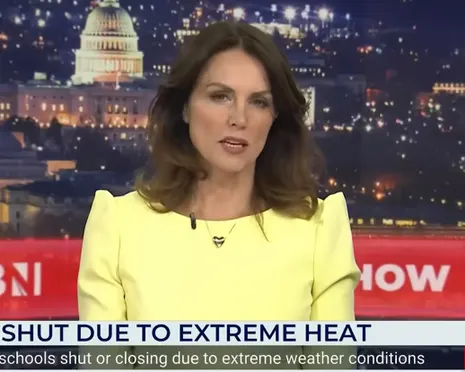
The episode began on 23 May, when the first wave of extreme heat swept across the country, marking the opening of what would become the hottest summer on record. Rather than sounding alarms, the on-air personalities at GB News and TalkTV spent the following weeks telling audiences to shrug it off, question the science, or blame the sun.
The Initial Dismissal
GB News host Cristo Foufas opened his segment with visible irritation at what he called the “naysayers” warning of danger:
“I am sick to death of the naysayers saying firstly that we’re all going to die and that we have to put out heat alerts, because, you know, just drink some water and drink a bit less rosé in the sunshine.”
His co-host Renée Hoenderkamp, who holds a medical doctorate, added a wry aside:
“We used to call it Darwinism.”
The late-June heatwave — the most extreme ever recorded in Europe — did not shift the editorial temperature. Will Kingston, a presenter and contributor on the free-to-air channel, compared the mortality risk to everyday accidents:
“People die each year from vending machines falling on them, and coconuts hitting their heads. People die, unfortunately, that’s a reality of life, and things get hot. It doesn’t mean you have to go about changing your life in ways big and small to accommodate for it.”
Across the streaming spectrum, TalkTV’s Julia Hartley-Brewer offered a similar shrug on 24 June, framing the issue as a slippery slope toward lifestyle restrictions no government was actually proposing:
“I’m very sorry if someone dies because of the heat, but I don’t think that’s a reason for us never to be allowed to take a flight again, or stop being allowed to eat meat.”
Her guest, conservative commentator Benedict Spence, concurred with a blunt fatalism:
“One way or another, something’s going to get you.”
The Meltdown Over the Modelling
On 13 July, an analysis linking the May and June heat to premature mortality in England and Wales estimated roughly 2,700 excess deaths, using the statistical relationship between temperature and mortality established in prior datasets. The figure triggered what can only be described as a full-blown on-air eruption from TalkTV host Kevin O’Sullivan, who had already spent days railing against what he called the “asinine snowflakery” of climate concern:
“Our hysterical hysteria over climate change because we’ve had a few nice days … It’s a nice day. Now we call it … a death risk.”
When the modelling number appeared, O’Sullivan rejected it outright:
“No such thing happened. They’ve sort of qualified it – and said 2,700 people might have died – and this has been apparently gamed by computer programmes and God knows what.”
He labelled the report “just disgraceful climate change scaremongering” and “absolute poppycock.” Kingston echoed the scepticism on GB News, drawing an analogy to pandemic-era forecasting:
“If there is one thing that Covid taught us, it is that modelling is effectively guesswork from clever-sounding people with an ideological agenda.”
Those remarks did not survive contact with the confirmed death count. The UK Health Security Agency’s figure of 2,877, based on recorded deaths rather than projections, landed two weeks later and rendered the earlier dismissals difficult to explain away.
Who Was “Less Important” to Die
A recurring theme across both channels was the minimisation of elderly and chronically ill victims. Ross Clark, speaking on TalkTV on 25 June, suggested that many of those at risk were:
“perhaps on the point of dying anyway.”
Presenters and guests on both outlets repeatedly pointed to the higher annual toll of cold-related deaths in winter, as though this arithmetic justified accepting summer heat mortality. No one on either channel was prompted to explain why any reduction in winter deaths brought about by a warming climate would make the rising summer toll acceptable. Nor was the comparison still arithmetically sound: the latest Office for National Statistics data show 2,805 heat-related deaths in England and Wales in 2025 against 2,244 cold-related deaths, reversing the long-standing seasonal imbalance.
Blaming the Sun, the Bogeyman, and “Freak Weather”
As temperatures climbed past every prior record, the channels did not simply downplay the danger — they denied the underlying cause. GB News presenter Nana Akua called the climate crisis a “scam” as the hottest May ever recorded drew to a close. Hoenderkamp attributed the heat to solar variability, a theory long superseded by peer-reviewed research. Fashion designer and regular contributor Jeff Banks asserted, incorrectly, that:
“The facts are that carbon dioxide in the atmosphere has been declining for the last 150 million years.”
On TalkTV, Hartley-Brewer told viewers in late June:
“We’ve always had freak weather.”
Hundreds of peer-reviewed studies indicate otherwise. The frequency, duration, and intensity of European heat extremes have shifted measurably over recent decades, and the 2026 summer sat at the extreme end of that trend.
One TalkTV presenter, André Walker, went further, assigning personal culpability to a single former politician:
“I believe by the end of his career, Ed Miliband will have killed 100,000 people because of his crazy green energy policies that freeze people in the winter and cook them in the summer.”
No evidence was offered for the claim. Miliband, who served as energy secretary from 2008 to 2011, remains the standard bogeyman of climate-sceptical commentary, but the arithmetic linking his tenure to a six-figure death toll was never substantiated on air.
What the Numbers Actually Say
The confirmed toll of 2,877 premature deaths from two weeks of extreme heat in a single country is not a modelling artefact. It is a count of named individuals whose death certificates recorded heat as a contributing cause. The channels that spent the preceding weeks telling viewers to drink less rosé, shrug at coconuts, and question computer programmes now face the question of what, precisely, they were telling their audiences to ignore. The answer, embedded in every quote above, is straightforward: the reality that a warming climate is already killing people in Britain, and that the number will keep climbing unless the underlying drivers are addressed.
Related Reading
Frequently Asked Questions
What is From psyops to hysterical hysteria?
From psyops to hysterical hysteria is the main topic of this guide. The article explains the context, practical details, and next steps readers should understand.
Why does From psyops to hysterical hysteria matter?
From psyops to hysterical hysteria matters because readers are looking for a useful answer, not just a short summary. Good content should match search intent and help them decide what to do next.