Twenty-five Anti-Isaac Herzog Protesters to Face Joint Trial in Sydney
Wanderstayfinder.com – Twenty-five individuals who participated in a protest against the visit of Israeli President Isaac Herzog to Sydney will stand trial together in a six-week hearing starting on 19 July 2027. The initial proceedings for the group took place at the Downing Centre Local Court on Thursday, where their legal team successfully secured a joint trial. This decision followed an application for a consolidated hearing, which they argued would streamline the process by addressing shared legal and factual elements across the cases.
The acting deputy registrar, Soly Najm, scheduled a week-long pre-trial hearing for 8 March 2027, during which the court will examine the details of the cases. Felicity Graham, one of nine legal representatives for the protesters, expressed confidence that the police commissioner, Mal Lanyon, would be the first witness called. The court also noted that assistant police commissioner Paul Dunstan and members of the Greens party, Sue Higginson and Jenny Leong, may be involved. Discussions are ongoing about including additional witnesses, such as “ministers and members of parliament,” to cover broader aspects of the incident.
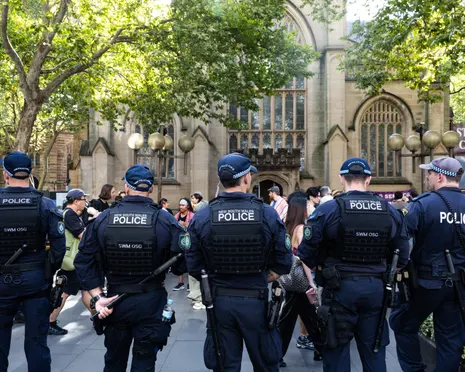
The protest, which took place at Sydney’s Town Hall in February, led to the charging of 30 people. However, one protester had their charges dismissed by authorities in March. The police response on the night of the demonstration is under scrutiny by the Law Enforcement Conduct Commission, which is investigating claims of police brutality. The commission’s inquiry is focused on whether the use of force during the protest was justified or excessive.
Legal Arguments for Joint Trial
Felicity Graham, a central figure in the defense team, emphasized the importance of a joint trial in highlighting the shared legal issues among the 25 protesters. She argued that the cases are interconnected, particularly regarding the legality of the police’s actions during the protest. The court was informed that the protest had been initially classified as unauthorised due to a public assembly restriction declaration, a measure enacted after the Bondi terror attack to control gatherings in specific areas.
“The police operation prevented them from exercising that right,” Graham stated during the hearing.
However, the law that imposed this restriction was later ruled unconstitutional by the Court of Appeal in April. This decision followed a challenge by the Blak Caucas and Palestine Action Group, who successfully argued that the declaration was an overreach of authority. Graham pointed out that this ruling means the protest should now be considered authorised, as the participants had submitted a formal notice of intention to hold a public assembly, known as a form one, to the police.
The legal team also raised concerns about the validity of the police’s use of a major event declaration, a tool typically applied to large sporting or cultural events. This declaration expanded the police’s powers during Herzog’s visit, allowing them to enforce stricter rules on protesters. Graham suggested that this could lead to challenges in proving the necessity of such measures, particularly in relation to the protest’s organisation and the application of force.
Another key point of contention is the admissibility of evidence across the 25 cases. Graham highlighted the potential for shared arguments in how the police’s actions were documented and presented in court. This includes debates over whether the use of force was proportionate and whether the protest’s location and timing contributed to the perceived threat.
Context of the Protest and Legal Background
The protest against Herzog’s visit, which drew international attention, occurred in a context where restrictions on public gatherings were still in place. These measures, introduced in the wake of the Bondi attack, aimed to prevent large-scale demonstrations in areas deemed vulnerable to security threats. The protesters, however, argued that these restrictions were applied inconsistently and that their right to assemble was upheld through the form one submission.
Graham’s team contends that the police’s initial classification of the protest as unauthorised was based on a legal framework that has since been invalidated. This highlights the dynamic nature of the law and how judicial decisions can impact the interpretation of public demonstrations. The case also raises questions about the balance between security concerns and the fundamental rights of citizens to protest, a debate that has gained prominence in recent months.
As the trial approaches, the focus will remain on the evidence presented by both the prosecution and defense. The police prosecutor, Sgt Adrian Walsh, acknowledged the commonality of witnesses but warned that a joint trial might complicate the process. He noted that while some witnesses would be relevant to all cases, others would address individual claims. Despite this, the defense’s arguments have persuaded the court to proceed with the consolidated hearing, setting the stage for a significant legal debate in Sydney.