A Dog Saved Houssein Hamze: Lebanon’s Wartime Animal Guardian
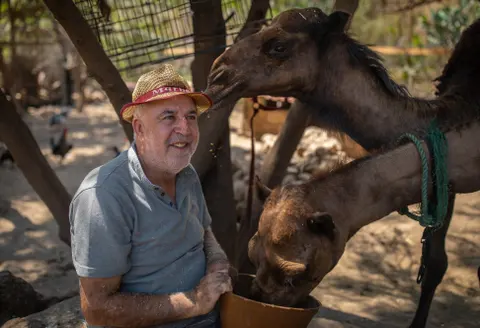
Wanderstayfinder.com – A dog saved Houssein Hamze from a bomb during Israel’s 2006 war. Now, as conflict returns to Lebanon, the 57-year-old remains at the Mashala shelter in Zefta village, caring for hundreds of animals while others flee. On a quiet morning, Hamze walked among his charges with the ease of someone who has spent decades caring for animals. A procession of dogs trailed behind him, their ears twitching at every step, while two camels rescued from the Bekaa valley stood alongside chickens and geese in a harmonious menagerie.
“This is Jamoola and her son, Jamool,” Hamze explained, watching the camel place her head gently in his lap. “She is so sweet. When I don’t visit for more than two days, she starts to cry. And when I come back, she wraps her neck around me as if she’s hugging me.”
The donation-supported farm hosts an eclectic collection of rescues. Approximately 200 dogs—some missing ears or tails from past conflicts—gnawed on donated chicken feet while horses whinnied at visitors near the entrance. Chickens darted between the camels’ legs while geese patrolled the perimeter of their enclosure. A small group of ravens flew in circles around the forested valley, never straying too far from the shade during the intense summer heat.
A Debt Repaid Across Two Wars
Hamze’s journey began during Israel’s 2006 war against Hezbollah. One night, he woke to the sound of barking and rose to check on his first rescue pet. Moments later, a bomb fell beside his home, and a piece of shrapnel landed exactly where he had been sleeping. That moment when a dog saved Houssein Hamze changed everything.
“I swear to God, he really saved me from death. Animals always possess a sixth sense we don’t have,” Hamze said.
Twenty years and two conflicts later, the man still felt he was repaying his debt to the dog that had spared his life. Soon after that near-death experience, he established the Mashala shelter in the village of Zefta, south Lebanon, to care for animals in the region. In peaceful times he welcomes strays, and during wartime he becomes the only lifeline for creatures in the area.
Standing Firm When Others Fled
Hamze was among roughly 20 residents who remained in his village during the most recent Hezbollah-Israel war, which began on March 2, 2026. That conflict forced approximately a quarter of Lebanon’s population to abandon their homes. While many fled and left their animals behind—some tied up—Hamze stayed to tend to the creatures, proving that the bond between a dog saved Houssein Hamze extends to all animals.
“Many people fled and left their animals behind during their displacement – some of them left their animals tied up. We would go out, untie them and leave them water,” said Hamze.
He pointed to Lulu, a dog he rescued who lost a portion of her tail in an airstrike and whom he has cared for ever since. About 50 dogs arrived at the shelter on their own during the war, seeking food. Hamze made daily rounds in his battered truck, distributing dry provisions to abandoned dogs and livestock throughout south Lebanon’s villages.
The work proved difficult. Food was scarce, and he frequently carried jerrycans of water over long distances to reach dogs in remote areas. On several occasions, airstrikes struck a building adjacent to where he was working. Once during his feeding rounds, Hamze encountered the corpse of a man recently killed by a drone strike.
“By the end, all the dogs knew me. I would beep and they would come running,” he recalled.
Braving the Skies for Creatures
Hamze traveled between villages despite an Israeli drone that hovered overhead, watching his every movement. He attached the “Mashala” animal shelter sign to his car’s roof so the drone could identify him—though this offered no guarantee of safety. Drones regularly struck people in the area, ranging from Hezbollah fighters to medics to a man and his friend who returned to collect clothing from their home.
“I wasn’t afraid for myself. I was only afraid for the animals. I kept thinking: if I die, who will look after them? They would be lost,” Hamze said.
Despite his courage, Hamze quietly made arrangements in case he was killed. He sent eight donkeys to a shelter in Beirut, worried that unlike the dogs, they would not survive on their own if he perished. He would have sent the camels and horses as well, but they would not fit in his pickup truck.
Since a ceasefire in June ended most fighting in Lebanon, life has returned to near-normal for Hamze and the animals in his shelter. The thud of artillery is now more distant and no longer triggers a chorus of furious barking. Hamze occupies himself with routine tasks: repairing irrigation tubing chewed by dogs and chasing animals with a syringe to administer tick treatments. His wartime dedication made him a minor celebrity across Lebanon, with videos of him braving drones to feed animals circulating widely online.
Frequently Asked Questions
Where is the Mashala shelter located? The Mashala shelter is located in the village of Zefta in south Lebanon, near the border region affected by recent conflicts.
How many animals does Houssein Hamze care for? The shelter hosts approximately 200 dogs, along with camels, horses, donkeys, chickens, geese, and ravens.
What happened during the 2006 war that changed Hamze’s life? A bomb fell beside his home while he was checking on his rescue dog. A piece of shrapnel landed exactly where he had been sleeping, proving that a dog saved Houssein Hamze from death.
When did the most recent war begin? The Hezbollah-Israel war began on March 2, 2026, forcing approximately a quarter of Lebanon’s population to abandon their homes.
How does Hamze ensure his safety while feeding animals? He attaches a “Mashala” animal shelter sign to his car’s roof so drones can identify him, though this offers no complete guarantee of safety.