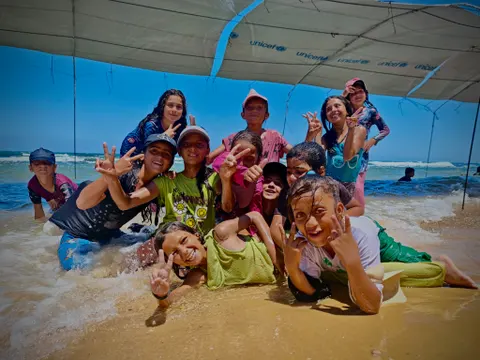
Swimming Classes Resume in Gaza After Three Years of War
Reclaiming Childhood Through the Waves
Wanderstayfinder.com – After three long years of conflict, children in Gaza are once again finding joy in the water. Hundreds of young boys and girls are learning to float, doggy paddle, and take their first swimming strokes in five temporary sea pools constructed from sandbags and rubble scattered across the beaches. These lessons offer a precious opportunity for several hundred children to reclaim their childhood for a few hours each day in a region where playgrounds are scarce, formal education has been disrupted, and the constant threat of Israeli attacks hangs over daily life.
A United Nations survey conducted in March revealed that 96% of children in Gaza felt death was imminent. Yet amid this uncertainty, the seafront has become a sanctuary. “Swimming gives me a chance to escape the war, and the worries I live with,” shared Alma Shabat, a thirteen-year-old who witnessed her mother killed in an Israeli strike during May. After three weeks of attending lessons, Alma has developed freestyle as her preferred stroke, formed new friendships, and conquered her fear of the waves and open sea. “Coming to the beach is a beautiful and enjoyable experience,” she reflected.
Building Hope by Hand
Amjed Tantesh, who established Gaza’s inaugural swimming academy more than twenty years ago, has organized dozens of volunteers throughout this summer to construct the series of pools along central Gaza’s beaches. Tarpaulins have been stretched overhead to provide relief from the intense Mediterranean sun. With heavy machinery largely absent from Gaza, the volunteers completed every task manually, transporting tons of debris and filling sandbags to create walls before excavating sand to deepen the pools.
The schedule is thoughtfully designed. In the mornings, the pools host free sessions for children who lost parents in Israeli attacks. During afternoons, the facilities open to all, drawing delighted children who splash enthusiastically in the warm water. “It’s a rare chance to enjoy, relax and reclaim part of their stolen childhood,” explained Tantesh, who has also served as a journalist for the Guardian and various other media outlets. His niece, Seham Tantesh, currently reports from Gaza for the Guardian. “The pools attract children from all along the beach like huge magnets.”
A Generation Marked by Trauma
Most Palestinian children have endured years of profound trauma. The loss and maiming of loved ones has been devastating, with one in ten of the prewar population killed or injured in Israeli attacks. Thousands more are believed to remain buried beneath the rubble. Gaza now holds the highest concentration of child amputees worldwide. “Disability among Palestinian children has ceased to be an individual medical condition and has now become a defining demographic reality,” noted a UN commission in its report examining Israel’s targeting of Palestinian children.
The human-made famine triggered by Israel’s siege last year will leave many children with lifelong mental and physical stunting. Formal schooling has been absent for three years, and nearly all educational buildings have suffered damage or complete destruction. Among the nearly 700,000 school-age children in Gaza, only a minority can access makeshift tent schools operated by aid organizations. Survivors are packed into crowded, hot, and noisy tent camps occupying merely a third of prewar Gaza, lacking sufficient water or sanitation facilities.
Healing Through Water
Swimming classes provide desperately needed physical and mental respite from this harsh reality. “Being here allows me to train, play and breath fresh air, away from the tents,” said Maryam al Musri, ten years old, who lost her father during the war. Laila Qahman, fourteen, who lost her seven-year-old brother when a mosque near where he was playing was bombed, dreams of becoming a pharmacist. She explained that swimming gave her the opportunity to relax, cool down, and temporarily forget life in a tent.
“I come here every other day because it makes me feel like I’m living my life and enjoying my time, instead of staying in the tent listening to the sounds of shelling and living with fear and sadness,” Laila said. “Before I learned how to swim, I was a little afraid of the sea and did not have the courage to go into the water. Now, I feel much more confident and no longer feel afraid when I swim.”
So far, 700 children have participated in six weeks of classes. Tantesh hopes to instruct thousands more over the summer if he secures funding to compensate teachers, who are currently volunteering their time, and to cover other essential expenses. The joy radiating from these young swimmers has brought healing to Tantesh himself as he mourns his older brother Bahjat, a karate champion killed in an Israeli attack.
Related Reading
Frequently Asked Questions
What is Reclaiming stolen childhoods?
Reclaiming stolen childhoods is the main topic of this guide. The article explains the context, practical details, and next steps readers should understand.
Why does Reclaiming stolen childhoods matter?
Reclaiming stolen childhoods matters because readers are looking for a useful answer, not just a short summary. Good content should match search intent and help them decide what to do next.