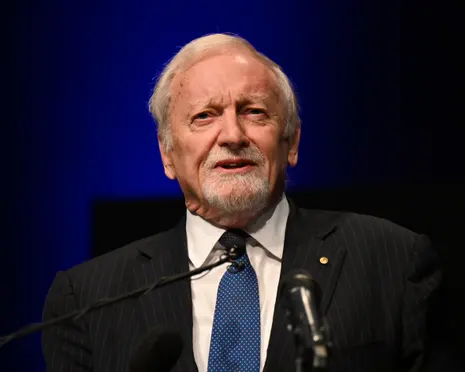
Aukus Is Among Australia’s Worst Foreign Policy Decisions, Says Former Minister Gareth Evans
Wanderstayfinder.com – Former Australian foreign affairs minister Gareth Evans has criticized the Aukus defense pact as a pivotal misstep in the nation’s diplomatic strategy, arguing that it exemplifies an overreliance on American military dominance. Speaking during a public inquiry into the $368 billion nuclear submarine deal with the United States and United Kingdom, Evans highlighted concerns about the agreement’s long-term viability and its implications for Australia’s strategic autonomy. The inquiry, which is not tied to parliamentary proceedings, has drawn attention from trade unions and the Australian Peace and Security Forum, with its first session held in Melbourne on June 11, 2026.
Exposing the Flawed Logic of Extended Nuclear Deterrence
Evans, who served in the cabinets of Labor Prime Ministers Bob Hawke and Paul Keating, questioned the justification for Australia’s participation in Aukus. He described the transfer of Virginia-class submarines from the U.S. beginning in the early 2030s as an extension of American naval power rather than a strategic partnership. “The idea that extended nuclear deterrence ensures Australia’s security is a myth,” he asserted. “The U.S. is only willing to defend us if its own interests on the ground are directly threatened, not if we face an existential threat from China.”
“The belief that the U.S. would sacrifice San Francisco for Sydney, or Miami for Melbourne, is a delusion that has persisted for decades. It’s a convenient narrative, but it doesn’t reflect the realities of international relations.”
Evans also pointed out that the U.S. might not provide the same level of support in the future, especially as geopolitical tensions shift. He emphasized that the current administration’s commitment to the deal is built on optimistic assumptions that may not hold under scrutiny. “Aukus requires a level of heroic optimism that is unmatched by any other policy in recent history,” he said, noting that the agreement’s second phase—UK-designed, Australian-built submarines—introduces even greater complexity and uncertainty.
Challenges in Submarine Production and Nuclear Waste Management
Evans raised concerns about the timeline and logistical hurdles of the Aukus program. He warned that the U.S. is already facing delays in its own submarine construction, with limited capacity to fulfill Australia’s order. “The U.S. defense-industrial base is under immense pressure, and the UK’s submarine program is on the brink of collapse,” he stated. “Australia’s plan to spend $4.5 billion over a decade to accelerate production is a gamble with no guaranteed payoff.”
The inquiry also addressed the environmental and security risks of nuclear technology. Tilman Ruff, co-founder of the International Campaign to Abolish Nuclear Weapons, argued that the use of weapons-grade uranium to power the submarines undermines global non-proliferation efforts. “Australia has no clear strategy for managing the radioactive waste generated by these submarines,” Ruff said. “The material poses a long-term threat, and there’s no guarantee it will remain isolated from potential misuse for millennia.”
“The risk is that in 10,000 years, someone could unearth this waste and use it to build nuclear weapons. Australia’s track record of imposing nuclear facilities on local communities without consent adds to the concern.”
Ruff also criticized the government’s handling of public consultation. “For decades, Australia has prioritized national security over community welfare, often pushing radioactive waste facilities onto unwilling populations,” he explained. “This agreement could exacerbate that pattern, especially if the Commonwealth declares vast areas of the country as defense zones.”
Public Inquiry Faces Criticism from Labor Ministers
The public inquiry, which will hold hearings nationwide before releasing its report in October, has sparked debate. Current Labor ministers have accused the panel of being inherently anti-Aukus, despite its bipartisan support. The inquiry is chaired by Peter Garrett, a former Labor minister, and includes Chris Barrie, a retired defense official. Their roles in the process have raised questions about potential biases, though the government maintains the inquiry is focused on transparency and accountability.
Evans’s testimony was part of the inquiry’s broader examination of Aukus’s costs and benefits. He argued that the deal’s financial projections are speculative and that Australia’s dependence on the U.S. and UK for nuclear capabilities could weaken its diplomatic leverage. “We’re investing heavily in a system that may not be reliable, and the risks are not fully accounted for,” he said. “This isn’t just about submarines—it’s about the long-term consequences of aligning too closely with nuclear powers.”
Global Implications and the Path Forward
Evans’s critique extends beyond Australia’s immediate interests. He warned that the Aukus program could escalate tensions in the Indo-Pacific region, particularly as the U.S. views the submarines as tools to counter Chinese naval threats. “The agreement positions Australia as a frontline asset in the U.S. strategy against China, but it does so at the expense of our own strategic independence,” he said. “The question is: how much of our national interest are we willing to cede to American priorities?”
Ruff echoed these concerns, emphasizing that the nuclear waste issue is a global challenge. “No country has yet found a permanent solution for storing this material, and the risks of proliferation are real,” he stated. “Australia’s involvement in Aukus could create a domino effect, encouraging other nations to follow suit without considering the environmental and health impacts.”
Meanwhile, foreign minister Penny Wong addressed the inquiry’s progress, confirming that discussions with UK officials had taken place overnight. “We’ve maintained consistent communication with our partners, and the UK has reaffirmed its commitment to the project,” she said. However, the UK’s submarine program has already faced delays, with the first steel for the new vessels set to be cut next year. This timeline, combined with Australia’s financial commitments, has left critics questioning whether the project can meet its goals without further setbacks.
The Aukus deal, initially framed as a way to strengthen Australia’s defense capabilities, now appears to be a test of the nation’s strategic priorities. As the inquiry moves forward, it will scrutinize the agreement’s impact on Australia’s foreign policy, environmental standards, and democratic governance. The debate over whether Aukus is a necessary alliance or a costly mistake is far from over, with key stakeholders divided on its long-term value. For now, Evans’s warning serves as a stark reminder of the risks involved in relying on nuclear deterrence as a primary security strategy.
A Call for Reevaluation in a Shifting Geopolitical Landscape
Evans’s testimony underscores the need for a more balanced approach to Australia’s defense policy. He argued that the nation’s security should not be contingent on the goodwill of distant allies, especially when those allies may prioritize their own strategic interests. “Aukus is not a guarantee of safety—it’s a calculated risk that could backfire if the U.S. or UK faces its own crises,” he said. “We must ask whether this deal is the best use of our resources or a political expedient.”
As the inquiry continues, the findings will shape the future of Aukus and its place in Australia’s foreign policy history. The agreement, which has already drawn scrutiny for its financial and environmental implications, remains a focal point for critics who see it as a flawed partnership. With the UK’s submarine program under strain and the U.S. preparing to integrate the new fleet into its command structure, the challenges of Aukus are becoming increasingly evident. The debate over its merits is likely to intensify as the project progresses, testing the resilience of Australia’s commitment to nuclear alliances.