Witchcraft Retreats: A Modern Sanctuary for Women’s Liberation
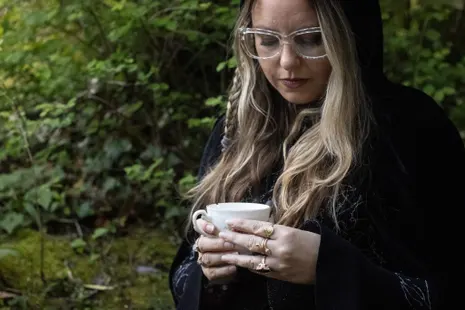
Wanderstayfinder.com – In a sunlit room of a centuries-old Irish estate, a group of 15 witches gather to commune with the unseen. The air hums with anticipation, much like the first day of school, as they prepare to engage with forces beyond the ordinary. Some wear flowing black capes and bandannas, while others opt for casual attire—Columbia fleeces, spaghetti-strap tank tops, and Adidas sneakers. This gathering is part of a growing trend of witchcraft retreats, where women from across the United States seek solace and empowerment through ancient rituals and contemporary spiritual practices.
The Power of the Pendulum
Isabella Ferrari, known as Penny the Witch, leads the group in creating divination maps—sheets of paper marked with “yeses” and “nos” that function like Ouija boards. As the women pose questions, their pendulums swing in response, guided by unseen energies. One participant, Tara Monte, exclaims when her pendulum spins wildly, “Isabella, do I stop this? Someone really wants to talk to me.” Later, she admits the movement was her archangel Michael, affirming her parents’ pride and their enduring love.
The retreat, called Green Veal, is a two-and-a-half-day event that blends spellcraft with somatic healing. Participants craft candles, confront ancestral wounds, and build connections through shared vulnerability. Ferrari emphasizes the importance of trusting intuition, noting that many women have been conditioned to doubt their inner wisdom. “We are so used to not trusting ourselves,” she says, “especially those who have been taught to disconnect from their instincts.” The practice becomes a ritual of reclaiming power, where the focus shifts from external spirits to the participants’ own voices.
Emotional Resonance and Collective Catharsis
Later in the retreat, the act of sharing summoned entities turns into a deeply emotional experience. Monte reveals she spoke with her boyfriend, who died by suicide, while another woman recounts a conversation with a paternal figure. One participant, a hearing specialist from Massachusetts, writes in an unknown language, claiming it was a spirit’s message. As they share stories, the women weep together, their grief and frustration intertwining in a collective release.
Ferrari encourages them to lean into these emotions, chanting phrases like “I will learn to use my voice” and “I am so afraid.” The retreat’s climax involves a repeated mantra: “I am so angry. I am so angry. I am so angry.” For many, this is their first time expressing that emotion aloud in a space designed to amplify it. The exercise becomes a cathartic declaration, symbolizing the pent-up anger of women who have long been marginalized by patriarchal systems and religious institutions.
From Counterculture to Contemporary Practice
Ferrari, an Italian-born witch, has hosted similar retreats across continents. When her Ireland-based event sold out in April, she expanded capacity, but even then, tickets priced from €1,900 to €3,000 were snapped up. With over 180,000 followers on Instagram, her witchcraft style merges spirituality with entrepreneurship, offering a space for women to process their disillusionment with churches, workplaces, and political structures.
Helen Berger, a Harvard Divinity School sociologist and expert in modern paganism, notes the roots of this revival trace back to the 1960s counterculture movement. “Witchcraft has always been a symbol of resistance,” she explains. “It resists easy definition, embodying ancient folk magic, herbal traditions, and self-directed healing.” The practice now encompasses everything from solitary spellcasting to communal rituals, with activities like scattering protective salts or buying crystals considered part of the broader movement.
As the decade progresses, witchcraft retreats have become a global phenomenon. Their popularity aligns with a surge in anti-authoritarian sentiment, Berger observes. “Spikes in alternative spirituality often coincide with spikes in rebellion against established power.” This connection is evident in how women use witchcraft to reclaim agency. By engaging with spirits, they also confront internalized beliefs about their worth, often shaped by centuries of patriarchal control.
Reclaiming the Sacred
Ferrari’s retreats are not just about summoning the supernatural; they are about redefining the sacred. The divination maps, for example, serve as tools for self-discovery, allowing participants to interpret their questions through a lens of intuition and ancestral connection. “It’s less about the spirits,” Ferrari says, “and more about learning to believe in your own power.” This philosophy reflects a broader shift in how women perceive spirituality—a move from institutionalized faith to personal, embodied practices.
The retreat’s structure mirrors this transformation. With limited time, the focus is on intensity and immediacy. Women are encouraged to embrace raw emotions, from grief to anger, as part of their healing journey. Ferrari’s instruction to “stay with the fairies” instead of engaging with demons highlights a deliberate choice to center positive energies. “The underworld is a space for fear,” she explains. “But today, we’re choosing to connect with what uplifts us.”
Participants often leave with a renewed sense of purpose, their experiences weaving together ancient traditions and modern needs. For Monte, the retreat becomes a turning point—her pendulum’s movement is no longer a mystery but a confirmation of her inner strength. For others, it’s a validation of their longing for belonging in a world that has historically excluded them. “These retreats are a sanctuary,” Ferrari says, “where women can reclaim their voices without judgment.”
The Future of Witchcraft in a Changing World
As the movement grows, so does its influence on broader cultural narratives. Witchcraft retreats have become a platform for women to challenge societal norms, using rituals as a form of protest against centuries of repression. The practice, once dismissed as mere superstition, now thrives as a symbol of empowerment, blending the mystical with the practical. Ferrari’s success is a testament to this shift, with her events selling out despite their high cost.
But the question remains: how long will this trend last? Berger suggests it is part of a larger cycle, where spirituality evolves in response to social and political climates. “Witchcraft has always been a mirror for collective struggles,” she says. “It adapts as people seek new ways to connect with meaning.” For now, the retreats provide a temporary haven, a space where women can temporarily escape the constraints of their everyday lives and embrace a more fluid, intuitive relationship with the world.
Yet, the movement’s roots lie in history. From the medieval persecution of witches to the feminist reclamation of the term in the 1960s, the practice has endured as a form of resistance. Ferrari’s work builds on this legacy, offering a modern iteration that is both accessible and transformative. As the women at Green Veil chant their truths, they are not just summoning spirits—they are reclaiming their place in a world that has often denied them.
These retreats, though brief, leave a lasting impact. They remind participants that their intuition is not a flaw but a gift. In a society that has long taught women to suppress their inner wisdom, the act of engaging with the unseen becomes an act of defiance. The pendulum’s swing, the candle’s flame, the whispered messages from the dead—all are threads in a tapestry of empowerment, woven together in the quiet moments of a sun-drenched Irish room.