Smoke from Canadian Blazes Casts Long Shadow Over North American Communities
A Growing Crisis Across Borders
Wanderstayfinder.com – Millions of residents throughout North America are navigating increasingly difficult conditions as wildfire smoke blankets vast regions. The atmospheric haze has prompted widespread cancellations of outdoor events, disrupted commercial operations, and forced vulnerable populations to remain inside their homes. Government health officials caution that these challenging air quality conditions are expected to endure for some time.
More than twenty American states have issued air quality warnings as smoke originating from south-central Canada, northern Ontario, and portions of Minnesota drifts toward southern regions. Approximately 109 million citizens residing in the midwest, mid-Atlantic, and northeastern areas have encountered unhealthy atmospheric conditions during the current week. While American headlines dominate media coverage, Canadian residents face equally severe challenges.
Canadian Communities Bear the Brunt
For countless Canadians, this seasonal phenomenon has evolved into a regular occurrence. Tenille Bonoguore, a resident of Waterloo, Ontario, emphasized that Canadian populations are experiencing impacts comparable to or exceeding those felt south of the border.
“Much of the coverage focuses on the US, but multimillions of Canadians are faring as badly or worse,” she explained. “In a country where we get through winter by anticipating summer, we are locked indoors gazing at hazy streets visibly full of smoke.”
Households are confronting difficult tradeoffs between maintaining comfortable indoor temperatures and filtering out harmful particulates. Families without climate control systems must decide whether to endure oppressive heat or suffocating smoke. Bonoguore noted that many residents are enduring their second, third, or fourth consecutive summer of conditions that would have seemed extraordinary just ten years prior.
Currently, more than 180 active fires continue burning throughout northern Ontario, contributing to what experts describe as an intense wildfire season. These flames have repeatedly pushed smoke across the international boundary, affecting communities on both sides.
Workers and Families Feel the Impact
Individuals whose occupations require outdoor work are experiencing particular hardship. Ted Brearley, a self-employed carpenter operating in Hamilton, Ontario, reported significant reductions in his business productivity. The smoke has compelled him to send employees home earlier than usual and cut his own working hours substantially.
“My business has experienced a huge loss in production,” Brearley stated. “Sending staff home early and then losing hours and pay as well.”
He expressed frustration regarding government preparedness, questioning whether sufficient resources have been allocated to address escalating wildfire threats. “Freebies don’t help when I can’t breathe, can’t work, or can’t feed my family or keep a roof over my head,” he remarked, highlighting the economic toll on working families.
Urban Centers Record Historic Air Quality Levels
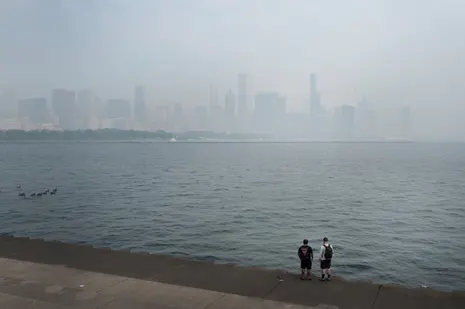
South of the Canadian boundary, even brief outdoor excursions revealed noxious atmospheric conditions. Chicago achieved the distinction of hosting the world’s worst air quality on Thursday evening, according to IQAir’s comprehensive global rankings. Detroit and Minneapolis also appeared among the most heavily polluted metropolitan areas during the same period.
Zeff, a twenty-six-year-old student residing in Skokie, Illinois, described the smoke as carrying a sharp, chemical odor reminiscent of burning plastic. “The air stinks of burnt plastic, like it’s been poisoned,” he observed. “It’s impossible to take a deep breath without my nose and throat burning.”
“There’s a mirage hanging on the treetops, white fog blanketing everything in the distance,” he added. “Everybody I speak to voices a profound, resigned hopelessness.”
Vlad, a data engineer who has called Chicago home for twenty years, reported unprecedented severity in current conditions. Concerned about his asthmatic son, he has maintained strict indoor confinement and plans to upgrade his home’s heating and cooling system filters while purchasing an air quality monitoring device.
“This is the worst it’s been in Chicago since I moved here 20 years ago,” Vlad declared. “If you go outside, you can taste the air, and it tastes toxic. My body is actively trying to tell me this is not good to breathe.”
Communities Adapt to New Realities
As atmospheric conditions spread eastward, neighborhoods began modifying daily schedules to minimize outdoor exposure. Orange-tinted skies and persistent smoke odors characterized New York City during this period. In Farmington Hills, Michigan, children’s librarian Michelle Stiennon relocated an outdoor story time gathering indoors as conditions worsened, humorously dubbing the situation a “story-time apocalypse.”
“Our library also made N95 masks available to staff and the public,” Stiennon noted. “I was surprised by how many kids showed up, but it seemed parents were using us as their one activity before sheltering at home.”
The ongoing crisis demonstrates how climate-related challenges increasingly affect daily life across North America, requiring communities to develop new strategies for protecting public health while maintaining economic activity.