Trump Withdraws Hormuz Tolls Threat Amid Ongoing Regional Tensions
Trump withdraws Hormuz tolls threat but says – President Trump has reversed course on his proposed toll for maritime traffic through the Strait of Hormuz, announcing that the United States will not implement the previously threatened 20% fee. This decision comes as American forces continue their military operations against Iranian targets, marking the third consecutive day of airstrikes in the region. The reversal represents a significant shift in American policy regarding one of the world’s most critical shipping lanes.
Strategic Reversal on Maritime Fees
The president made the announcement just five hours before the toll was scheduled to take effect, citing “highly productive conversations with Middle East leadership” as the catalyst for the change in approach. Rather than imposing a direct fee on commercial vessels, Washington is now pursuing investment and trade agreements with regional partners. Trump emphasized that while the United States protects the strait for global commerce, he believes “nobody should charge a fee” for passage through waters that American forces are securing.
Analysts note that reopening the strait by force would require tens of thousands of American troops, making the diplomatic approach potentially more sustainable in the long term. The original toll proposal had represented a departure from the traditional “freedom of navigation” principle that the United States has historically championed in international waters.
Military Operations Continue
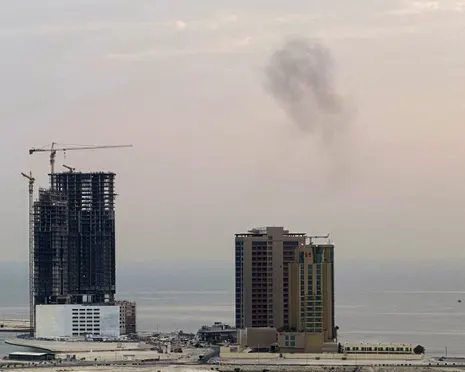
Despite the policy shift on tolls, the American blockade of Iranian ports remains firmly in place. The strikes that began Tuesday morning targeted key facilities in Bushehr and Bandar Abbas, with the stated objective of degrading Iran’s capacity to attack commercial shipping vessels. These operations have resulted in at least 28 casualties according to AFP tallies, including one Indian seafarer killed and ten others wounded across two tankers.
Iranian retaliation has been multifaceted, with attacks directed at Bahrain, Jordan, and the United Arab Emirates. Kuwait successfully intercepted incoming projectiles, while Bahrain accused Iran of targeting civilian populations. Jordan’s air defenses intercepted four missiles, and the United Arab Emirates experienced damage to its tanker fleet. The EU Aviation Safety Agency has issued warnings advising aircraft to avoid the airspace of Bahrain, Kuwait, Qatar, the UAE, and the Gulf of Oman.
Diplomatic and Economic Implications
Israeli Prime Minister Benjamin Netanyahu issued a stark warning from Dimona, stating that “days are over when someone strikes us and we don’t hit back.” His comments underscore the broader regional instability that has accompanied the American military campaign. Meanwhile, India is formally lodging a protest regarding the casualties suffered by its merchant mariners.
The Strait of Hormuz has been effectively closed during the four-month conflict with the United States, though a memorandum of understanding was supposed to facilitate its reopening. That agreement is now almost halfway through its 60-day period, with key issues including the strait’s status, Iran’s nuclear program, and broader regional security concerns still under negotiation. Oil prices have climbed to a four-week high exceeding $86 per barrel as markets digest the evolving situation.
“20% is of course too much. We will be fair,” said Iranian Foreign Minister Abbas Araghchi, while maintaining that the United States has no legitimate role in the strait. He declared Tehran the eternal guardian of the waterway.
The Trump administration’s decision to withdraw the Hormuz tolls threat while maintaining military pressure demonstrates a nuanced approach to the escalating crisis. American forces continue to degrade Iranian capabilities while Washington explores diplomatic pathways through trade and investment rather than punitive fees. The coming weeks will reveal whether this balanced strategy can stabilize the region or if further escalation remains inevitable.