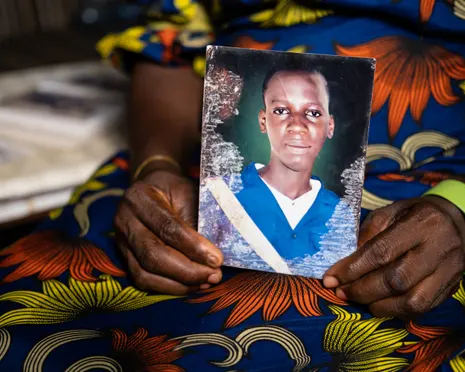
Justice Delayed: A Mother’s Long Wait for Her Son’s Remains
Give us his body to bury – After nearly six years of uncertainty, Bosede Onifade finally received confirmation that her son’s body had been lying in a Lagos mortuary all along. On June 24, 2026, a coroner’s inquest officially verified that the corpse tagged with number 1385 was indeed Pelumi Onifade, based on a DNA sample his mother had submitted years earlier. The legal proceedings have now been postponed to July 29, leaving the family in yet another period of limbo.
The Day Everything Changed
Pelumi Onifade was just twenty years old when his life was cut short. A second-year mass communication student and intern at Gboah TV, he had been filled with enthusiasm about covering the #EndSars demonstrations that had swept across Nigeria. His mother last saw him on the morning of October 24, 2020, when he left their home to report on what would become one of the most significant youth-led movements in the country’s history.
According to eyewitness accounts, Pelumi was documenting a protest in Abule Egba, a district within Lagos State, when a bullet struck him. Members of the Lagos police taskforce reportedly seized the young journalist and forced him into a van alongside other detained demonstrators. The family and their friends spent days searching desperately, but their efforts yielded nothing until a relative discovered a body in a morgue located in Ikorodu, approximately thirty-seven kilometers north of central Lagos, on October 30.
“We want them to release his body. If they have already killed him; they should give his body to us to bury,” Bosede says, sobbing.
Tragically, when the Onifade family finally reached the morgue, Pelumi’s remains had already been removed.
A Movement That Shook a Nation
The protests that claimed Pelumi’s life began in October 2020 when thousands of Nigerians took to the streets to demand accountability from the Special Anti-Robbery Squad, commonly known as SARS. Established in 1992, this police unit had accumulated a reputation for serious offenses including kidnappings, unlawful killings, theft, and sexual violence. What started as a campaign to dissolve SARS quickly evolved into a broader movement calling for good governance, corruption elimination, police reform, and improved living conditions for ordinary citizens.
The government’s response was swift and brutal. The Lekki shooting incident became particularly infamous, with protesters being fired upon, resulting in at least twelve deaths and numerous injuries. Amnesty International documented a minimum of fifty-six fatalities throughout the demonstrations, which continued for over two weeks across major urban centers.
Nigeria’s then information minister, Lai Mohammed, initially dismissed the Lekki deaths as a “phantom massacre.” However, following a critical judicial investigation, he acknowledged the report contained “many errors, discrepancies” though he maintained that its conclusions lacked evidentiary support.
Unfinished Business
On October 11, the government officially disbanded SARS and introduced the Special Weapons and Tactics unit in its place. Despite this change, public skepticism persisted, with many viewing the transition as nothing more than a cosmetic rebranding exercise. Multiple inquiry panels across different states concluded that security personnel were responsible for shooting and mistreating protesters, yet accountability remained elusive.
Bosede Onifade has endured tremendous hardship during her son’s absence. She has experienced significant weight loss, suffers from memory problems, and battles depression. The uncertainty has been particularly tormenting.
“He was not doing anything wrong, and even if he was doing something wrong,” says Bosede, breaking down in tears, “they could have arrested him and not killed him in cold blood.”
Isa Sanusi, who serves as the director of Amnesty International in Nigeria, emphasized that it remains entirely unacceptable for Pelumi’s family to have been denied both justice and the dignity of a proper burial ceremony.
The family has pursued every available avenue, attending judicial panels of inquiry, providing DNA evidence, and participating in court hearings. Federal police spokesperson Olumuyiwa Adejobi confirmed in 2020 that Pelumi’s death had been formally reported to an inquiry panel examining police brutality allegations. By 2024, the Lagos State government informed the Committee to Protect Journalists that an internal investigation was still ongoing.
For Bosede, faith remains her anchor. She often recalls a Yoruba saying: “If the Earthly king does not see you, the king in heaven sees.” She believes that those in power who mistreat others’ children will eventually face consequences for their actions.