‘Paralysed by fear’: Venezuelans tell of escape and loss after huge earthquakes
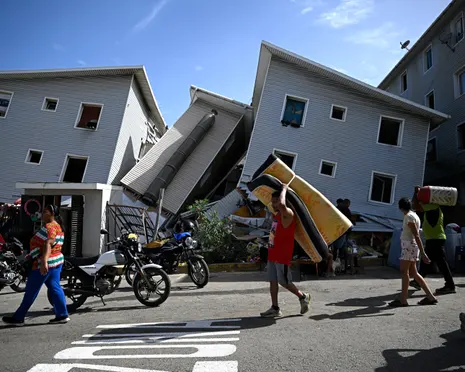
Paralysed by fear – Two devastating earthquakes struck Venezuela’s northern coast on Wednesday, sending tremors through the capital, Caracas, and shaking the foundations of communities already struggling with economic hardship. The quakes, measuring 7.2 and 7.5 on the Richter scale, occurred within a minute of each other shortly after 6pm local time, causing widespread panic and destruction. Residents fled their homes as buildings crumbled, their once-stable structures now reduced to fractured remnants. The disaster unfolded in a region where economic instability and political tensions had already left many vulnerable to the next crisis.
The Shaking of Caracas
Sebastian Rodríguez, an 18-year-old shop owner in the affluent Los Palos Grandes district, described the chaos as the ground convulsed. “The house felt like it was dancing to a different beat than the earth,” he recounted. “I had to carry my mum out. She was frozen with fear.” His family’s business, located in Centro Plaza—a brutalist commercial hub—seemed to weather the quakes, but the surrounding neighborhoods faced catastrophic damage. At least three structures in the area collapsed, leaving debris and the echoes of shattered lives in their wake.
“I had to carry my mum out. She was paralysed by fear.” — Sebastian Rodríguez, 18, shop owner
As night fell, emergency responders and volunteers rushed to the scene, combing through rubble in search of survivors. Jessica Galvis, a critical care physician, stood outside a collapsed six-story building, her voice trembling. “There’s so much rubble,” she said, waiting for news about a friend believed to be trapped beneath the wreckage. Nearby, José Morillo, 61, sprinted across the city on his motorbike, his mind racing with dread. “My brother, my son, and nephews are all inside,” he pleaded, before a relative was pulled from the ruins, still breathing.
Areas of Wealth and Woe
Los Palos Grandes and Altamira, nestled at the base of Ávila Mountain, are home to Venezuela’s elite and international diplomatic missions. The British, German, and Brazilian embassies, along with upscale hotels and restaurants, stood amid the destruction. Yet, the same region that symbolized prosperity was now a backdrop to despair. In contrast, working-class districts like Catia faced even greater devastation, with residents already burdened by the country’s severe economic crisis.
José Luis, a PE teacher in Catia, described his home as a “mangle of masonry and steel.” “My walls have crumbled. Water is pouring through the roof,” he said, his voice thick with exhaustion. “The quake lasted so long—it smashed everything.” Fearing another collapse, he opted to sleep on the streets, using mattresses, cardboard, or tents as makeshift shelters. “The government needs to send firefighters,” he implored. “If there’s another quake like that, this building will fall.”
“My walls have crumbled. There’s water coming in through the roof.” — José Luis, PE teacher
Isra Colmenares, 58, from the same region, recalled the second quake as “a truly hideous experience.” She described how her building swayed violently, the ground trembling so fiercely that it felt like “a monster was swallowing the city.” “It was the first time in my life I’ve felt anything like this—it was so powerful,” she said. The disaster echoed the 1900 earthquake, which had left a mark on the nation’s history, but this time, the scale of destruction was far greater.
Residual Strains of Crisis
While the earthquakes left visible scars on the landscape, their impact was compounded by the country’s ongoing economic turmoil. In Catia, where residents grapple with hyperinflation and scarce resources, the quakes exposed the fragility of their living conditions. Many families had already lost their homes to previous crises, and now, the ground itself seemed to conspire against them. “We are used to losing things,” said Luis, a resident. “But this time, we lost everything.”
Further north, the situation grew dire at La Guaira, a port city that serves as a lifeline for the capital. The international airport, which had been a critical node in Venezuela’s efforts to sustain trade and aid, was rendered inoperable after its roof caved in. Social media videos captured the frantic escape of passengers, their faces streaked with dust as they fled the collapsing terminal. “It was like a nightmare,” one traveler posted, their voice shaking. “We had no idea what to do.”
Apolitical or Not?
The quakes arrived as the coastal region still reeled from the recent U.S. military operation to capture President Nicolás Maduro on January 3. Trump’s forces had targeted Catia La Mar, a seaside town west of La Guaira, with air-to-surface missiles that destroyed defense systems and radar installations. The strikes paved the way for helicopter raids aimed at Maduro’s capture, but the aftermath left buildings in ruins and communities in shock. On Wednesday, those areas once again became focal points of turmoil.
Communication lines were severed, complicating efforts to reach those trapped or missing. Without reliable updates, families were left in limbo, their hopes pinned on the slow unfolding of rescue operations. The official death toll stood at 164 by Thursday morning, though the number was expected to climb as search teams worked through the night. “There’s still so much to find,” said a relief worker, their hands stained with dust and blood.
Voices in the Wake of Disaster
Residents’ accounts painted a vivid picture of the devastation. For some, the quakes were a cruel reminder of the country’s vulnerability. “This is what we all fear,” said Luis, echoing the sentiment of many Caraqueños. “We’ve seen this before, but nothing like this.” Others, like Jessica Galvis, were left grappling with the emotional toll. “I was waiting for news all night. Every second felt like an eternity,” she admitted, her eyes scanning the wreckage for any sign of her friend’s survival.
The earthquakes also highlighted the stark divide between Venezuela’s wealthy and working-class populations. While embassies and luxury hotels in Altamira remained standing, Catia’s crumbling infrastructure had been hit hardest. “It’s like the world is falling apart,” said Colmenares, her voice breaking. “Even the ground is betraying us.” As the sun rose on Thursday, the search for survivors continued, with teams working tirelessly through the rubble. Yet, the fear of another quake lingered, casting a shadow over what had already become a night of unimaginable loss.
“This is what we all fear.” — Luis, PE teacher
Trump’s social media presence remained active in the aftermath, with the former president posting updates about the disaster. “A devastating number of deaths,” he wrote, “but we will be there for our new and great friends.” His words, however, offered little comfort to the families in Catia La Mar, where the quakes had added yet another layer of suffering to an already fractured society. The road ahead seemed uncertain, with the nation’s resilience tested in the face of nature’s fury and political upheaval.