What lessons will Iran’s new leadership draw from the 110-day war?

What Lessons Will Iran’s New Leadership Draw From the 110-Day War?
Wanderstayfinder.com – As the 110-day conflict between Iran and its adversaries concludes, the nation’s incoming leadership faces a critical juncture. The ideological directions they choose to take from this brief yet intense period may ultimately decide the fate of ongoing negotiations with the United States. A successful agreement could prevent Iran from acquiring nuclear capabilities, marking a potential shift in the country’s economic landscape and altering the geopolitical dynamics of the Middle East. Yet, the question remains: will this newly formed leadership still cling to the Islamic ideological vision that has long defined its foreign policy, or has the recent reality of pragmatic compromises signaled a departure from that ideal?
A Leadership Shaped by Crisis
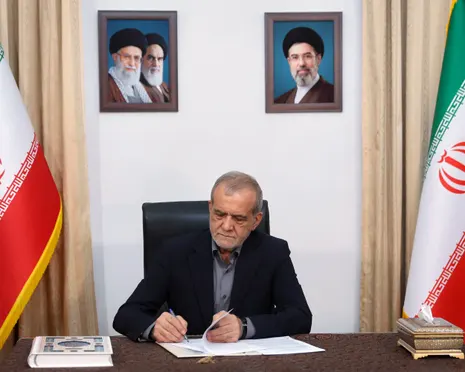
The rapid consolidation of Iran’s leadership team during the war has created a unique political climate. With Mojtaba Khamenei, the supreme leader, largely out of sight and seemingly sidelined, the interregnum period offers a chance for new directions. Khamenei’s recent statement, published on Thursday, reveals a strategic deference to President Masoud Pezeshkian, who has taken the lead in the nuclear talks. While Khamenei opposed the deal in principle, he accepted the president’s authority after assurances that the U.S. would not push for excessive demands. This move allows the leadership to maintain a veneer of ideological purity while navigating the complex terrain of international diplomacy.
Khamenei’s position underscores a recurring pattern in Iranian politics: placing the burden of external negotiations on elected officials while shielding the religious leadership from blame. This strategy has historically allowed the supreme leader to retain influence even when political outcomes are uncertain. By deferring to Pezeshkian, Khamenei ensures that any failures in the talks can be attributed to the government rather than to the broader ideological framework. The debate within Iran’s leadership is now framed as a test of whether the country can sustain its stance on nuclear ambitions or must adopt a more flexible approach to secure economic stability.
US Perspectives and the Shadow of Distrust
Meanwhile, the U.S. administration grapples with its own interpretations of Iran’s intentions. Donald Trump, who has taken a hardline stance on Iran, appears to have aligned with the view that the country’s leaders are untrustworthy. At the Évian-les-Bains G7 summit, Trump criticized the Iranian leadership, calling them “very dishonourable people who don’t deal in good faith.” This sentiment echoes the concerns of John Ratcliffe, the CIA director, who warned that there is a significant gap between the public statements and private discussions of Iranian officials. Ratcliffe’s intelligence assessment suggests that the leadership may secretly pursue nuclear capabilities if the agreement proves too costly.
Yet, JD Vance, a prominent voice in U.S. policy circles, argues that the current leadership is more open to compromise than ever before. In a recent address, he noted that the U.S. has gained unprecedented access to Iran’s senior figures, a development that could reshape the nation’s strategic posture. Vance highlighted that some within the Iranian system, including IRGC officials, have begun to acknowledge the flaws of their long-standing approach to U.S. relations. “The coolest thing about the progress we’ve made over the last few weeks is that you’re seeing people within the Iranian system say: ‘We recognise the way we’ve done business with the US for 47 years is a mistake,’” Vance stated. This admission, however, is contested by hardliners who claim the opposite is true.
The Deterrence of Geography
Iran’s leadership is also grappling with the strategic implications of the strait of Hormuz. The recent conflict has reaffirmed the strait’s importance as a vital artery for global oil supplies, proving that geographic advantages can outmaneuver technological dominance. Payam Fazlinejad, a hardline editor at the magazine Naqd Andisheh, emphasized this point in a recent interview. “History has shown America that geography can take revenge on technology,” he said. “Part of the source of power lies in these straits, not in heavy military equipment. Iran has come to understand that its greatest deterrent is not the nuclear weapon itself, but the control it holds over this critical chokepoint.”
Fazlinejad’s argument highlights a broader perspective on Iran’s security strategy. While the nuclear deal is a key focus, the country’s leaders are also recognizing the enduring value of its geographic position. The strait of Hormuz has become a symbol of Iran’s ability to assert influence over global energy markets, a power that could be leveraged even without a nuclear arsenal. However, Fazlinejad also urged the leadership to break free from the cycle of conflict and diplomacy that has plagued the nation. “The country cannot afford a new miscalculation and must restore stability,” he told Pezeshkian during a recent meeting of media editors. This call for balance reflects a growing awareness that the war, while a strategic victory, has also exposed the risks of prolonged instability.
Pragmatism or Ideology?
The debate over Iran’s ideological trajectory has intensified in the wake of the war. Some analysts suggest that the leadership’s willingness to accept a memorandum of understanding indicates a shift toward pragmatism. This could mean a departure from the Islamic revolutionary ethos that Henry Kissinger once described as a “crusade.” However, others argue that the acceptance of the deal is merely a tactical maneuver, not a fundamental change in ideology. The leadership, they contend, still seeks to uphold its vision of an Islamic state while adapting to the realities of international negotiations.
Behind the scenes, the Paydari Front—a hardline faction long opposed to Western engagement—has been vocal in its criticism of the deal. This group, which includes many of the country’s most conservative voices, has been denigrating the agreement as a betrayal of Iran’s core principles. Their opposition suggests that the war may have reinforced rather than weakened the ideological divide within the country. While the president and his team have pursued pragmatic solutions, the supreme leader and his allies continue to cast doubt on the long-term viability of such compromises.
As the talks continue, the balance between ideology and pragmatism remains precarious. The U.S. and Iran both face the challenge of aligning their interests without sacrificing their strategic goals. For the Iranian leadership, the 110-day war has been a proving ground for their ability to navigate complex negotiations while maintaining the ideological foundations of the Islamic revolution. For the U.S., it has been a test of whether it can secure a binding agreement that ensures Iran’s compliance with nuclear non-proliferation terms. The outcome of these discussions will not only shape the future of Iran’s nuclear program but also determine the stability of the Middle East in the years to come.