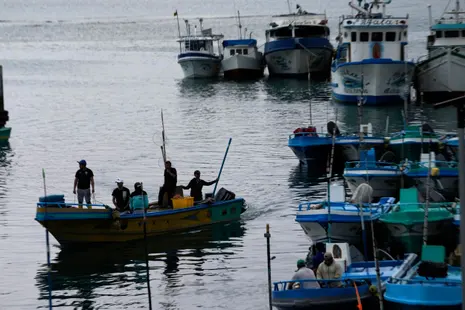
US claims it is not responsible for strikes on Ecuadorian fishing boats – so who is?
The Incident on March 17
Wanderstayfinder.com – On March 17, Captain Hernán Flores, a seasoned mariner, was navigating his vessel approximately 170 miles east of Ecuador’s Galápagos Islands when an unexpected explosion shattered the calm. A drone, operating without a pilot, struck the cabin of the fishing boat, igniting a fierce fire that quickly spread. Flores’s nephew, who was aboard, suffered severe injuries, with his face split and a foot crushed, leaving the bone exposed. “Some guys looked for an extinguisher, but the fire was already spreading,” Flores recounted. “So some of our crew leapt into the water.”
Flores, who has commanded the Negra Francisca Duarte for nearly two decades, described the chaos as the boat’s crew scrambled to survive. The attack left eight men missing and presumed dead, adding to the growing list of casualties attributed to a broader US military campaign that has targeted vessels in the Caribbean and eastern Pacific since September 2025. Despite this, the Trump administration has distanced itself from the specific incident involving Flores’s boat, claiming no direct involvement.
US Coast Guard’s Role in the Rescue
When the explosion occurred, the US Coast Guard cutter Bertholf was conducting routine patrols in the eastern Pacific. A spokesperson confirmed that the crew heard the distress call, “MAYDAY, MAYDAY, vessel on fire,” over the ship’s radio. The Coast Guard assumed coordination responsibilities for a search and rescue operation, dispatching the Bertholf to the scene. However, Flores and his crew continued their journey eastward, relying on their own efforts to seek help.
As they navigated through the waters, a small observation plane shadowed their path. “We kept our eyes fixed on it for fear it would drop another bomb,” Flores said. The plane’s presence raised questions about its purpose, though no immediate action was taken against the fishermen. After 40 minutes, the crew spotted another vessel, which they believed was altering course to escape. “As we approached with the wounded man, we saw several Americans pointing guns at us,” Flores recalled. “They were yelling ‘hands up’ in Spanish, using translators.”
The fishermen were then subdued, with Flores handcuffed behind his back and a hood placed over his head. He was led to the top of the boat, where he and his crew were seated one by one on the deck. “Around three in the afternoon, they gave us a bottle of water, and the boat set sail,” Flores added, emphasizing the abrupt transition from crisis to captivity. The next day, the survivors were transferred to a Salvadorian coastguard vessel, where they were described as a “shipwrecked crew.”
Denials from US Authorities
Both the Pentagon and the US Coast Guard have publicly denied any participation in attacks on Ecuadorian fishing vessels. “We have no knowledge of, nor were Department of War forces involved in, the incidents described in those reports,” stated a Southcom spokesperson in a statement to the Guardian. “US forces conduct operations under established legal authorities and hold its forces to the highest standards of professionalism, safety, and compliance with US and international law.”
The Coast Guard further clarified that it does not deploy armed drones, contradicting earlier reports that suggested the drone used in the attack was a military asset. Despite these denials, the fishermen remain uncertain about the true nature of the operation. “They never charged us with any wrongdoing,” Flores said. “We were given emergency travel permits to return to Ecuador by the end of the month.”
Investigation and Uncertainty
Human rights organizations, including Amnesty International, Human Rights Watch, and the Human Rights Commission (CDH), have scrutinized the events surrounding the attack. Their investigations have revealed discrepancies in the official narrative, prompting calls for transparency. “There are strange aspects to the official ‘rescue’ story in the Negra Francisca’s case,” said Will Freeman, a Latin America studies fellow at the Council on Foreign Relations (CFR). “The crew disputes this, claiming they were captured and taken to El Salvador – a country whose government has yet to clarify the situation.”
Freeman noted that while there is no definitive evidence linking the attack directly to US forces, the absence of clarity raises concerns. “We do not have smoking gun evidence to say this was a US strike,” he continued. “But who else might have taken these men – found so far from El Salvador – to that country?” The Ecuadorian and Salvadorian embassies have not yet responded to inquiries about their role in the incident, leaving the timeline of events shrouded in ambiguity.
The attack has sparked debates about the extent of US military operations in the region. Critics argue that the coordination of the rescue mission by the Coast Guard suggests a broader involvement, even if the administration maintains otherwise. “The US military’s presence in the eastern Pacific has been growing, and these strikes could be part of a larger strategy,” said a regional analyst. “But without clear evidence, it’s hard to determine the exact actors.”
Broader Implications
The incident highlights the growing tensions between Ecuador and the United States, with the latter’s military activities potentially affecting Ecuadorian fishermen. While the US has denied responsibility, the lack of transparency has fueled suspicions among local communities and activists. “The fishermen’s accounts are consistent, but the government’s response is fragmented,” said a representative from a local advocacy group. “This creates a gap in understanding the full scope of the operations.”
Experts suggest that the US could be using its naval assets to conduct surveillance or targeted strikes in the region. “The Bertholf’s proximity to the attack site and its role in coordinating the rescue indicate a possible military objective,” Freeman added. “Even if the drone was not armed, the timing and location of the strike raise questions about its purpose.”
As the investigation continues, the focus remains on the chain of command and the legal frameworks under which these operations are conducted. The US has maintained that its actions are justified under existing authority, but the fishermen’s ordeal underscores the need for further clarity. “The outcome of this incident could have significant implications for maritime security in the region,” said another analyst. “If the US is involved, it could set a precedent for future operations.”
Meanwhile, the fishermen’s story has captured public attention, with calls for accountability and justice. Their experience, marked by both the attack and the subsequent capture, serves as a stark reminder of the potential consequences of military campaigns in contested waters. As they await further details from the involved governments, the mystery of who orchestrated the strike on the Negra Francisca Duarte continues to linger, challenging the narratives of responsibility and innocence that have been presented so far.