
Aid Worker’s Humanitarian Mission Becomes an Unintended Headline in Nepal’s Flood Crisis
Wanderstayfinder.com – When Alastair Chambers stepped off a helicopter into Kathmandu’s airport last week, he expected to hand over sleeping bags and ration packs to communities stranded by collapsed bridges. What he did not expect was to find himself, within hours, listed among the 119 people Nepalese authorities announced had been pulled from the wreckage of the country’s deadliest flash-flood disaster in decades. The 45-year-old former Gloucester councillor, who had spent several days in a village along the Trishuli river in central Nepal delivering essentials, was greeted at the terminal by police officers requesting his personal details. The confusion was confirmed when his name appeared on a list of rescued individuals published by local officials on Tuesday, and an army spokesperson subsequently told reporters at a press briefing that a British national was among those saved.
“I gave them my details, just abiding by the rules, and they obviously thought that I’d been rescued,” Chambers told the Press Association.
The mix-up quickly spiralled into a media frenzy. Chambers said he received calls and messages from roughly fifteen journalists within a few hours, each asking how he was coping after being pulled from the floodwaters. His response was blunt and slightly exaspered:
“Well sorry, I haven’t been rescued.”
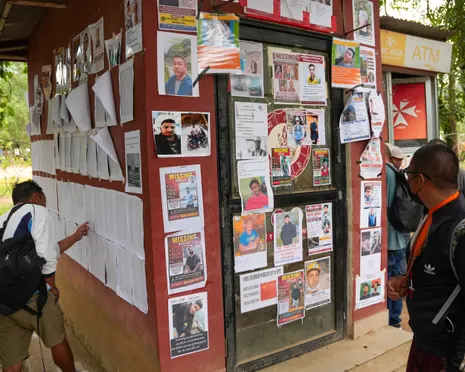
The episode, while almost comical in its absurdity, landed in the middle of a catastrophe of staggering scale. Since Wednesday’s cataclysmic floods, at least 1,050 people have been confirmed dead in Nepal, while Chinese state media reported 66 fatalities in Tibet. More than 4,000 individuals remain missing. Nepal’s prime minister, Balendra Shah, stated that 11,000 people had been rescued across the affected region, a figure that included 330 foreign nationals according to an update issued by the Nepalese tourist board on Tuesday. Of the 119 names on the specific rescue list that caught Chambers’ attention, 118 were Nepali nationals — 44 women and 74 men.
The Scale of the Disaster
Preliminary analysis of satellite imagery points to the collapse of a glacier high in the Himalayas as the primary trigger. The event was so massive that it was initially registered by seismological instruments as a magnitude-4.4 earthquake. The resulting torrent of water, mud, and ice tore along the Lhende Khola, Bhotekoshi, and Trishuli rivers on Wednesday, overwhelming downstream settlements and infrastructure. Nepal’s geography makes such events recurrently lethal: the country’s steep valleys, dense river networks, and rapidly melting glacial ice create a perfect storm of vulnerability, particularly as climate change accelerates ice loss at altitude.
Search and rescue crews have contended with unstable terrain, ongoing flooding, and debris fields that shift hour by hour. A critical focus of current operations is reaching approximately 600 workers believed to be trapped inside tunnels at several hydropower stations in the region. Nepal’s dependence on run-of-river hydroelectric schemes means that thousands of labourers work in confined underground spaces where a single structural failure can be fatal. An army spokesperson described the ongoing efforts on Tuesday:
“Massive work has been going on in the tunnel, all the tunnels.”
The International Red Cross estimates that 93,000 people have been directly affected by the disaster, a figure encompassing those displaced, injured, or cut off from basic services. Britain’s Foreign Office minister, Stewart Wood, told the House of Lords on Tuesday that 36 British nationals are missing — an increase from the earlier figure of 33. A rapid deployment rescue team from the UK arrived in Nepal on Saturday to assist Britons and their families, part of a £5 million government commitment to relief and recovery operations.
Chambers’ Background
Chambers’ presence in Nepal was entirely voluntary and humanitarian. A former member of Gloucester city council, he led a group of community independents on that body until 2024. His trip last week was aimed at distributing sleeping bags, food, and other essentials to communities whose access had been severed by collapsed bridges in the Trishuli valley. His return by helicopter to the capital was a routine extraction after completing that mission, not a rescue operation.
His public profile in Britain has not been without controversy. In June 2022, Chambers pleaded guilty to breeding and selling dogs without a licence and was fined £49,000. He is also scheduled to stand trial in November after denying that he used homophobic slurs against a bar owner and former council worker. Neither matter bears on the Nepal disaster, but they form part of the public record surrounding the individual who found himself, briefly and accidentally, at the centre of an international news cycle.
What Happened Next
The article was amended on 1 September 2026. An earlier version had stated that a British man had been rescued after the deadly floods. In fact, the individual in question was Chambers, the aid worker who had flown out to assist communities the previous week. The correction underscores how quickly information can become distorted in the chaotic first days of a major disaster, when authorities are piecing together survivor lists from incomplete data and journalists are working under extreme time pressure. For the families of those still missing — more than 4,000 of them — every hour of confusion costs precious time in the search.
Related Reading
Frequently Asked Questions
What is British aid worker mistakenly identified?
British aid worker mistakenly identified is the main topic of this guide. The article explains the context, practical details, and next steps readers should understand.
Why does British aid worker mistakenly identified matter?
British aid worker mistakenly identified matters because readers are looking for a useful answer, not just a short summary. Good content should match search intent and help them decide what to do next.