London neurosurgeons perform first successful AI-assisted operation to remove brain tumour

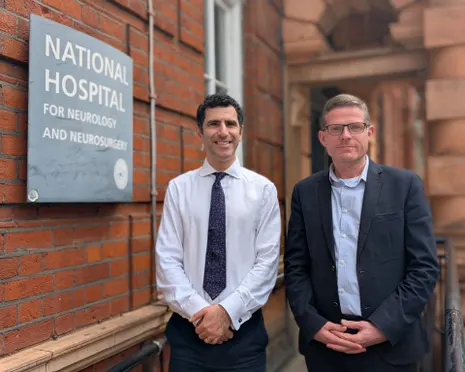
Table of Contents
London’s First AI-Assisted Brain Tumour Removal
Wanderstayfinder.com – When London neurosurgeons perform first successful AI-assisted neurosurgical tumour removal, the operating theatre crosses a threshold no one predicted would arrive this decade. In May, a surgical team at the National Hospital for Neurology and Neurosurgery (NHNN) used a live machine-learning system to guide excision of an 11 mm pituitary tumour from 48-year-old Rhys Hibbert, a customer service manager based in Bedfordshire. Health authorities confirmed on Thursday that the procedure preserved Hibbert’s vision entirely — a result that positions the NHNN, part of University College London Hospitals NHS Foundation Trust, at the centre of a new era in brain surgery.
From Diagnosis to Recovery
Hibbert received his pituitary diagnosis in 2024 and spent roughly twelve months under conservative management. Over that period his hormonal balance deteriorated sharply and his sight declined to the point where clinicians warned of irreversible blindness absent intervention. The tumour occupied one of the skull’s most congested anatomical corridors, where optic nerves, major cerebral arteries, and the gland itself are separated by mere fractions of a millimetre.
The May operation, conducted under clinical-trial conditions and funded by the National Institute for Health and Care Research (NIHR), restored his vision. Within seven days of waking, Hibbert was ambulating independently — no glasses, no walking aids — and has since resumed his full-time role.
“When I came round … I could see everything in the room clearly,” Hibbert recalled. “It feels like I’ve got a 360-degree panoramic view of everything around me.”
What the Software Actually Does
The AI platform does not grip a scalpel. Surgeons maintained complete manual control throughout the resection. What the system supplied was a real-time overlay: colour-coded identifiers projected onto live camera footage, flagging cranial nerves, arterial branches, and other structures requiring avoidance adjacent to the tumour bed. In effect, it added a second layer of spatial awareness at the moments when the surgeon’s attention was most finely divided.
Dr Sophia Bano, associate professor in robotics and AI at University College London and technical lead on the project, described the training foundation:
“By learning from hundreds of surgical videos, [the system] has been exposed to a breadth of surgical examples that would take a surgeon many years to encounter. It is designed to help recognise critical anatomy, surgical instruments and tissue interactions in real time, supporting the surgeon during highly delicate procedures.”
The NHNN had employed the platform as a research and validation tool prior to this operation. The May procedure marked its inaugural deployment on a living patient. Prof Mike Lewis, scientific director for innovation at the NIHR, characterised the milestone as a pioneering step toward routine integration of machine-learning guidance in neurosurgical practice.
Why Pituitary Surgery Demands Sub-Millimetre Precision
The pituitary gland — roughly the size of a pea — hangs beneath the brain and orchestrates hormonal cascades across every organ system. It is flanked by the internal carotid arteries, the cavernous sinuses, and the optic chiasm, the crossing point of the two optic nerves. A deviation of even one millimetre during resection can sever a visual pathway, rupture a major vessel, or precipitate intraoperative haemorrhage. Officials stressed that “going a millimetre wrong can make a critical difference,” with consequences spanning permanent blindness, stroke, and death. An auxiliary system that highlights those structures frame by frame reduces cognitive load precisely when the stakes are highest.
A Two-Century Institution Meets Its Next Chapter
The NHNN opened in 1859 as the world’s first hospital dedicated exclusively to neurosurgery. Its two-century record includes landmark advances in understanding brain structure and function. For Hibbert, the coincidence of setting felt deliberate.
“The NHNN was founded in 1859 … and was the world’s first dedicated neurosurgical hospital. So to me, it seems very fitting that the same hospital should also be the world’s first to carry out an AI-assisted neurosurgery,” he said.
Frequently Asked Questions
Did the AI operate the instruments? No. Surgeons retained full manual control at every stage. The system provided real-time visual overlays identifying critical anatomy; it did not move, cut, or manipulate any surgical tool.
Was this the first AI-assisted brain tumour removal anywhere? Yes. Health officials confirmed the May procedure at the NHNN as the first successful AI-assisted neurosurgical tumour excision performed on a living patient worldwide.
What kind of tumour was removed? An 11 mm (0.4 inch) lesion in the pituitary gland, diagnosed in 2024 and managed conservatively for approximately one year before surgical intervention became necessary to prevent permanent blindness.
Who funded and regulated the procedure? The operation was conducted under clinical-trial conditions and funded by the National Institute for Health and Care Research (NIHR), the UK’s public research body for health and social care.
What is the patient’s current status? Rhys Hibbert regained full vision, was walking independently within a week of surgery, and has returned to his employment as a customer service manager in Bedfordshire.