On scraps of land and under constant threat, Gaza farmers struggle to survive

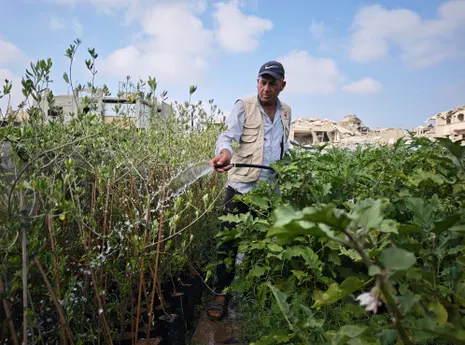
Table of Contents
Gaza’s Last Plots: Farming Under Fire in a Territory Shrunk to Fragments
Wanderstayfinder.com – Two million and one hundred thousand people now crowd into a shrinking corridor of land in Gaza, and among them a small number of farmers continue to coax food from soil that has been shattered, shelled, and in many cases bulldozed flat. Working with scarce water, near-absent fertiliser, and greenhouse infrastructure reduced by more than eighty percent, these growers rely on sheer ingenuity to clear rubble and nurture seedlings back into life. Yet the act of stepping outside to tend a row of vegetables has become, for some, a matter of life and death.
A Father’s Loss in the Fields of Beit Lahiya
In the northern Gaza district of Beit Lahiya, Saqer Abu Rabee lost two close relatives within months of each other while they worked the land. His eldest son, Yousef, aged twenty-four, was struck by a drone-fired missile in October 2024 while tending a small agricultural plot. Abu Rabee was in the field roughly ten metres away at the moment of impact.
“The missile was aimed directly at him and I have no doubt that he was the intended target,” Abu Rabee said.
Yousef had become a local figure through a volunteer collective originally named “We’ll Plant It,” later shortened to simply “Our Land.” The group rallied farmers and community volunteers to return to the soil and rebuild agricultural capacity across the area. Abu Rabee insists his son held no political affiliations and that the targeting was deliberate.
“They decided to target him directly,” he said. “Before his death, we received daily threats from the Israeli army. They shelled our area every day three or four times while I was working alongside the labourers.”
Nine months later, on 2 July, Abu Rabee’s brother Bilal was killed after travelling to a destroyed building to recover agricultural supplies. His death arrived during a partial ceasefire that, by the time of his killing, had already seen Israeli forces kill more than 1,200 Palestinians. Abu Rabee believes farmers have become prime targets precisely because their work sustains Palestinian communities amid the ruins.
The Israel Defense Forces have denied targeting farmers or any civilians, stating they have responded only to imminent threats posed by Hamas since the October ceasefire took effect.
Cultivating a Bulldozed Orchard
Despite the losses, Abu Rabee, forty-eight, works his plot every day. The 1.4-hectare (3.4-acre) parcel in Beit Lahiya was, before the war, an orchard of orange trees. Israeli forces bulldozed the grove, and the family spent months clearing debris and rehabilitating the ground using basic hand tools, manual labour, and what Abu Rabee describes as “tremendous human effort.”
“It took a great deal of time and hard work before it was ready for cultivation again,” he said.
From that recovered strip of earth, the family has produced hundreds of thousands of seedlings of aubergine, tomato, and pepper. They sell their own aubergine harvest to wholesale traders for cash income, while distributing most of the seedlings to neighbouring farmers and individual households for planting in small patches of earth around homes and tents.
Market Prices Collapse as Local Production Returns
The effect on local food prices has been dramatic. Aubergines now trade at under two shekels per kilogram, down from roughly forty shekels just months earlier. Peppers and mulukhiyah — a dark-green leafy vegetable central to Palestinian cooking — are selling at about one-tenth of their earlier market value.
“What has happened is that Beit Lahiya has regained a degree of self-sufficiency,” Abu Rabee said. “In my view, without Beit Lahiya, Gaza would face famine. Before the war, it was considered the food basket of Gaza Strip because of its fertile soil, fresh groundwater and light, productive land.”
Beit Lahiya’s agricultural heritage stretches back generations. Its alluvial soils, proximity to aquifer recharge zones, and relatively flat topography made it the most productive farming district in the strip before the current war. The loss of that capacity, and its partial restoration, carries implications well beyond a single neighbourhood.
A Fragile Recovery Measured in Hectares
Increased aid shipments and commercial deliveries flowing under the ceasefire have pulled Gaza back from the brink of famine conditions experienced last year. Nevertheless, UN agencies estimate that 1.4 million people — sixty-seven percent of the territory’s population — still face crisis-level acute food insecurity or worse. Much of the commercially imported food, moreover, is of poor nutritional quality, offering calories without adequate micronutrients.
Qu Dongyu, director general of the UN Food and Agriculture Organization, warned in July that the limited recovery will remain precarious unless domestic production resumes.
“Food security in Gaza cannot recover unless local food production starts again and farmers, herders, fishers and other producers can rebuild their livelihoods,” Qu said.
Satellite analysis compiled by the FAO paints a stark picture of what remains. Of the roughly 4,100 hectares of cropland that existed before the war, little more than a quarter is still accessible. Only about three percent — approximately 450 hectares — is undamaged, free of debris, and ready for immediate cultivation. The majority of prewar farmland now sits under Israeli military occupation, and the proportion has continued to grow as the army advances what it calls the “yellow line” steadily forward throughout the ceasefire period.
For the farmers who remain, each season is a negotiation between survival and exposure. They plant not merely for profit but because the alternative — dependence on aid convoys of uncertain timing and nutritional value — has already proven fatal. In a territory where the distance between a seedling and a missile can be measured in metres, the decision to work the soil is itself an act of defiance.
Related Reading
Frequently Asked Questions
What is On scraps of land and under?
On scraps of land and under is the main topic of this guide. The article explains the context, practical details, and next steps readers should understand.
Why does On scraps of land and under matter?
On scraps of land and under matters because readers are looking for a useful answer, not just a short summary. Good content should match search intent and help them decide what to do next.