Starbucks Korea raided by police after ‘Tank Day’ campaign sparks public outrage

Wanderstayfinder.com –
Starbucks Korea Raide
Starbucks Korea raided by police on Tuesday as authorities moved to investigate a controversial marketing campaign that many citizens felt disrespected the nation’s democratic history. The raid, conducted at the company’s headquarters in southern Seoul, marks a significant escalation in how South Korea is addressing corporate sensitivity toward its historical struggles. This action follows widespread public outrage over a promotion that inadvertently mocked key moments in the country’s past.
Details of the Police Raid
According to official statements released on Wednesday, investigators searched the Starbucks Korea headquarters as part of their inquiry into whether the marketing campaign violated regulations concerning the trivialization of historical events. While official details remain limited, South Korean media outlets reported that officers simultaneously conducted searches at the residences of several Starbucks Korea executives. This suggests the investigation extends beyond corporate premises to individual accountability for the campaign’s messaging.
The police investigation was formally launched following complaints submitted by relatives of victims from the 1980 Gwangju uprising. These family members argued that the campaign’s imagery and slogans failed to honor the sacrifices made by demonstrators who fought against military authoritarianism during one of South Korea’s most turbulent periods. The involvement of law enforcement highlights the severity of the public backlash.
Tank Day and the Gwangju Legacy
At the center of the controversy is the campaign’s designation of May 18 as “Tank Day,” a date that holds profound significance in South Korean collective memory. This anniversary commemorates the 1980 Gwangju uprising, when citizens of Gwangju city rose up against military rule. Official records indicate that approximately 200 people lost their lives during this crackdown, making it one of the most significant democratic movements in South Korea’s modern history.
The campaign introduced a range of stainless-steel reusable tumblers branded as “SS Tank,” with the “SS” abbreviation creating unintended associations with military terminology. The timing and naming of these products, combined with the Tank Day declaration, led many observers to question whether the marketing team fully understood the historical weight of their chosen date and imagery. This oversight became a focal point for critics.
The Thwack Slogan Controversy
Perhaps the most contentious element of the campaign was its slogan, “Thwack it on the table!” This phrase resonated negatively with many South Koreans because it evoked a notorious incident from 1987 involving student activist Park Jong-chul. During that case, authorities had falsely claimed that Park Jong-chul died after investigators “hit the desk with a thwack,” using this phrase to conceal the truth that he had actually died from torture during police interrogation.
“Thwack it on the table!”
The slogan’s unintended connection to this cover-up story amplified public outrage, as it appeared to mock both the victim and the broader struggle for transparency in South Korean society. Many citizens viewed the phrase as dismissive of the suffering endured by democracy activists during the country’s authoritarian era. This specific linguistic error played a major role in the decision for Starbucks Korea raided by police.
Rapid Corporate Response and Future Steps
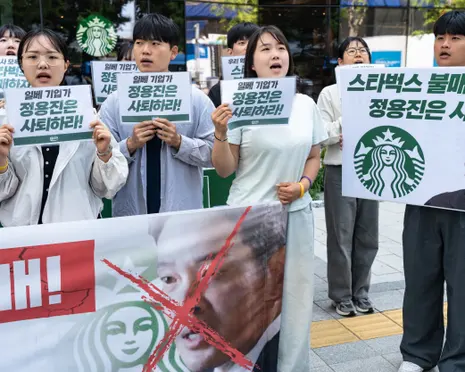
The backlash against the campaign was swift and severe. Shinsegae Group, which maintains a 67.5 percent ownership stake in Starbucks Korea, moved quickly to address the situation. Within hours of the controversy emerging, the conglomerate announced the cancellation of the entire promotion and dismissed the company’s chief executive officer. Chung Yong-jin, the chair of Shinsegae, subsequently issued a televised apology to the public.
In a further measure to address the controversy, Starbucks Korea announced that all of its stores nationwide would close on June 22 for mandatory training focused on history and social awareness. This decision reflected the company’s commitment to ensuring that its employees and management better understand the cultural and historical context of South Korea before resuming operations.
Frequently Asked Questions
Why was Starbucks Korea raided by police? The raid occurred because the police investigated whether the company’s “Tank Day” campaign violated regulations by trivializing the 1980 Gwangju Massacre and other historical events through its slogans and product names.
What is the significance of “Tank Day”? May 18 is known as Tank Day in South Korea, commemorating the 1980 Gwangju uprising where citizens rose up against military rule. The campaign’s use of this date for a tumbler promotion was seen as insensitive.
What does the slogan “Thwack it on the table” refer to? The slogan refers to a 1987 incident involving student activist Park Jong-chul, where authorities falsely claimed he died after being hit with a “thwack” to the desk, concealing the fact that he died from torture.
What actions did Starbucks Korea take after the raid? Starbucks Korea canceled the promotion, dismissed its CEO, and closed all stores on June 22 for mandatory historical training to address the public’s concerns and prevent future misunderstandings.