Chicago Officials Search for Suspect After Burnt Cross Found in Grant Park
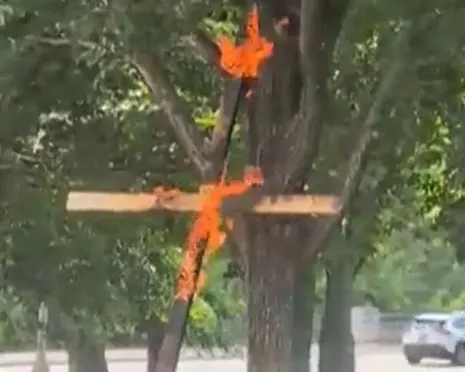
Wanderstayfinder.com – On Tuesday afternoon, a cross was set ablaze in Grant Park, prompting Chicago authorities to launch an investigation to identify the individual responsible. The incident, which occurred around 2:30pm, was reported to the Chicago Fire Department, which swiftly responded to the scene. While no injuries were recorded, the flames were extinguished quickly, leaving the area visibly affected. The event has sparked a citywide effort to trace the perpetrator, with police releasing images of a person of interest who allegedly fled the location shortly after the cross was ignited.
Person of Interest Identified
The suspect, described as a young man in his early 20s, was captured on surveillance footage in the moments following the act. According to police, he wore dark trousers, a black backpack, and white sneakers, and was seen moving rapidly through the park before disappearing into the crowd. These details have been shared with the public in hopes of generating leads, as the city aims to resolve the case as quickly as possible. The images have been widely circulated on social media, with many residents expressing concern over the deliberate nature of the attack.
The cross burning, a symbolic act often tied to white supremacy and racism, has drawn attention to its historical significance. This form of protest, historically associated with groups like the Ku Klux Klan, is meant to convey a message of hate and intimidation. Rev. Michael L Pfleger, pastor of the Faith Community of Saint Sabina, has emphasized the gravity of the incident, offering a $10,000 reward for information leading to the arrest of the perpetrator. “This was so premeditated,” Pfleger explained during an interview with ABC7, highlighting the meticulous planning involved. “You made this cross somewhere. You carried it, you got it downtown. You put it in one of the most visible spots in Chicago and then set it afire.”
“
This is a decades-old symbol of hate and supremacy, and the Ku Klux Klan,” Pfleger added. “This is their symbol.”
The act has also resonated with Chicago’s mayor, Brandon Johnson, who recently returned from a trip to Vatican City where he met Pope Leo. Speaking publicly about the event, Johnson condemned the incident as a deliberate act of intolerance. “Like many Chicagoans across our city, we were deeply disturbed upon seeing the images which have emerged following this incident,” he said. “Hate has no place in our city.”
“
Every Chicagoan deserves to feel safe, protected, and respected while going about their day or enjoying our public spaces,” Johnson continued. “We will continue working across City government to uphold that standard and ensure Chicago remains a welcoming, inclusive, and safe place for all.”
While the police and fire department have taken the lead in the investigation, the FBI has also joined forces to analyze the case further. An FBI spokesperson, quoted by ABC7, stated: “We take all potential bias-motivated incidents seriously.” The agency’s involvement signals a broader concern about the role of hate crimes in urban settings and the need for collaborative efforts to address them. Officials are now working to determine whether the act was a standalone incident or part of a larger pattern of racially motivated violence in the city.
Grant Park, a central hub of Chicago’s public life, has become a focal point for the community’s reaction. The cross, a prominent feature of the park’s landscape, was placed in a highly visible location, which authorities believe was intentional. This choice underscores the symbolic intent behind the act, aiming to provoke a strong emotional response and send a message to diverse communities. The timing of the incident—during a period of heightened social awareness around racial equity—has added layers of meaning to the event, with many interpreting it as a deliberate challenge to Chicago’s inclusive identity.
As the investigation progresses, residents and local leaders are calling for transparency and accountability. The reward offered by Rev. Pfleger has generated widespread interest, with community members and activists mobilizing to assist in the search. “We need to find the person who did this,” said one local resident, who requested anonymity. “It’s not just about punishing them—it’s about showing that we stand together against hate.”
Meanwhile, the city is reevaluating its approach to addressing hate-related incidents. With the FBI’s support, Chicago officials are exploring ways to enhance surveillance and community engagement to prevent future acts of violence. The mayor has announced plans to host a town hall meeting in the coming days, inviting citizens to share their perspectives and discuss measures to strengthen public safety. “This incident reminds us that vigilance is essential,” Johnson stated. “We cannot allow fear to dictate our actions or silence our voices.”
Historically, cross burnings have been used to signify racial segregation and oppression, but their modern-day relevance extends beyond traditional groups. In recent years, such acts have been linked to a range of ideologies, including white supremacy, far-right nationalism, and anti-immigrant sentiment. The Chicago incident is part of a growing trend of symbolic violence in public spaces, which has prompted discussions about the intersection of history and contemporary social issues.
Community leaders, including Pfleger, have stressed the importance of unity in the face of such acts. “This cross is not just a symbol of hate—it’s a reminder of the challenges we still face,” Pfleger said. “But it’s also a call to action for us to come together and protect the values we hold dear.” His words have been echoed by other local figures, who have called for increased support for marginalized communities and stronger enforcement of anti-discrimination laws.
The Chicago Police Department has also issued a statement reaffirming its commitment to justice. “We are dedicated to uncovering the truth behind this incident and bringing those responsible to account,” the department said. “This is not just a matter of public safety—it’s a matter of protecting our city’s diverse population.” As the search for the suspect continues, the city remains focused on addressing both the immediate crisis and the underlying issues that fuel such acts of hate.
In the wake of the cross burning, local schools and community centers have begun hosting discussions on racism and historical symbols. These events aim to educate younger generations about the significance of the act and foster a sense of collective responsibility. “It’s important for our children to understand the meaning behind this symbol and how it reflects the struggles of the past,” said a parent attending one such gathering. “We want to ensure they grow up in a city where they can feel proud of their heritage without fear.”
With the FBI’s assistance and the public’s active participation, Chicago is working to uncover the motive and identity behind the cross burning. As the investigation unfolds, the city remains determined to uphold its reputation as a place of opportunity and belonging, despite the challenges posed by acts of intolerance. The incident serves as a stark reminder of the ongoing need for vigilance, solidarity, and justice in the fight against hate.